Parallel ⇒ corresponding angles equal
Dependencies: Corresponding/alternate angles ⇔ lines parallel (the forward direction, used to "manufacture a line"), and Through a point off a line, exactly one parallel exists (Playfair) (to squeeze "the other parallel" back onto the original).
Statement
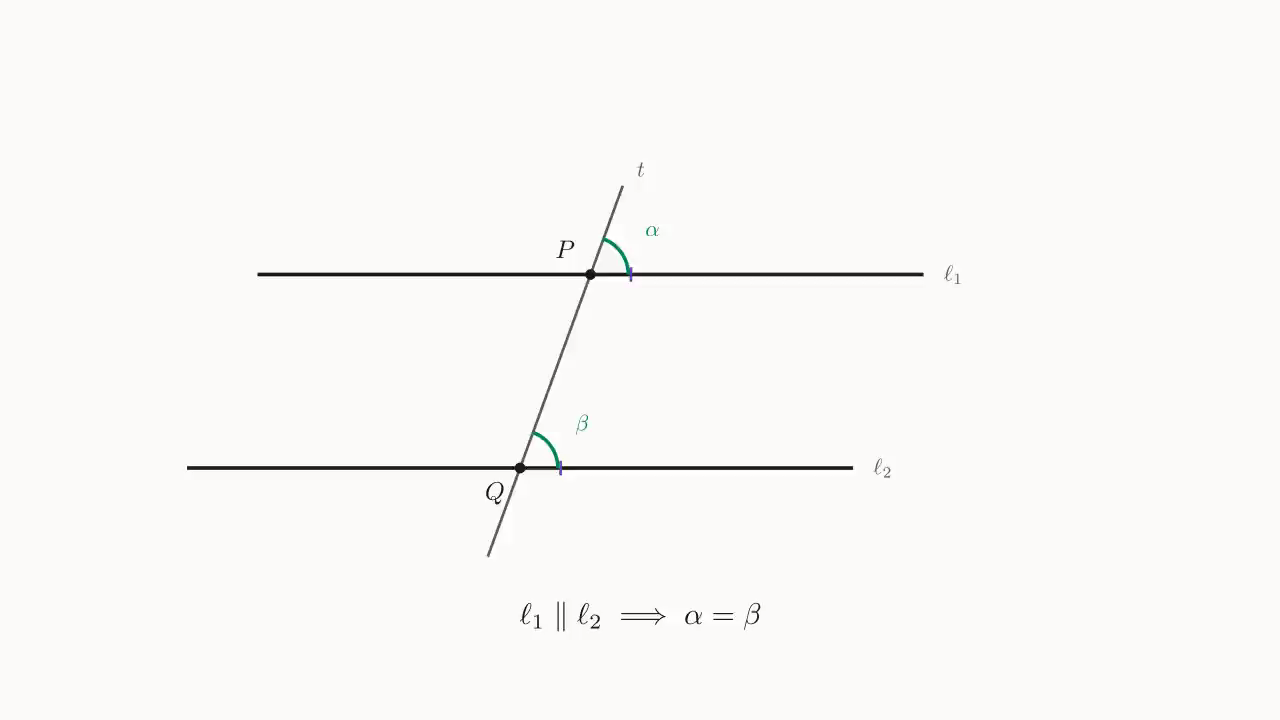
Let be cut by a third line : meets at and at . Denote by , the same-side corresponding angles formed at and by and . Then
Proof
The strategy is to manufacture a hypothetical line → use uniqueness to press it onto .
Step 1 (manufacture ): through draw a line such that the corresponding angle of with at is exactly the corresponding angle at . This step uses only the planar existence of "drawing a given angle through a given point" — i.e. copying the angle at .
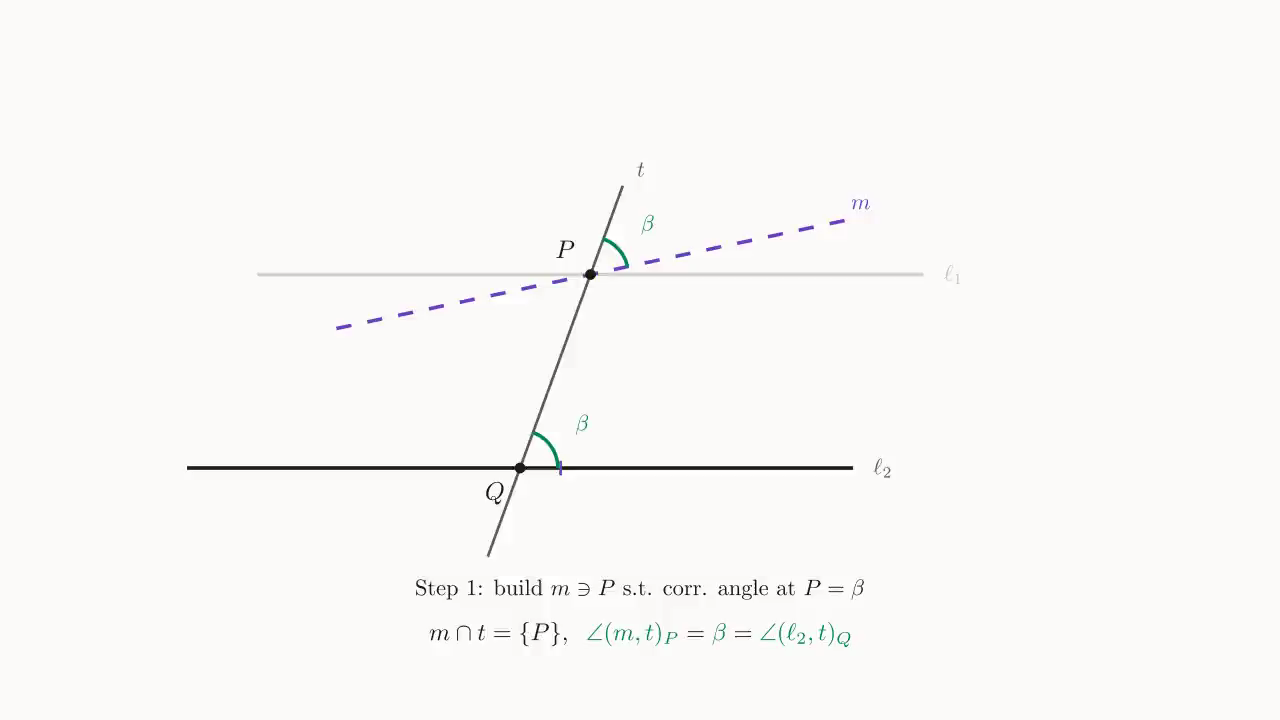
Step 2 (): and are cut by , and by construction the corresponding angles at the two intersection points are equal (both are ). By Corresponding/alternate angles ⇔ lines parallel, .
Step 3 (): now both and pass through and are parallel to . By Through a point off a line, exactly one parallel exists (Playfair), and must be the same line, so .
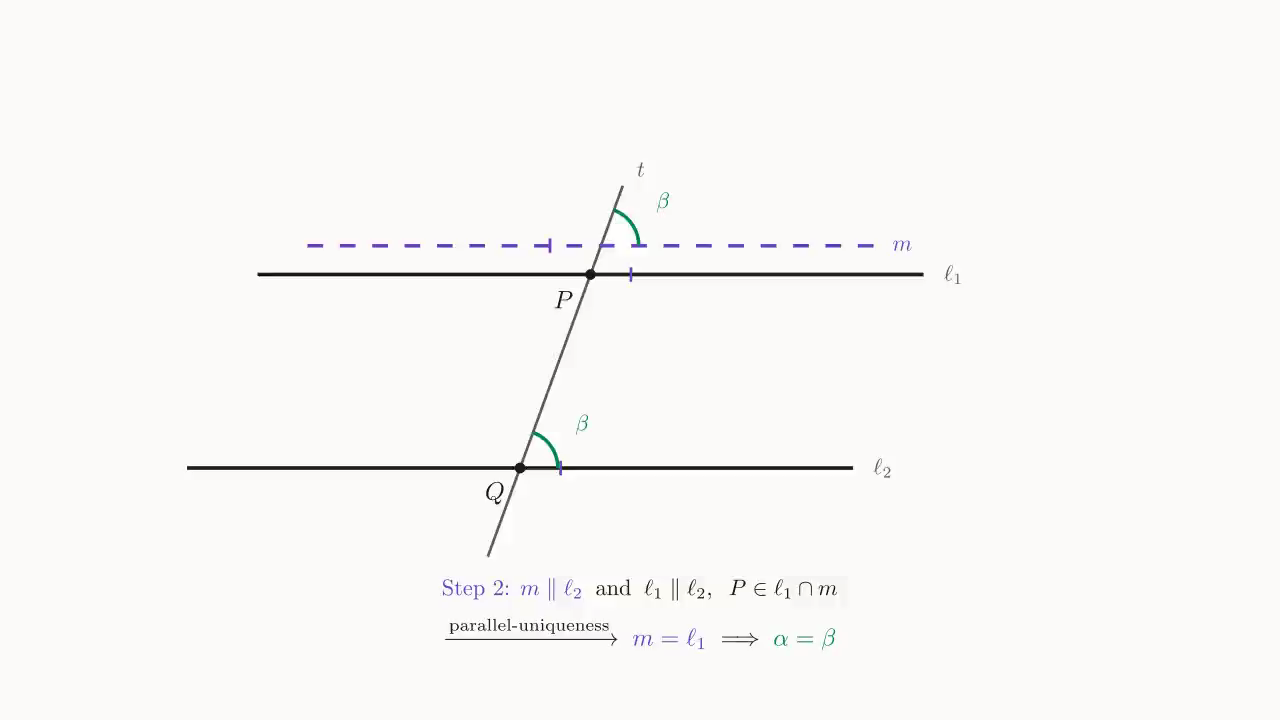
Hence the corresponding angle at formed by and equals the produced for , so .
Immediate consequences
- Parallel ⇒ alternate angles equal: alternate interior angles differ from corresponding angles by a vertical angle; combined with Vertical angles are equal, the result is immediate.
- Parallel ⇒ co-interior angles supp.: co-interior angles and corresponding angles form a linear pair; combined with Linear pair sums to 180°, the result is immediate.
- Bidirectional criterion for parallelism: this theorem together with the forward direction Corresponding/alternate angles ⇔ lines parallel gives " corresponding angles equal", the foundational tool for all subsequent arguments about parallelograms and the angle sum of a triangle.
Remarks
This is the first time in Principia we use the technique of "manufacture a candidate line + squeeze it onto the original by uniqueness": first use the forward theorem to construct "a line with property X", then use the uniqueness axiom to align it with the known line. The same pattern recurs in the proof of parallel ⇒ alternate interior angles and Triangle interior angles sum to 180° — it converts the "reverse direction" into a two-step "forward construction + uniqueness", avoiding contradiction.
Euclid's Elements I.29 uses contradiction (assume , then the same-side co-interior angle sum , and the fifth postulate forces the lines to meet on that side, contradicting the hypothesis of being parallel). Here we split the fifth postulate into uniqueness of parallels (more intuitive), making the proof structure entirely constructive.