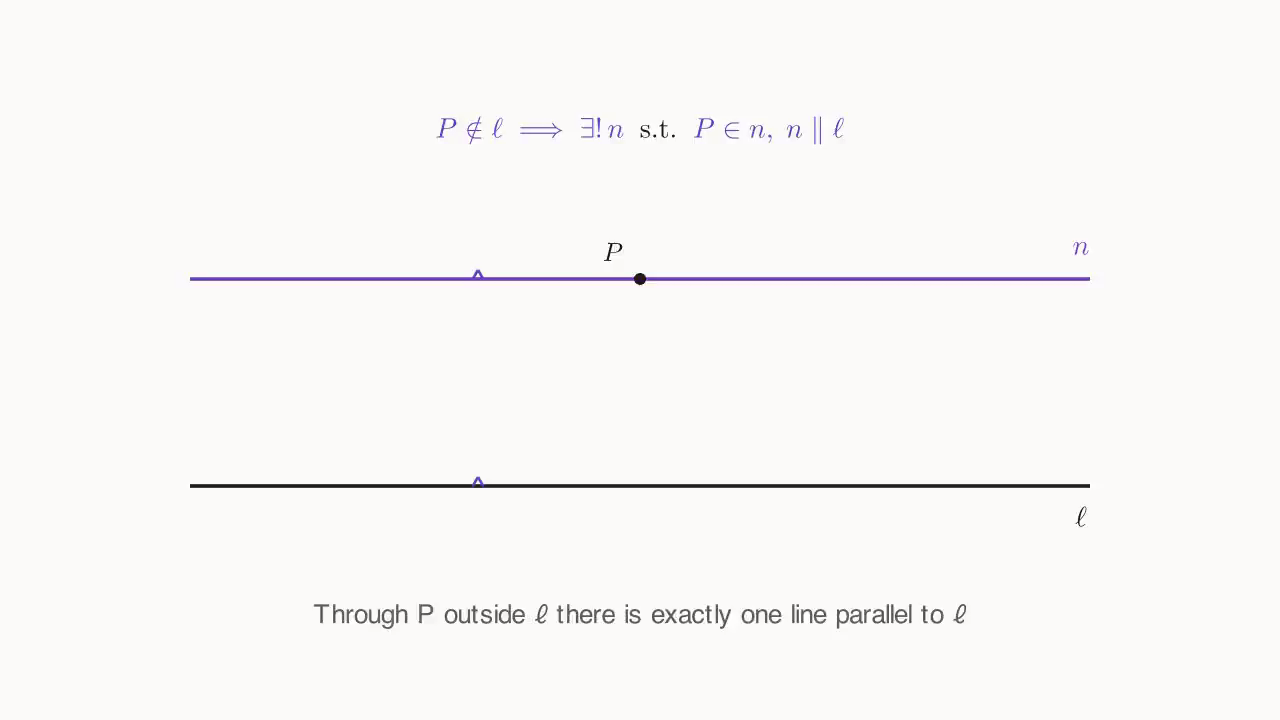
Through a point off a line, exactly one parallel exists (Playfair)
Dependencies: Corresponding/alternate angles ⇔ lines parallel (Corresponding/alternate angles ⇔ lines parallel), dropping a perpendicular from a point to a line (Perpendicular from a point to a line exists and is unique), the triangle exterior-angle inequality (Exterior angle > either non-adjacent interior angle).
Statement
Let be a line, and let be a point off (). Then there exists exactly one line through parallel to .
Denote this unique parallel by . The statement has two halves: existence — at least one can be constructed; uniqueness — there is no second one. This is the celebrated Playfair's axiom of elementary geometry — equivalent in Euclidean geometry to Euclid's fifth postulate; here we treat it as a theorem to be proved, using only the three already-established results above.
Proof
Existence — two perpendiculars in succession. By Perpendicular from a point to a line exists and is unique, drop a perpendicular from to , with foot , giving the line at (and ). Apply Perpendicular from a point to a line exists and is unique again at the point on to draw the perpendicular to , giving a line with . View as a transversal cutting and : at , gives a angle; at , gives a angle; the two lie on the same side of and form a pair of equal corresponding angles. By Corresponding/alternate angles ⇔ lines parallel we obtain .

Uniqueness — contradiction + Exterior angle > either non-adjacent interior angle. Suppose another line also passes through with . Examine the angle between and at : if this angle , then at ; but is already the perpendicular to at , so by the uniqueness part of Perpendicular from a point to a line exists and is unique we get , contradicting the assumption. Hence this angle . Without loss of generality, let denote the acute angle (so ) among the two pairs of vertical angles formed by and at , and let be the ray on from entering "the half-plane containing (i.e. the side containing )" such that the angle between and the ray is exactly (this is the side on which appears; the other side carries the supplement of ).
Key step — pick a triangle big enough. Starting from the ray , walk far enough along to a point so that the interior angle of at is greater than . This step is delivered by the protractor axiom (axiom III): as moves along away from , takes every value in and approaches ; since , there exists with . Fix such an .
Examine . At , (because ). At , the angle between rays and is , while the angle between and ray is exactly ; moreover and ray lie on the same side of ray (both are in the half-plane containing , on 's side), so lies inside (angle additivity, axiom III). In other words, the ray starts at , lies along , and enters the interior of .
By a standard corollary of Exterior angle > either non-adjacent interior angle (also known as the Pasch lemma): a ray from a vertex of a triangle that enters the interior must meet the opposite side — here the "opposite side" is . Hence must meet . But , so meets , directly contradicting .

In sum, the only line through parallel to is .
Immediate consequences
- Parallel is transitive: if and ( pairwise distinct), then . Otherwise , and through both and would be parallel to — contradicting parallel uniqueness. This transitivity is the foundation of subsequent arguments about parallelograms and similar figures.
- A prototype of the converse corresponding-angles theorem: if two parallel lines are cut by a third line, the corresponding angles are equal. Proof by contradiction using parallel uniqueness: if the corresponding angles differ, at the intersection point one can draw another line whose corresponding angle with the transversal equals that of the first line; by Corresponding/alternate angles ⇔ lines parallel this new line is also parallel to the first, but it passes through the same intersection point parallel to the same line — contradicting parallel uniqueness.
- Triangle angle sum : the classical proof draws through a vertex of the triangle a parallel to the opposite side, transporting the other two vertex angles to the vertex via corresponding and alternate interior angles to combine into a straight line. The "unique parallel auxiliary line" used for the transport is selected by parallel uniqueness.
Remarks
Playfair's place in the system — in Euclidean systems this conclusion has two equivalent "legislative roles": either write down Playfair's axiom as a postulate; or, as in this section, prove it from the three combined results Perpendicular from a point to a line exists and is unique (perpendicular existence and uniqueness) + Corresponding/alternate angles ⇔ lines parallel (equal corresponding angles ⇒ parallel) + Exterior angle > either non-adjacent interior angle (which blocks "another parallel"). The latter reveals that the genuine hardness of parallel uniqueness is concentrated in Corresponding/alternate angles ⇔ lines parallel's "equal corresponding angles ⇒ parallel" — once we move to hyperbolic geometry, Exterior angle > either non-adjacent interior angle still holds but Corresponding/alternate angles ⇔ lines parallel fails, and the parallels through become infinite in number.
Two-stage structure of the uniqueness proof — there are two small details worth peeling off in the proof. First, the boundary case "" is peeled off and handed to the uniqueness part of Perpendicular from a point to a line exists and is unique; the remaining case " not perpendicular to " is then docked with Exterior angle > either non-adjacent interior angle. Second, an early draft tried to read off "the exterior angle of at ", but this equality does not hold in elementary diagrams — the side does not lie along ( is the projection of onto , not on ), so the "exterior angle" of and the "angle between and " are two different angles. We correct this to "choose a sufficiently large so that enters its interior, then apply the ray–opposite-side lemma", which is one of the standard corollaries of Exterior angle > either non-adjacent interior angle (a ray entering the interior of a triangle must meet the opposite side), closing the logical chain entirely.
Comparison with hyperbolic geometry — worth recording: in hyperbolic geometry, infinitely many lines through are parallel to , and every line between the "two limiting parallels" fails to meet . The "choose with " step in this section still works in the hyperbolic setting (the protractor axiom is neutral), and the corollary of Exterior angle > either non-adjacent interior angle " enters ⇒ meets the opposite side" also still holds — what fails in the hyperbolic setting is not this step, but rather the step "the existence of another pair can be ruled out directly by Corresponding/alternate angles ⇔ lines parallel": in the hyperbolic setting, an angle no longer uniquely determines a parallel direction.