PRINCIPIA · THEOREM

Perpendicular from a point to a line exists and is unique

Dependencies: Protractor axiom, Linear pair sums to 180°, SAS congruence, Exterior angle > either non-adjacent interior angle.

Statement

Let \ell be a line and PP any point in the plane (either PP\in\ell or PP\notin\ell). Then there exists and is unique a line \ell' through PP that is perpendicular to \ell.

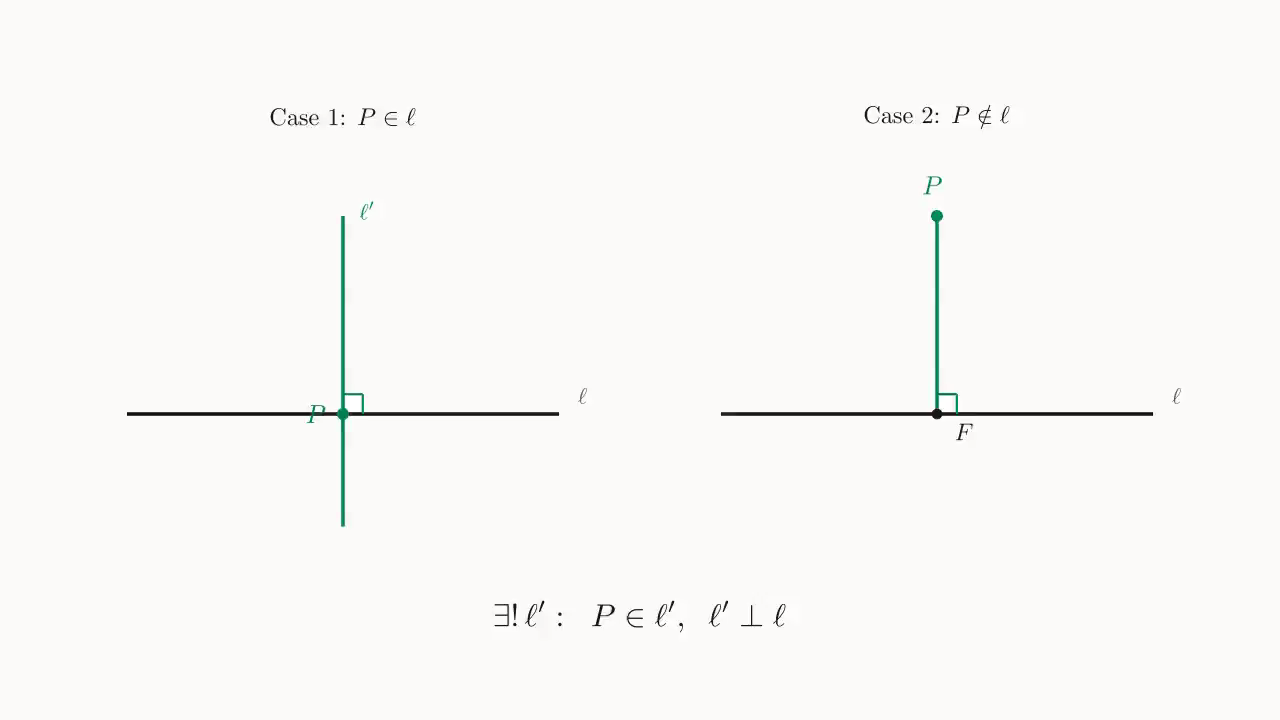
Unified statement of the two cases: on the left, when P\in\ell, take the 90^\circ ray directly via the protractor to obtain \ell'; on the right, when P\notin\ell, construct \ell' through P perpendicular to \ell at the foot F.

Proof

Existence · Case 1 (PP\in\ell). Place the centre of the protractor at O=PO = P with the initial side along one of the rays of \ell. By Protractor axiom, take the ray rr at the value 9090^\circ; rr together with its opposite ray makes a line \ell'. The angle between \ell' and \ell at PP is exactly 9090^\circ, hence \ell'\perp\ell.

Existence · Case 2 (PP\notin\ell). Pick any AA on \ell. By Protractor axiom, on the other side of \ell construct a ray with QA=PA\angle QA\ell = \angle PA\ell, then by the Ruler axiom pick QQ on this ray with AQ=APAQ = AP. Since PP and QQ lie on opposite sides of \ell, the segment PQPQ meets \ell at some point FF. In PAF\triangle PAF and QAF\triangle QAF, we have AP=AQAP = AQ, PAF=QAF\angle PAF = \angle QAF, and the common side AFAF, so by SAS congruence PAFQAF\triangle PAF\cong\triangle QAF, hence PFA=QFA\angle PFA = \angle QFA. Also PFA+QFA=180\angle PFA + \angle QFA = 180^\circ (Linear pair sums to 180°), so

PFA=QFA=90,\angle PFA = \angle QFA = 90^\circ,

i.e. the line PQPQ passes through PP and is \perp\ell.

Existence in Case 2: reflect P across \ell to Q; \triangle PAF \cong \triangle QAF (SAS), and combining with the linear-pair sum 180^\circ yields \angle PFA = \angle QFA = 90^\circ.

Uniqueness. Suppose there is another line mm through PP with mm\perp\ell at some GFG\neq F. In PFG\triangle PFG, we have PFG=90\angle PFG = 90^\circ; viewing PG\angle PG\ell as the exterior angle of this triangle at GG, by Exterior angle > either non-adjacent interior angle it is strictly greater than the non-adjacent interior angle PFG=90\angle PFG = 90^\circ. But mm\perp\ell gives PG=90\angle PG\ell = 90^\circ, contradicting >90>90^\circ, so the perpendicular through PP is unique. \blacksquare

Uniqueness by contradiction: suppose a second line m\perp\ell at G\neq F; in \triangle PFG we have \angle PFG = 90^\circ, but the exterior angle at G along \ell must be > 90^\circ (exterior-angle inequality), contradicting the assumed 90^\circ.

Immediate consequences

Remarks

Existence in the two cases shares a common origin — Protractor axiom generates directions by numerical value: in Case 1 simply take 9090^\circ; in Case 2 first construct a symmetric point QQ on the other side, then let SAS translate "equal angles on both sides + linear-pair sum 180180^\circ" into "each equals 9090^\circ". The uniqueness step goes deeper: it depends on Exterior angle > either non-adjacent interior angle rather than the stronger "interior-angle sum =180= 180^\circ" — the latter requires the parallel postulate, whereas the present theorem is a neutral-geometry result, valid in geometries on both sides.

Help me make this theorem better