SAS congruence
Dependencies: SAS similarity axiom.
Statement
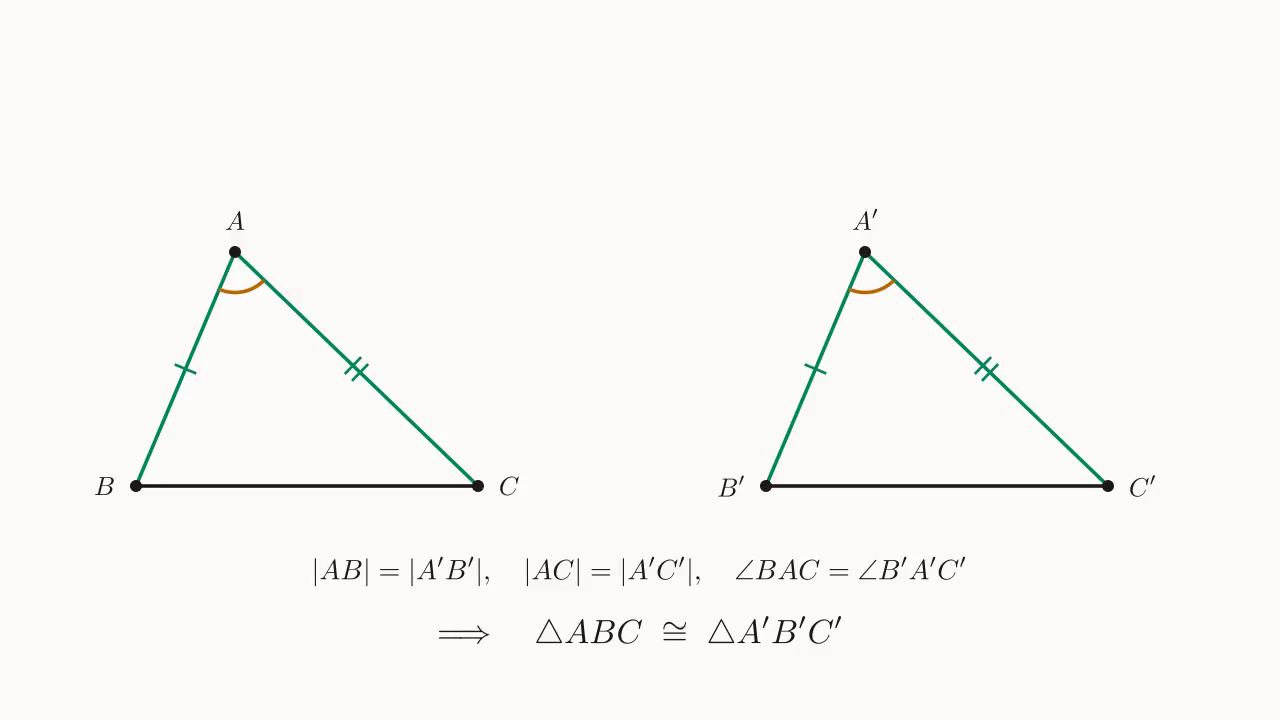
Let and both be non-degenerate (i.e. their three vertices are not collinear), and suppose
Then the two triangles are congruent:
i.e. the three pairs of corresponding sides are equal, and the three pairs of corresponding angles are equal.
Proof
SAS congruence is the degenerate version of axiom IV — the special case where the similarity ratio is set to .
Axiom IV (SAS similarity) states: if
then , and furthermore
Substituting the hypotheses and immediately gives
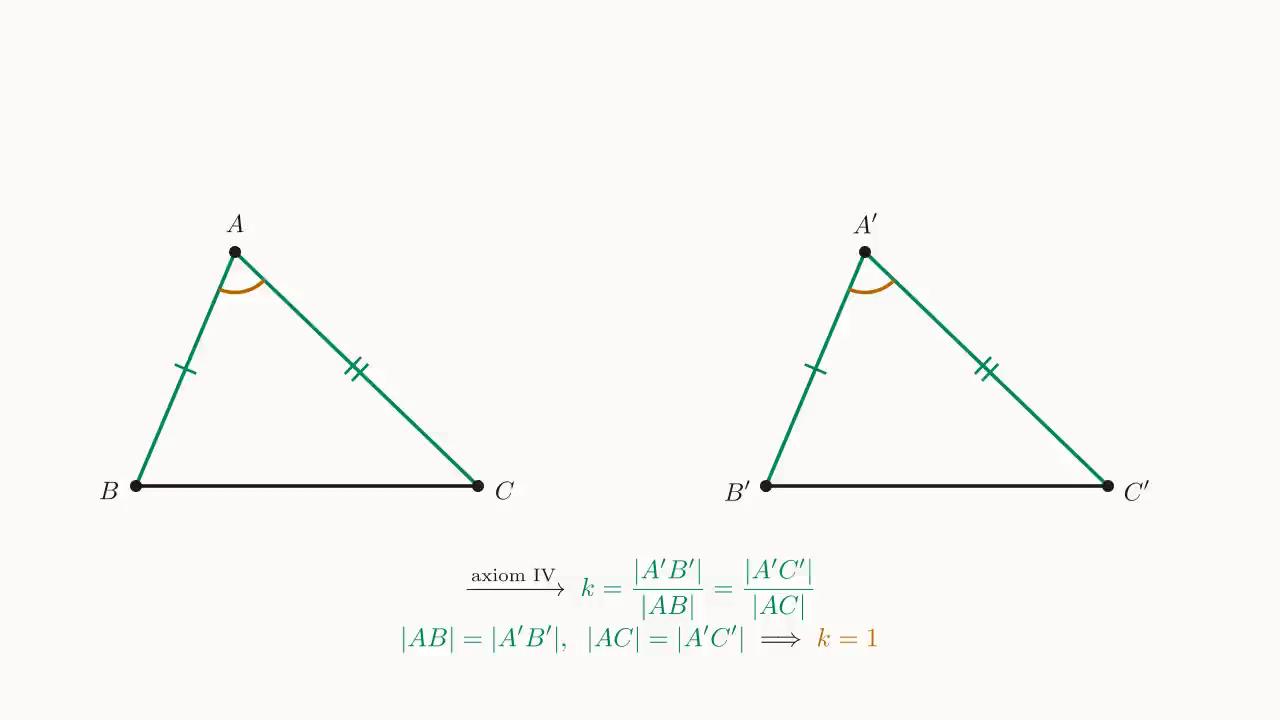
Substituting back into the three conclusions of similarity:
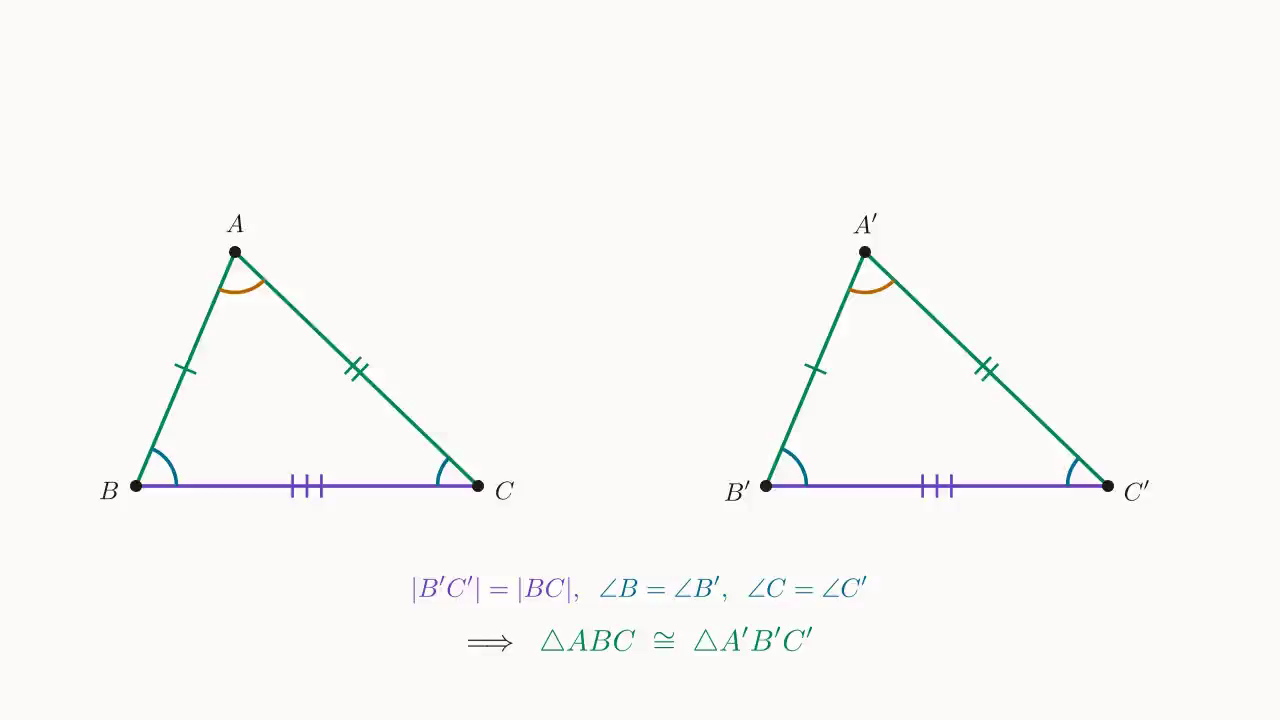
- , so ;
- (independent of ; always holds for similarity);
- (likewise).
Adding the directly-given hypotheses , , , all three pairs of corresponding sides and all three pairs of corresponding angles are equal, so by definition the two triangles are congruent.
Immediate consequences
-
"Congruence" = "similarity with ": SAS congruence formally absorbs "congruence" into the framework of "similarity" as a special case. From here on, every argument that needs to "copy a triangle" (Base angles of an isoceles triangle are equal for isosceles base angles, SSS congruence for SSS, Perpendicular bisector ⇔ equidistant from endpoints for the perpendicular-bisector locus, …) can directly invoke SAS congruence without going back to axiom IV.
-
Unified finish for combined tests: ASA (ASA congruence), SSS (SSS congruence), AAS (AAS congruence), HL (HL (hypotenuse-leg) congruence), and so on, all finish by translating their information into "two sides plus an included angle" and applying SAS congruence once more.
-
Algebraic version of "rigid motion": translating Euclid's "two triangles can be made to coincide" into "corresponding sides and corresponding angles are equal item by item" — SAS congruence turns Euclid's "superposition" gesture into a purely algebraic system of equalities, eliminating the need for geometric intuition about rigid motions.
Remarks
SAS congruence is the cheapest theorem in the four-axiom system: the proof is merely setting the parameter in axiom IV to . Yet in middle-school geometry it is the most heavily used — most subsequent proofs treat it as a "basic move".
The brevity of SAS congruence is precisely an advantage of the Birkhoff system over Hilbert's: Hilbert posits SAS congruence as a separate axiom (Group III), and treats "similarity" as a separate downstream theory, whereas Birkhoff merges the two into axiom IV, with SAS congruence simply being a degenerate invocation.