PRINCIPIA · THEOREM
Perpendicular bisector ⇔ equidistant from endpoints
Dependencies: Linear pair sums to 180°, SAS congruence, SSS congruence.
Statement
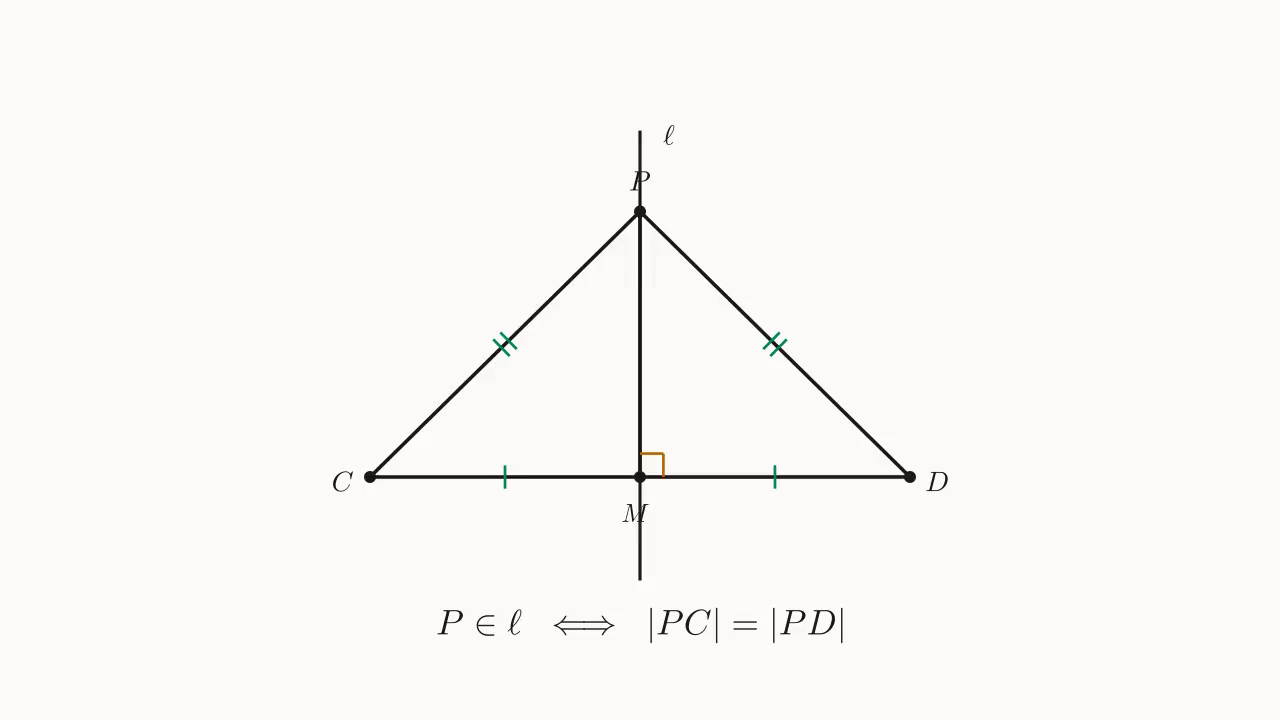
Let and be two distinct points in the plane. The perpendicular bisector of segment is defined as the line passing through the midpoint of and perpendicular to the line .
The theorem gives the point-set characterization of : for any point in the plane,
In other words, is exactly the set of points "equidistant from and " — this is the first locus theorem in middle-school geometry that recharacterizes "a line" via a distance condition.
10 foundational theorems free · one-time unlock for the rest
Unlock the complete proofs forever
Matching GeoSnap, 10 foundational theorems are completely free. Unlock every other proof, animation, and consequence with one $10 purchase.
Sign in to unlockHelp me make this theorem better