SSS congruence
Dependencies: SAS congruence, Base angles of an isoceles triangle are equal. The auxiliary construction in the proof additionally uses Ruler axiom ("lay off a fixed length along a ray") and Protractor axiom ("the ray with a given side and given angle is unique") — these are available by default in every theorem proof as "common-sense geometric tools".
Statement
Suppose and are non-degenerate, and the three pairs of corresponding sides are equal:
Then
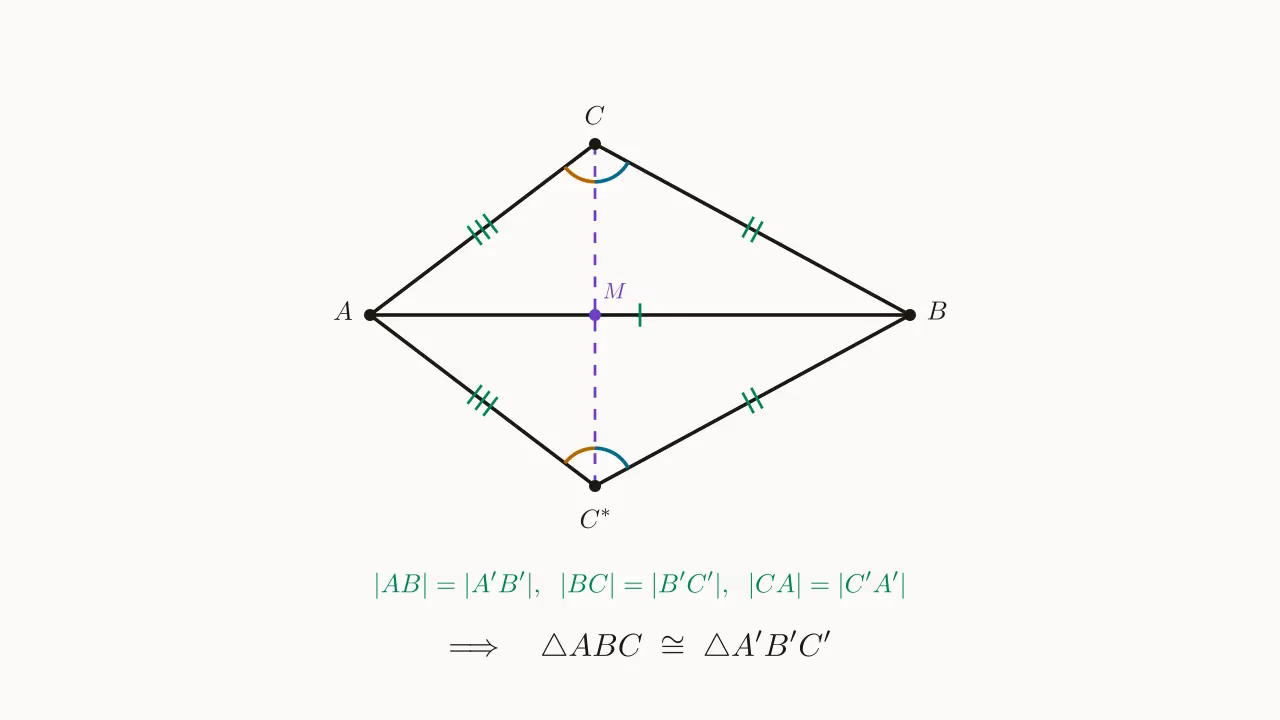
Proof
Strategy: "flip" a copy of into the plane of , on the side of line opposite from , obtaining a copied vertex . Then and form a "kite" shape across : , . Apply Base angles of an isoceles triangle are equal twice to get the base angles of two isosceles triangles equal; via angle additivity, translate and into combinations of the same components with the same sign; finish with SAS congruence.
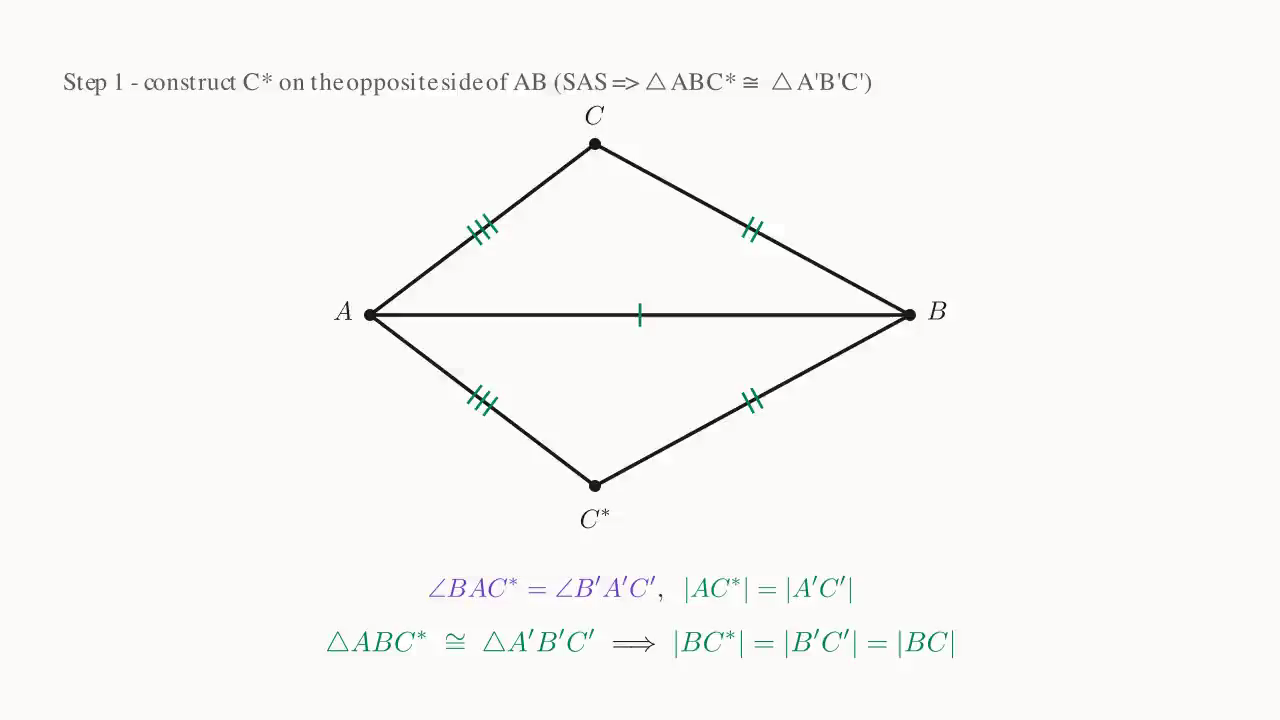
Step 1: construct congruent to .
By axiom III, the ray emanating from vertex that makes the angle with ray "on the side opposite from " exists and is unique. By axiom I, take the point on this ray at distance and call it . The construction gives
Apply SAS to and :
- (hypothesis);
- (construction);
- (construction).
Hence , and we read off the third pair of corresponding sides
So far,
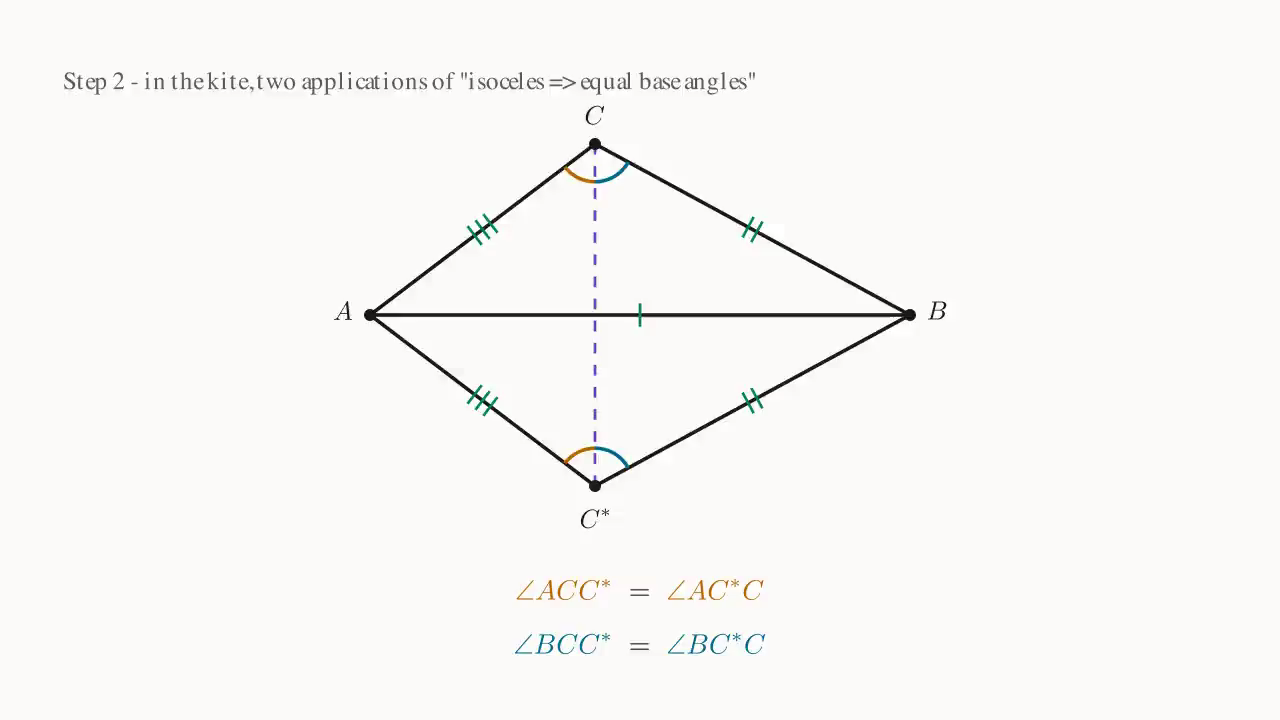
Step 2: two isosceles triangles in the kite give two pairs of equal base angles.
By construction, and lie on opposite sides of line . By the plane-separation property implied by the continuity in axiom III, the segment must cross line at a point .
By (i), is isosceles with apex (legs ); by Base angles of an isoceles triangle are equal,
Similarly is isosceles with apex ; by Base angles of an isoceles triangle are equal,
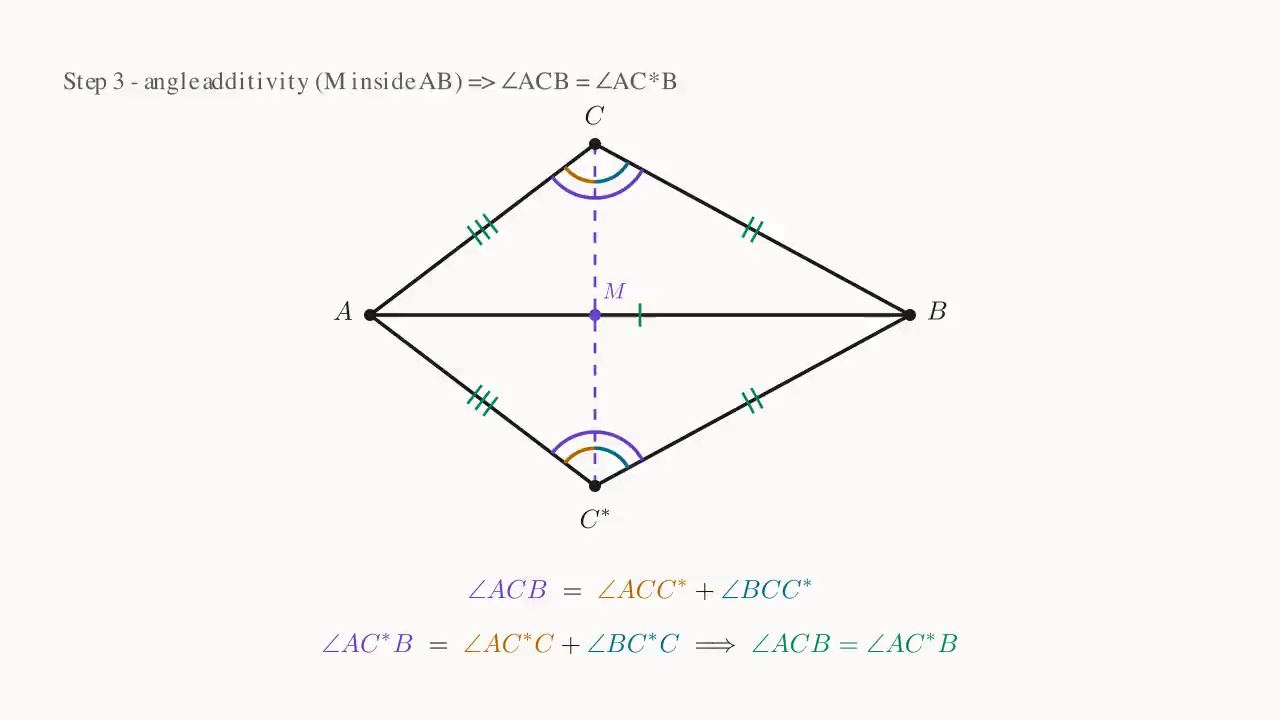
Step 3: by case analysis, angle additivity gives .
Let be the intersection of segment with line . At vertex , ray coincides with ray (since is interior to segment , lies between and ). So whether ray falls inside is completely equivalent to whether falls in the region bounded by rays , — and since also lies on line , the deciding factor is the position of relative to segment . The same test at vertex gives: whether ray falls inside is also determined by "the position of relative to segment ".
Note that is the same point, and its position gives identical outcomes at and at . So the angle-additivity forms at and at must take the same sign. Specifically:
- Case I ( strictly inside segment ): ray is inside , and symmetrically ray is inside . By angle additivity,
By , , the two right-hand sides are equal term by term.
- Case II ( on ray outside , i.e. between and ): ray falls outside on the side; symmetrically ray falls outside on the side. By angle additivity,
Rearranging,
and by , , the two right-hand sides are again equal term by term.
-
Case III ( on ray outside ): completely symmetric to Case II, and the equality follows from , in the same way.
-
Boundary cases ( or ): at this point the three points , , (or , , ) are collinear. For example, when , ray and ray are the same ray (both emanate from toward , with also on that direction); degenerates to , and directly yields — the equality still holds.
Combining all cases:
Step 4: finish with SAS congruence at and .
Apply SAS to and , with included angles at and respectively:
- by (i);
- by (ii);
- by (i).
Hence , and we read off . Substituting the construction from Step 1:
Finally, apply SAS once more to and (included angle at , ):
- ;
- (just obtained);
- .
We conclude .
Immediate consequences
-
Triangle "rigidity": the three congruence tests SAS congruence, ASA congruence, and SSS congruence together establish a deep fact — once three independent measurements (three sides, two sides and an included angle, two angles and an included side) are fixed, the shape and position of the triangle (up to reflection) are completely determined. This is the mathematical fact behind nearly every middle-school geometry application of "triangles are non-deformable" (truss structures, triangulation).
-
The entry point to SSS similarity: to prove "three pairs of corresponding sides in proportion ⇒ similar", the recipe is to first scale one of the triangles so that the three sides become equal, then apply SSS congruence to finish.
-
The "" direction of the perpendicular-bisector locus: in addition to the "isosceles base angles" route via ASA congruence / Isoceles converse: equal base angles ⇒ equal sides, one can rely purely on SSS congruence: if and is the midpoint of , then and have three pairs of equal corresponding sides; SSS congruence gives the congruence, and .
Remarks
SSS congruence is the hardest of the three middle-school congruence tests to prove — SAS congruence is 0 steps (axiom IV degenerates directly), ASA congruence is 1 step (one application of SAS congruence + the ray-uniqueness in axiom III), whereas SSS congruence requires assembling two applications of Base angles of an isoceles triangle are equal + one extra SAS congruence, plus the "flip" step constructing .
In Step 3, four cases are listed explicitly: many textbooks paper over this with "by symmetry", but the Birkhoff system does not presuppose rigid motions, so "symmetry" must be computed via angle additivity + Base angles of an isoceles triangle are equal. The fact that really does the work in the case enumeration is that is the unique intersection of line with line (given by axiom II); its position simultaneously decides the sign of angle additivity at and at — and this "synchronicity" is the algebraic incarnation of "kite symmetry".