AAS congruence
Dependencies: ASA congruence and Triangle interior angles sum to 180°.
Statement
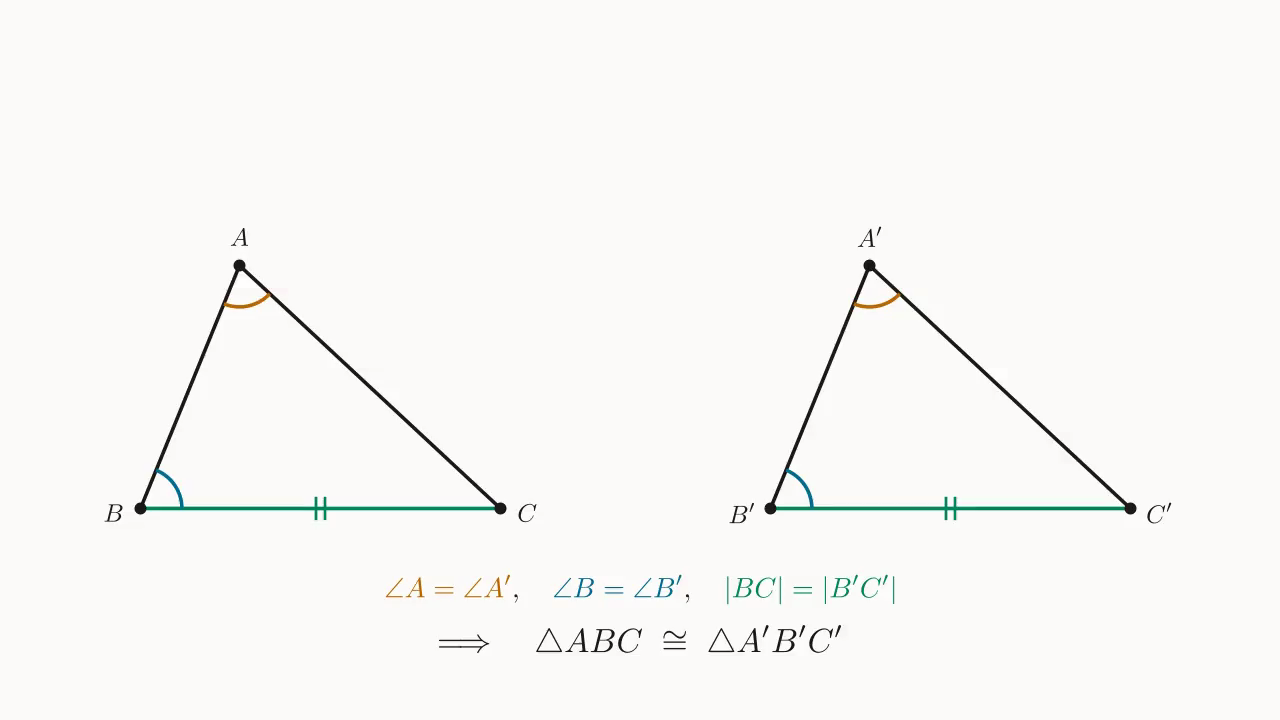
Suppose two triangles and satisfy
Note: is the side enclosed between and , but is not adjacent to — that is, the data given is "two angles + one non-included side". Then .
Proof
Step 1: recover the third angle from the triangle angle sum. By the triangle angle sum equals , the two triangles satisfy and respectively. Substituting the hypotheses and gives

Step 2: rearrange the known data into ASA form. Now , , are all in hand — and is precisely the side enclosed between and — this is exactly the input of ASA congruence (two angles with their included side), hence .

Immediate consequences
-
"Two angles + any side" determines congruence: combining AAS congruence with ASA congruence, two triangles are congruent as soon as they share two pairs of equal corresponding angles plus any one pair of equal corresponding sides. In practice this composite form is used far more often than ASA alone.
-
"One acute angle + one side" for right triangles: a right triangle already has one angle locked in, so once one acute angle and any side are given, AAS congruence immediately establishes congruence (the most common right-triangle congruence routine besides HL).
-
A common student pitfall: the only difference between AAS and ASA is the position of the side — ASA requires the side between the two angles, AAS requires the side outside them. But once the triangle angle sum equals recovers the third angle, the "non-included side" issue evaporates, so the two theorems are essentially two arrangements of the same fact; just remember to compute the third angle first.
Remarks
AAS congruence is not new geometric content but a wrapper around an "algebraic complement of angles": once the triangle angle sum equals solves for , the rest of the work is handed off entirely to ASA congruence. This trick of "using an independent algebraic identity to assemble the ASA input" recurs throughout elementary geometry and is a paradigm for translating known conditions into the input of an existing theorem.
One additional point worth emphasising: what this proof really depends on is not "two angles equal individually" but "the sum of two angles equal" — any condition that guarantees suffices to force and thus reduce to ASA congruence. This is why AAS congruence is repeatedly borrowed in more general geometric arguments.