PRINCIPIA · THEOREM

HL (hypotenuse-leg) congruence (right triangles)

Dependencies: Pythagorean theorem, SSS congruence.

Statement

In right triangles RtABC\mathrm{Rt}\triangle ABC and RtABC\mathrm{Rt}\triangle A'B'C', suppose

C=C=90,AB=AB=c,BC=BC=a.\angle C = \angle C' = 90^\circ,\qquad |AB| = |A'B'| = c,\qquad |BC| = |B'C'| = a.

That is, the two right triangles have equal corresponding hypotenuses and one pair of equal corresponding legs. Then

ABC    ABC.\triangle ABC \;\cong\; \triangle A'B'C'.

Notation: "HL" stands for Hypotenuse-Leg. Alongside the four general-triangle congruence criteria SSS / SAS / ASA / AAS, the HL congruence criterion is a fifth shortcut, available only for right triangles — locking in congruence with just two sides.
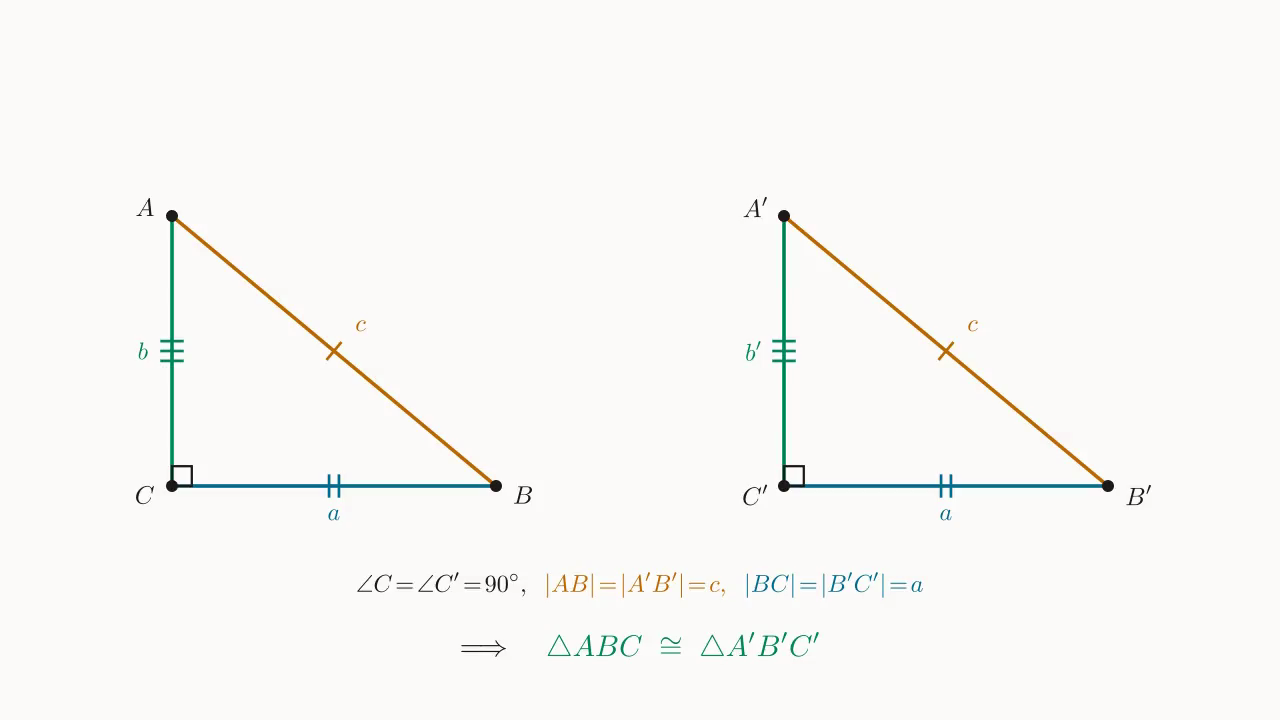
HL congruence: in two Rt△s, equal hypotenuse c + one equal leg a ⇒ third side b also equal ⇒ congruent.

Proof

The proof uses Pythagorean theorem once to compute the third side, then applies SSS congruence to finish.

Step 1: use Pythagorean theorem to compute the third side of each triangle.

Set AC=b|AC| = b and AC=b|A'C'| = b'. In RtABC\mathrm{Rt}\triangle ABC with C=90\angle C = 90^\circ, ABAB is the hypotenuse and BCBC, ACAC are the two legs. Pythagorean theorem gives

b2  =  AC2  =  AB2BC2  =  c2a2.b^2 \;=\; |AC|^2 \;=\; |AB|^2 - |BC|^2 \;=\; c^2 - a^2.

The same argument applied to RtABC\mathrm{Rt}\triangle A'B'C':

(b)2  =  AC2  =  AB2BC2  =  c2a2.(b')^2 \;=\; |A'C'|^2 \;=\; |A'B'|^2 - |B'C'|^2 \;=\; c^2 - a^2.

The squares are equal and both non-negative, so taking square roots gives b=bb = b', i.e. AC=AC|AC| = |A'C'|.

Step 2: three pairs of equal sides ⇒ SSS congruence finishes.

Combining Step 1 with the hypotheses:

AB=AB,BC=BC,AC=AC.|AB| = |A'B'|,\qquad |BC| = |B'C'|,\qquad |AC| = |A'C'|.

The three pairs of corresponding sides are equal, so by SSS congruence,

ABC    ABC.\triangle ABC \;\cong\; \triangle A'B'C'. \qquad\blacksquare

HL proof · by the Pythagorean theorem, both third sides b, b' are expressed as c^2-a^2 ⇒ b = b' ⇒ three pairs of corresponding sides equal ⇒ SSS congruence ⇒ congruent.

Immediate consequences

  • Gateway to the converse of the angle bisector: to prove that a point equidistant from the two sides of an angle lies on the bisector, the standard move is to drop two perpendiculars from the point to the two sides, producing two right triangles with a shared hypotenuse — equal hypotenuses + equal legs, so HL congruence gives the right triangles congruent in one step, and hence the two half-angles are equal. This route plugs HL congruence directly into Angle bisector test, which then cascades into the existence of the incenter of a triangle.

  • Gateway to excircle existence: the proof that an interior bisector + two exterior bisectors are concurrent at an "excenter" repeatedly invokes "equidistance from three lines" at each pairwise intersection of the bisectors, calling HL congruence each time. Excircle existence is therefore one step removed from this theorem.

  • Two sides instantly lock right-triangle congruence: a general triangle needs "three sides" or "two sides and the included angle" to be congruent; the right triangle's 9090^\circ pre-records one quantity, and HL cashes that record into a "two-side" shortcut — whenever you see two right triangles with a pair of equal hypotenuses and a pair of equal legs, just declare HL congruence.

Remarks

Why must "the two equal sides" include the hypotenuse? If the hypothesis is rewritten as "two corresponding legs equal" — i.e. BC=BC|BC| = |B'C'| and AC=AC|AC| = |A'C'|, plus C=C=90\angle C = \angle C' = 90^\circ — that is just SAS congruence (two sides plus the included angle), and has nothing to do with HL congruence; it of course gives congruence too, but via the SAS path. The name HL specifically captures the "hypotenuse + one leg" pairing, and the position of the hypotenuse cannot be swapped: replacing "equal hypotenuse" with "the other equal leg" reduces to plain SAS.

Why does a right triangle have one extra congruence shortcut? A general triangle requires three independent pieces of information (each of SSS / SAS / ASA / AAS counts to three) to lock in shape and size. A right triangle has already "paid" one piece — C=90\angle C = 90^\circ — so only two more independent pieces are needed. HL congruence spells this out in the "two-side" dimension: once the hypotenuse cc and one leg aa are pinned down, by Pythagorean theorem the third side b=c2a2b = \sqrt{c^2 - a^2} is also pinned, and the triangle is fully determined. This trick of "use Pythagorean theorem to algebraically supply the third quantity, then fall back on SSS congruence" is the same packaging as AAS congruence's "use the triangle angle sum equals 180180^\circ to supply the third angle, then fall back on ASA congruence" — one algebraic completion plus one existing criterion.

Help me make this theorem better