ASA congruence
Dependencies: SAS congruence, Protractor axiom. The auxiliary construction in the proof also uses Ruler axiom ("lay off a given length along a ray") and Point–line axiom ("two distinct lines meet in at most one point") — these are treated as default geometric tooling available to every proof and are not listed in the main dependencies, but the proof below points out exactly where they are used.
Statement
Let and be two non-degenerate triangles (i.e. with non-collinear vertices) satisfying two pairs of equal angles together with the included edge:
Then
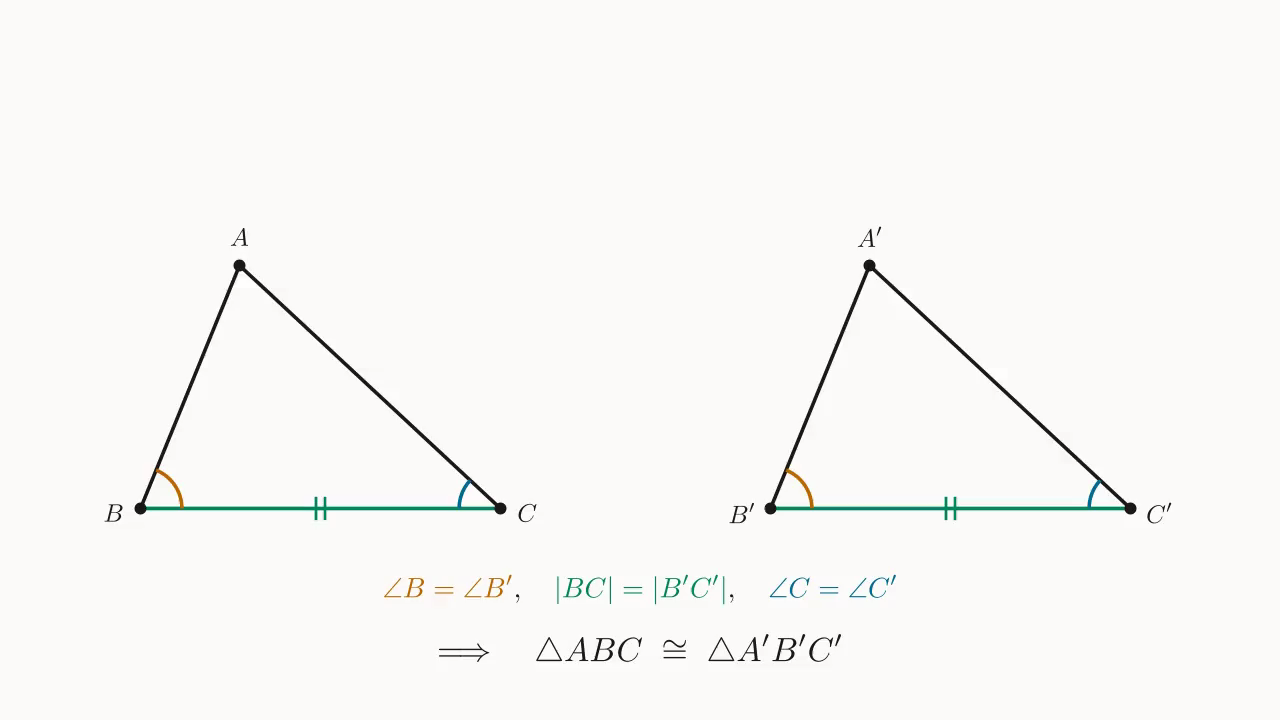
Proof
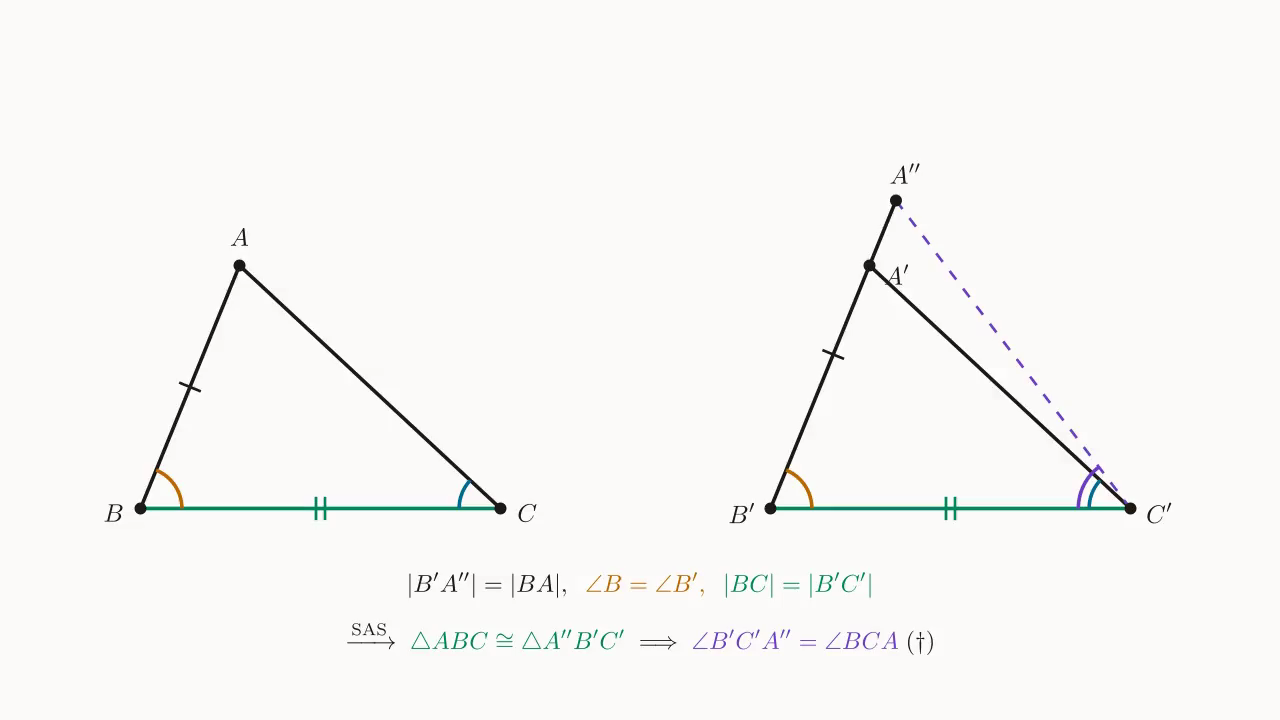
Strategy: take as a "template". On its edge , axiom I lets us lay off a segment of length ; call its endpoint . Use SAS to conclude . Finally, axiom III's ray-uniqueness together with axiom II's "two distinct lines meet in at most one point" forces .
Step 1: construct the auxiliary point and use SAS to get .
By axiom I (ruler), starting at along the ray there is a unique point with
Now we collect the three SAS conditions:
- First pair of edges: (by construction).
- Included angle: since lies on the ray , the rays and coincide, so the angle each of them makes with the common edge is the same:
- Second pair of edges: (hypothesis).
By SAS:
Read off the remaining pair of corresponding angles:
Step 2: by axiom III's ray-uniqueness, lies on the ray .
Axiom III's precise statement (strong form): from a given point, on a given side of a given ray, there is at most one ray making a prescribed angle with that ray. Concretely here: from , on the " side" of , there is a unique ray making angle with .
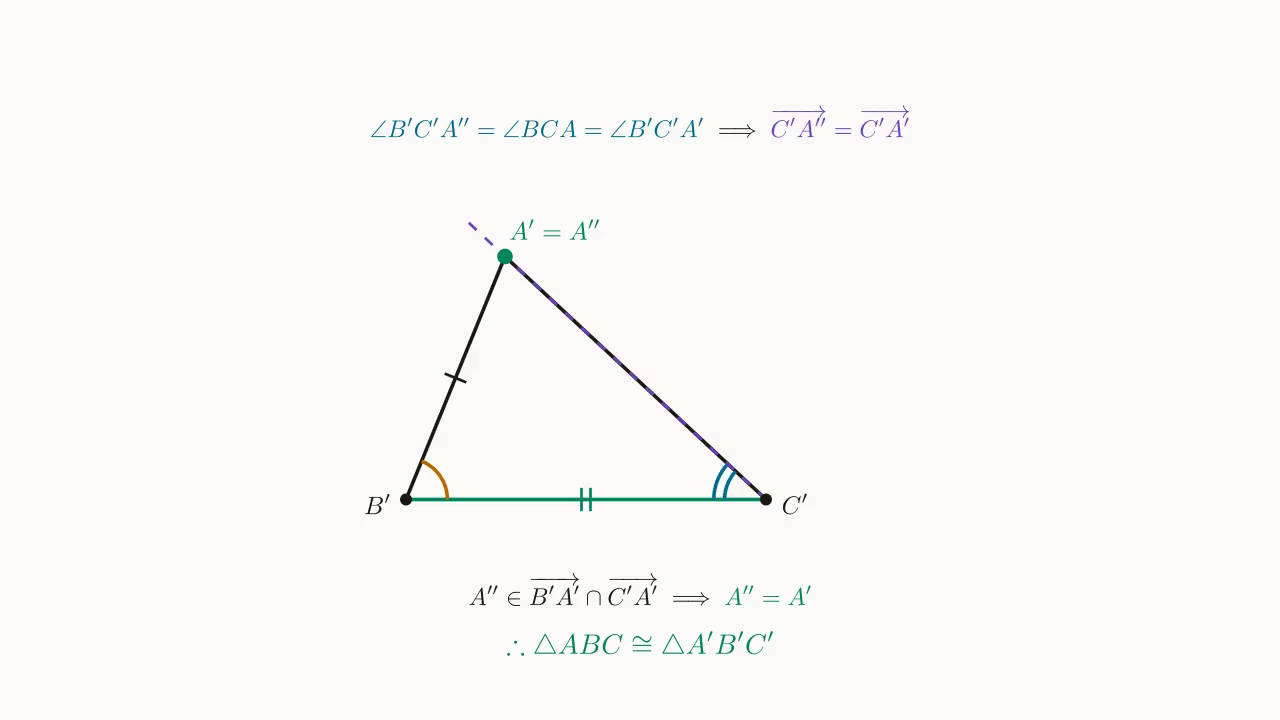
By hypothesis , and combining with gives
To apply ray-uniqueness, we still need and to lie on the same side of the line . This is a by-product of the construction: was placed on the ray , so lies on the same side of the line as (the entire ray lies on that side).
Thus the rays and have the same vertex, the same direction (same side), and the same angle, so by axiom III's ray-uniqueness
Step 3: by axiom II ("two distinct lines meet in at most one point"), conclude .
The point lies on two rays:
- by construction, is on the ray , hence on the line ;
- by step 2, is on the ray , hence on the line .
The lines and are distinct (if they coincided, , , would be collinear, contradicting non-degeneracy of ). By axiom II (two points determine a unique line, equivalently: two distinct lines meet in at most one point), they intersect only at .
Hence . Substituting into the congruence above :
Immediate consequences
- Isoceles converse: equal base angles ⇒ equal sides: apply ASA congruence directly to and its "swapped" copy , dual to the SAS congruence-based proof of Base angles of an isoceles triangle are equal.
- The "" directions of Perpendicular bisector ⇔ equidistant from endpoints and Angle bisector ⇔ equidistant from sides: in both reverse-locus arguments, the key step is to establish "two pairs of base angles are equal", then use ASA congruence on the two right triangles.
- Gateway to AAS congruence: when given two angles and an arbitrary corresponding edge, first use angle sum to fill in the third angle, recasting the data as ASA, then invoke ASA congruence.
Remarks
ASA congruence is the "angle version" of SAS congruence: the latter uses two edges and the included angle, the former uses two angles and the included edge. Together they cover almost every congruence scenario reachable by direct measurement in middle-school geometry; only SSS (SSS congruence) needs a separate argument.
Steps 2 and 3 of the proof are two precise applications of axioms III and II — together they replace the geometric intuition silently used in Euclid's "superposition" argument in Elements I.26. Ray-uniqueness ensures that "angle + side" pins down a unique ray, and two distinct lines meet in at most one point ensures the meeting point of two such rays is fixed.