II. Point–line axiom
Statement
Let and be two distinct points in the plane. Then there exists a unique line passing through both and :
We denote this line by (or ).
The axiom asserts two things at once:
- Existence: there is at least one such line.
- Uniqueness: there is at most one such line.
We will see below that these two halves are invoked in arguments in different ways, and that neither can be dropped.
Intuition
Two distinct points determine a line: given and , the line is an unambiguous geometric object — it depends neither on the order of the endpoints nor on any external choice.
This single statement does two jobs at once: it guarantees that "the line through two points" can always be produced (existence), and it guarantees that this line never splits into several (uniqueness). The first underwrites construction; the second underwrites language: when we write , we no longer need to add "I mean which one".
Uniqueness
The two halves of the axiom carry different loads. Pulling them apart lets us see what the "uniqueness" half is preventing.
1. If we promise only existence
Suppose the axiom is weakened to "at least one line passes through and ", with no ban on multiple. Such a system can still be consistent — spherical geometry is one example: when "lines" are taken to be great circles, infinitely many great circles pass through any pair of antipodal points, so existence holds while uniqueness fails.
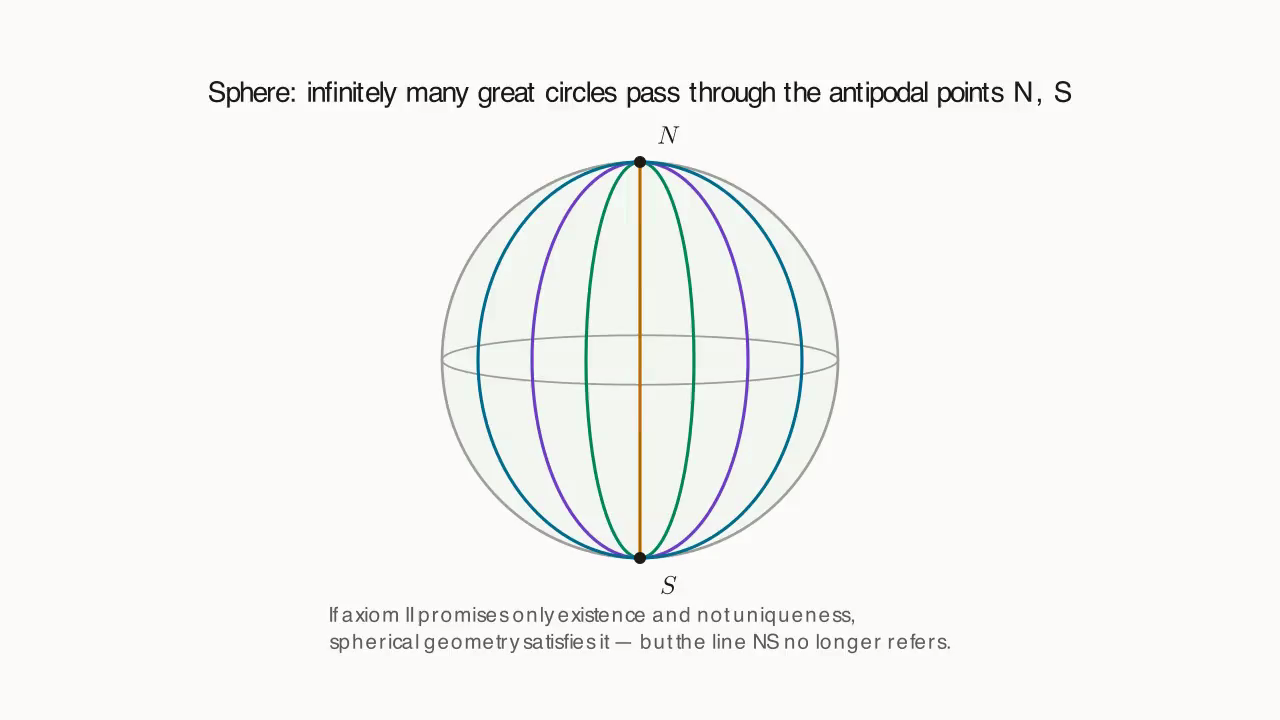
The price is the loss of a unified way to refer to "that line". Every time we write , we would have to specify additionally which one, and every lemma involving lines would branch into cases. Axiom II, by promising uniqueness, eliminates such branching at the root.
2. Uniqueness makes refer unambiguously
The notation maps "two distinct points" to "one line". For such a map to be well defined, the output must have only one candidate — and uniqueness is exactly what supplies this guarantee.
Without it, the very sentence " is a line" cannot be written down: you do not know which one it refers to. Every later step of the form "take the line " depends on this.
| Property | What it supports |
|---|---|
| Existence | "We can draw" |
| Uniqueness | "We can refer to" |
3. cannot be dropped
Consider the degenerate case : we want a line through this single point. In the plane, infinitely many lines pass through any fixed point — every direction qualifies — so uniqueness fails immediately.
One point is not enough to determine a line; two distinct points are exactly enough: each additional "passes through" constraint pins down one direction, and two independent constraints pin down all directions. This also explains why "three points are collinear" is later a non-trivial condition — the third point need not lie on the line determined by the first two.
4.
A direct by-product of uniqueness:
The axiom asks for "the line through and " without distinguishing which is named first; the two notations satisfy the same conditions, so by uniqueness they denote the same line.
This comes from a different source than in axiom I, but the spirit is the same: basic geometric objects do not carry a direction.
Immediate consequences
The axiom yields several facts directly, with no further proof:
- Two distinct lines meet in at most one point: if both pass through and (with ), then by axiom II they must coincide, contradicting . Hence two distinct lines have at most one point in common.
- : uniqueness makes the notation independent of the order of the endpoints.
- Collinearity is a non-trivial condition: given three points , , (pairwise distinct), does not hold in general; when it does, we say "the three points are collinear". This is a geometric predicate that can be tested and falsified.
- Any two points reconstruct the entire line: from a line, take any two distinct points; axiom II then returns, in reverse, the same unique line — a line and "any pair of distinct points on it" carry equivalent information.
Compared with the Elements / Hilbert
Euclid's first postulate (in the Elements): "A straight line may be drawn through any two points." It promises only existence; it does not state uniqueness explicitly. For two thousand years uniqueness was tacitly assumed to be "obvious", but a tacit assumption is not a theorem.
Hilbert (1899) split this postulate into two independent axioms of incidence:
- I.1: through any two distinct points there exists at least one line.
- I.2: through any two distinct points there exists at most one line.
The split clarifies the logical structure: existence and uniqueness are two independent matters, assumed separately and used separately.
Birkhoff (1932) kept the merged form, and this series follows him. In arguments, we still split it into the "existence" half or the "uniqueness" half as needed — exactly the move used repeatedly in the previous section.
| Source | Existence | Uniqueness |
|---|---|---|
| Euclid's first postulate (Elements) | explicit | tacit (not stated) |
| Hilbert I.1 / I.2 | I.1 | I.2 |
| Birkhoff's point–line axiom | merged into one statement | merged into one statement |
What it unlocks
A number of later results depend, directly or indirectly, on this axiom:
- The notation refers unambiguously: every step of the form "take the line " rests on this.
- Two distinct lines meet in at most one point: this turns "coincident / intersecting / disjoint" into a clean three-way classification of pairs of lines.
- Collinearity: three points , , are collinear , available as a usable geometric predicate.
- Definition of a triangle: three non-collinear points determine a triangle, and the prerequisite "non-collinear" relies on collinearity being testable.
- Concurrence: three lines "passing through a common point" becomes a statable, verifiable geometric event, which in turn supports higher-level results such as Ceva's theorem.
In the next chapter, Axiom III · Protractor, we redo the "measurement + uniqueness" story for angles; afterwards will stitch distance, angle, and the point–line structure together, and the deductive engine of school geometry is up and running.