Linear pair sums to 180°
Dependencies: Protractor axiom.
Statement
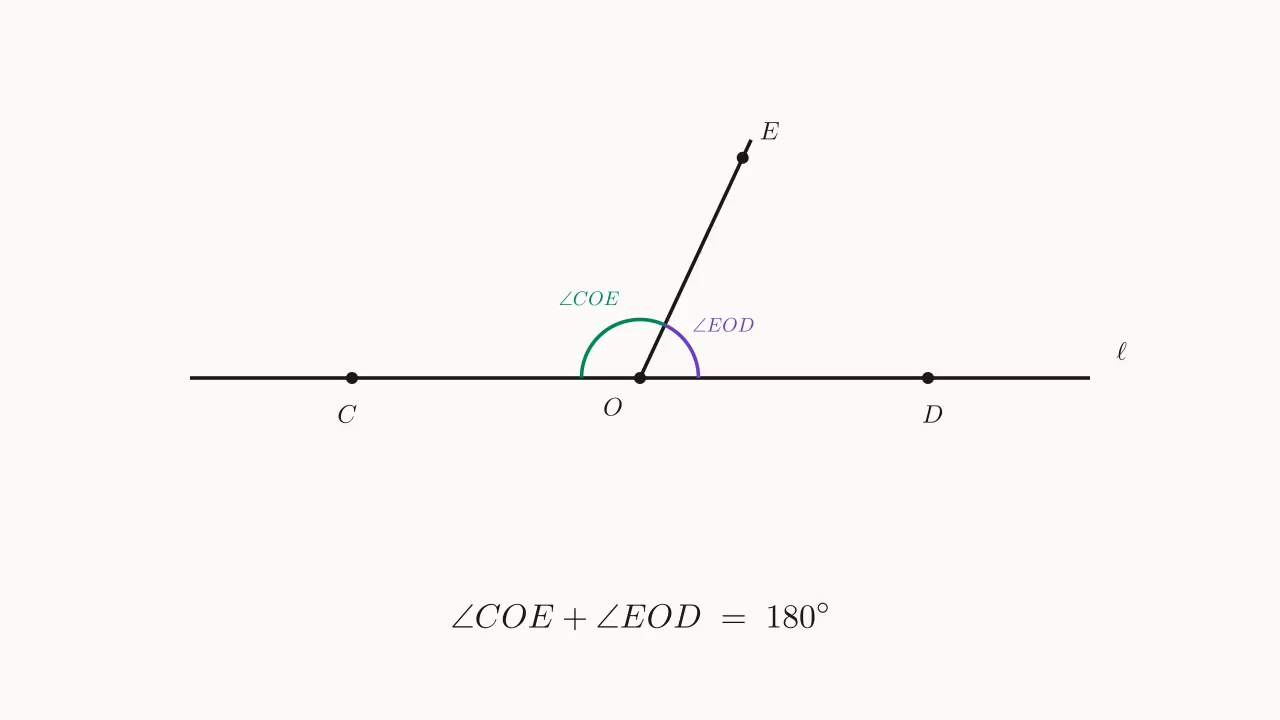
Let be a point on the line , and let , be points on on opposite sides of ; take a further point not on . Then the two angles in the linear pair sum to
Here a "linear pair" means two angles sharing the vertex and one ray , while their other rays , lie on the same line in opposite directions.
Proof
The proof uses only two direct consequences of Protractor axiom (axiom III).
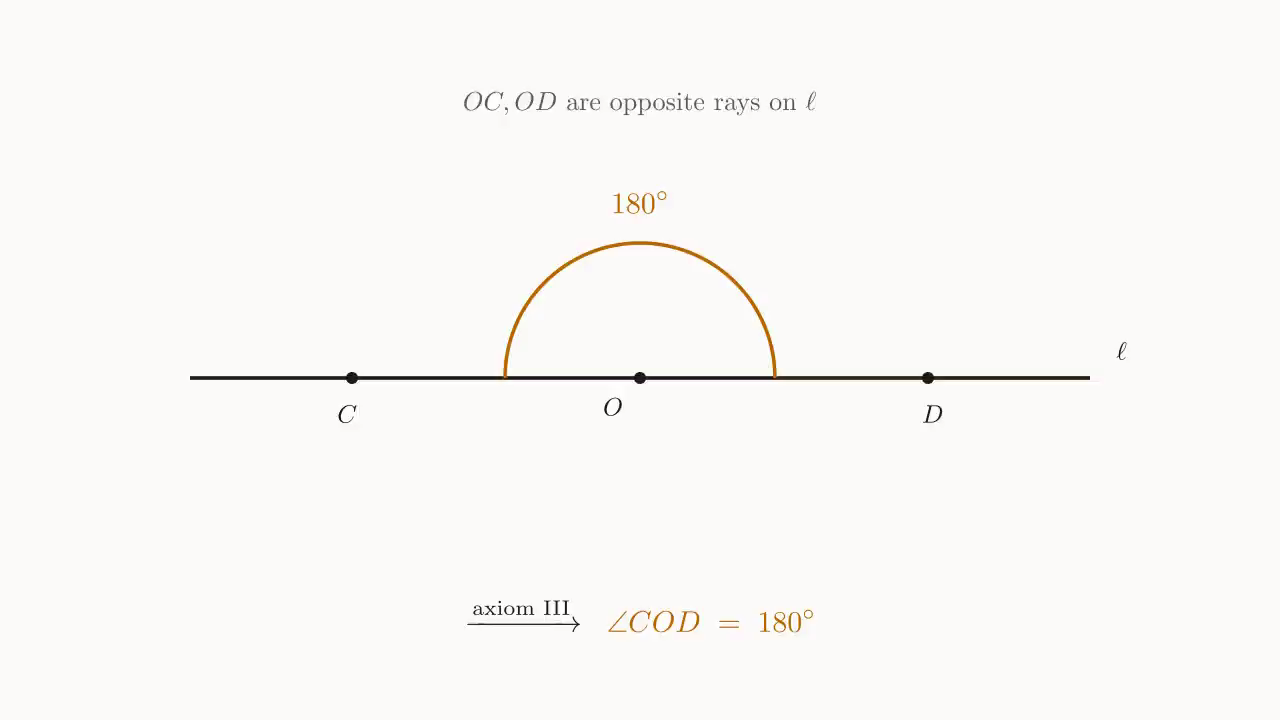
Step 1: The angle between opposite rays is .
Axiom III sets up a one-to-one correspondence between the rays from and the real numbers in ; the angle between two rays equals the difference of the corresponding numbers (taking the representative in ).
For the two opposite rays , from on line , the difference of the numbers assigned by axiom III is exactly . Hence
Step 2: Angle additivity splits .
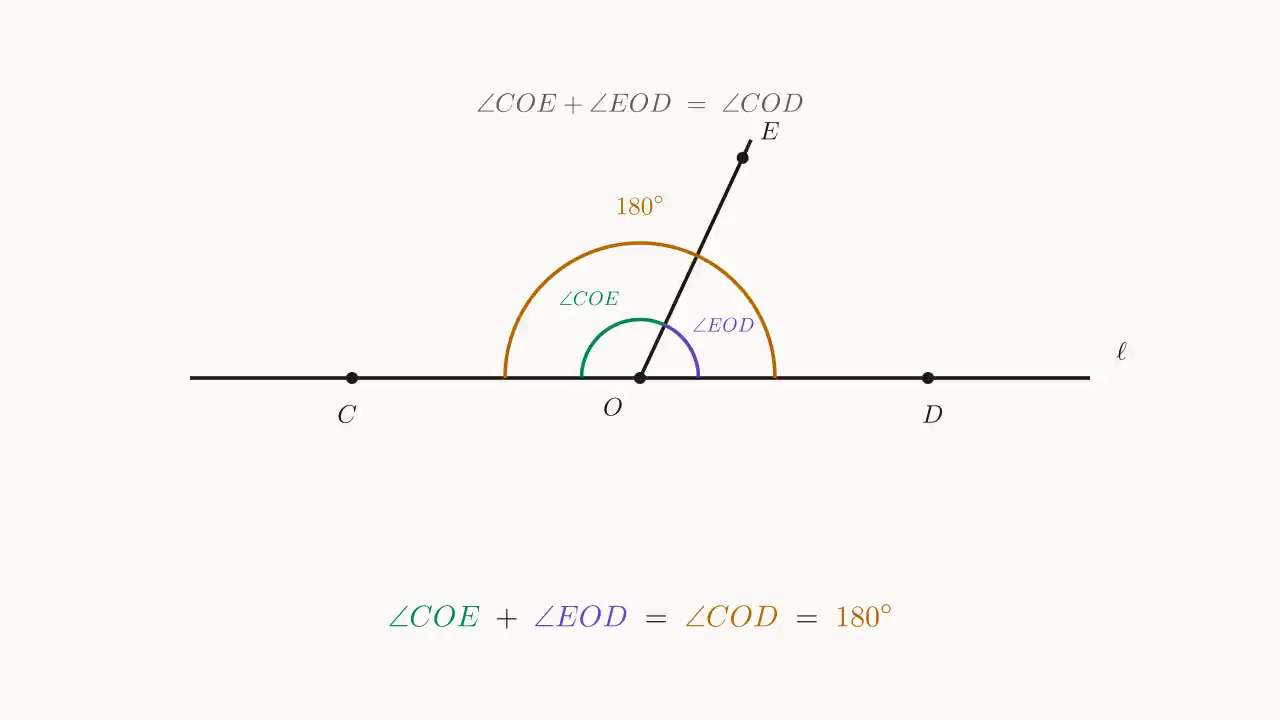
The ray is not collinear with (since is not on ), so by the plane separation implied by the continuity of axiom III, the line divides the plane into two disjoint open half-planes, and must lie in one of them. The two cases are symmetric, so we may as well take to lie in the "upper" half-plane.
View as the straight angle "pointing into the upper half" — its interior is exactly the upper half-plane minus the point . The ray leaves pointing toward , so it lies entirely inside this straight angle. By the angle additivity of axiom III,
Step 3: Combine.
Substituting step 1 into step 2:
Immediate consequences
- Entry point to triangle exterior angles: in , extending the side past to a point , the angles and share the vertex and the ray , while their outer rays , point in opposite directions along line . By the linear pair = 180° identity:
This is the entry point for Exterior angle equals the sum of two non-adjacent interior angles.
-
Quantitative definition of "perpendicular": if at some point a pair of linear-pair angles formed by two lines are equal, then each angle equals . This is precisely the standard definition of "".
-
Entry point to the vertical-angle equality: applying linear pair = 180° to two pairs of linear-pair angles and subtracting immediately yields Vertical angles are equal — see the proof of the next theorem.
Remarks
Linear pair = 180° looks "obvious", but it actually formally welds together two facts:
- Axiom II tells us "two points determine a line" — but the line itself carries no information about "spanning ";
- Axiom III assigns each ray a number in and stipulates that opposite rays correspond to numbers differing by .
It is this convention of axiom III that makes "line = " hold. Linear pair = 180° packages this convention together with angle additivity into a theorem that can be cited repeatedly; from this point on, every argument involving angle addition or subtraction (Vertical angles are equal, Triangle interior angles sum to 180°, Exterior angle equals the sum of two non-adjacent interior angles, Central angle is twice the inscribed angle on the same arc, …) starts from linear pair = 180°: cut a line at some point, and add or subtract the two resulting angles.