Vertical angles are equal
Depends on: Linear pair sums to 180°.
Statement
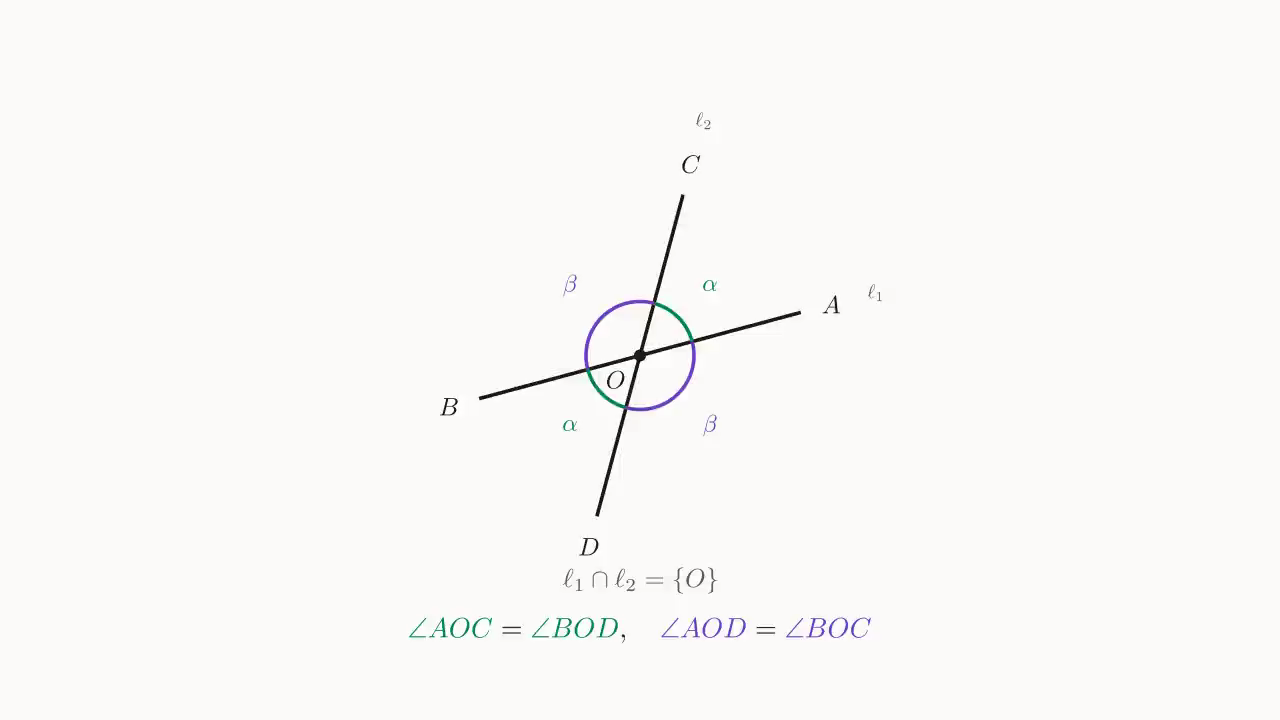
Let two distinct lines , intersect at a point . Four angles are formed at this intersection; any two angles that share no edge are called a pair of vertical angles, and there are two such pairs — their sides are given by the two opposite rays from along and respectively.
Take points , on on opposite sides of , and points , on on opposite sides of . Then the two pairs of vertical angles are equal:
Proof
We only use Linear pair sums to 180°. Let the same angle appear in two linear-pair equations at once; subtraction cancels it.
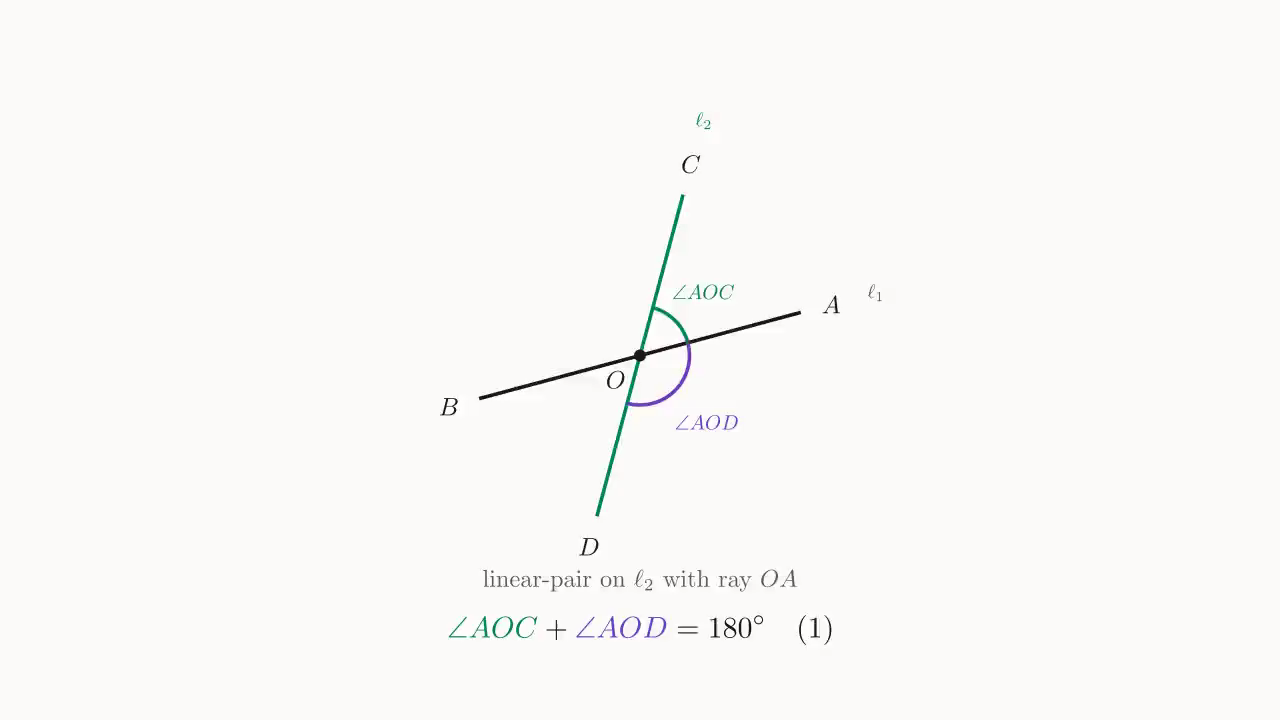
Application 1: at the intersection point , apply Linear pair sums to 180° to line (which contains and , with the opposite rays , from ) and ray (, and since , is not on , satisfying the "non-collinear" hypothesis of Linear pair sums to 180°):
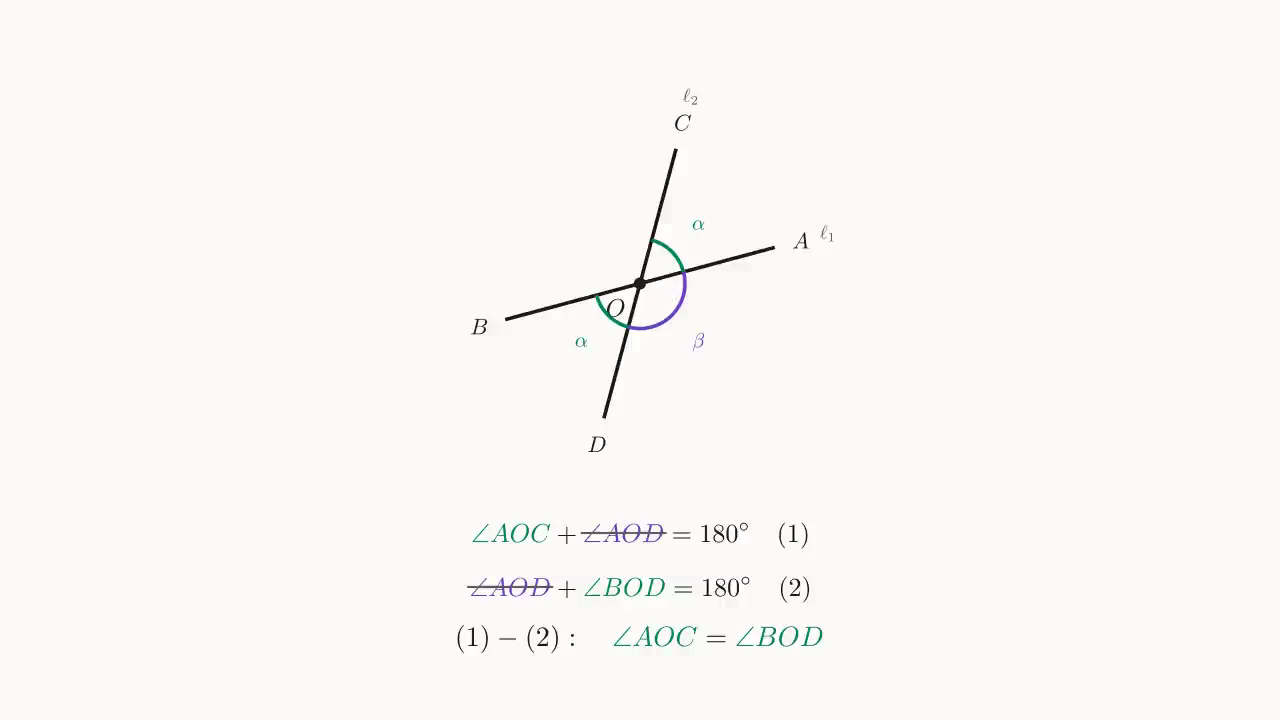
Application 2: at , apply Linear pair sums to 180° to line (opposite rays , ) and ray (, not on ):
cancels the term:
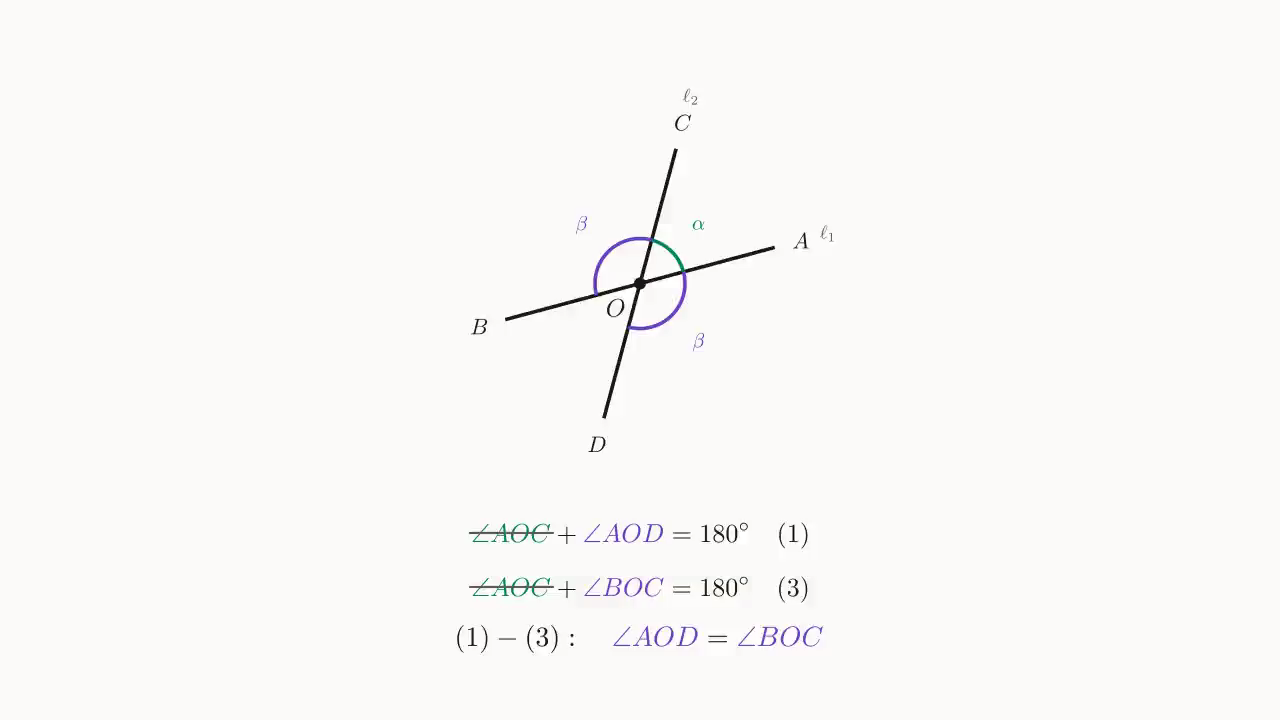
The second pair of vertical-angle equalities follows from one more application of Linear pair sums to 180°.
Application 3: at , apply Linear pair sums to 180° to line and ray :
cancels the term:
Immediate consequences
- The "scissors" four angles. The four angles formed by two intersecting lines pair up into two pairs of equal vertical angles and two pairs of supplementary linear pairs. Overall, the four angles sum to exactly .
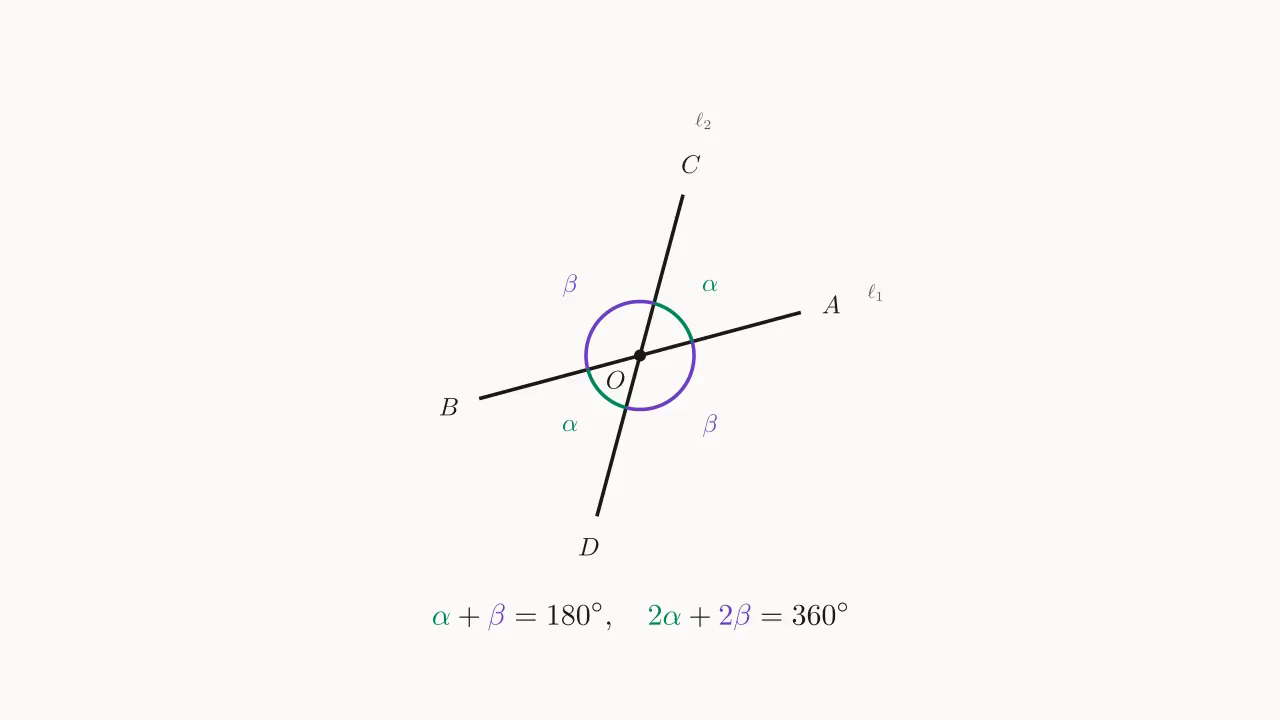
-
Transitivity of perpendicularity. If , then all four angles are (one pair of equal vertical angles + one pair of supplementary linear pairs equal to gives this immediately).
-
"Algebraization of angles." Vertical angles are equal is the first place where, on a figure of two crossing lines, we can shuffle angles around as if manipulating algebraic expressions — a technique that recurs throughout the proofs of "corresponding / alternate interior angles ⇔ parallel."
Remarks
The relationship between Linear pair sums to 180° and vertical angles are equal is one of the cleanest "reuse" examples in geometry: Linear pair sums to 180° carves "a straight line = " into a theorem, and vertical angles are equal applies that theorem to two lines simultaneously, so that the term appears in both equations and cancels by subtraction. The whole proof contains no "figure manipulation" — no translation, no rotation, just two substitutions and one subtraction.
This conclusion is I.15 in Euclid's Elements, where Euclid uses the same two-linear-pairs strategy; the only difference is that in the Elements the very statement "the angles are equal" depends on an implicit moving-figure argument, while here we land directly on axiom III, making the entire proof fully algebraic.