Supplements of the same angle are equal
Depends on: Protractor axiom (angles can be manipulated as real numbers).
Statement
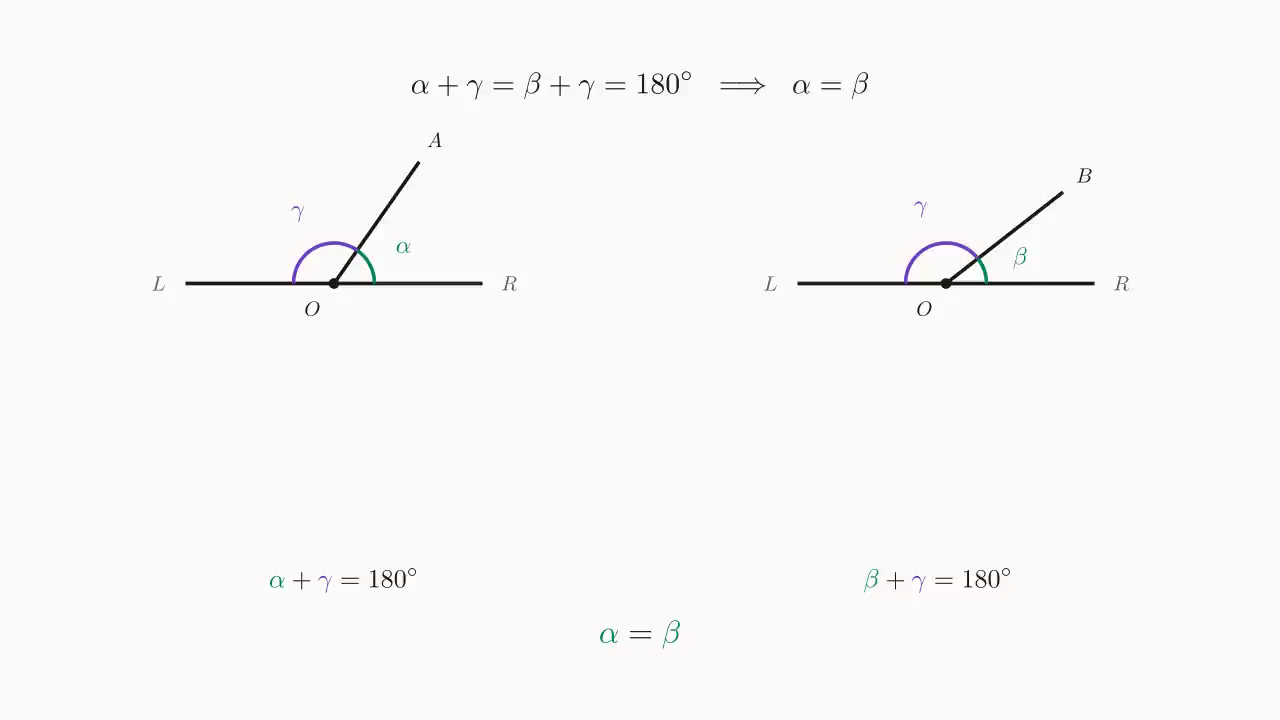
Let , , be three angles. If and are supplementary, and and are also supplementary — that is,
then . In other words, the two supplements of the same angle must be equal.
Proof
Place the two given equations side by side — the left figure gives , the right figure gives , and they share the same .
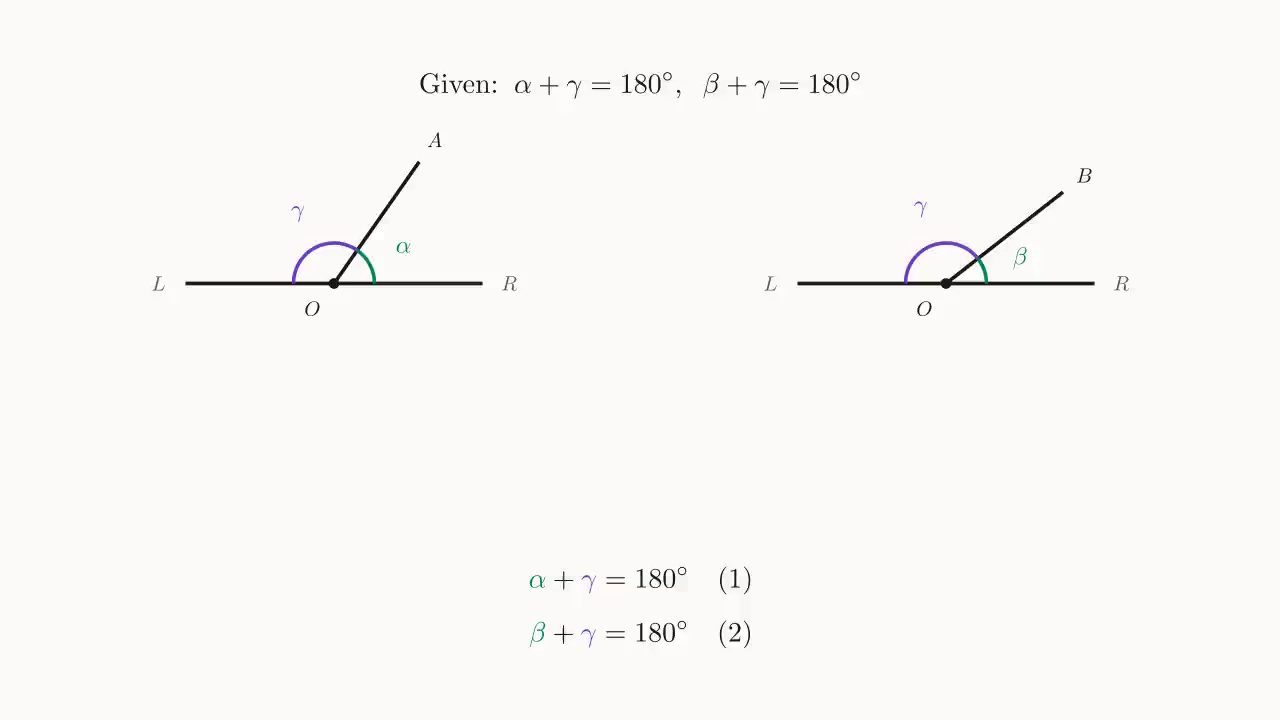
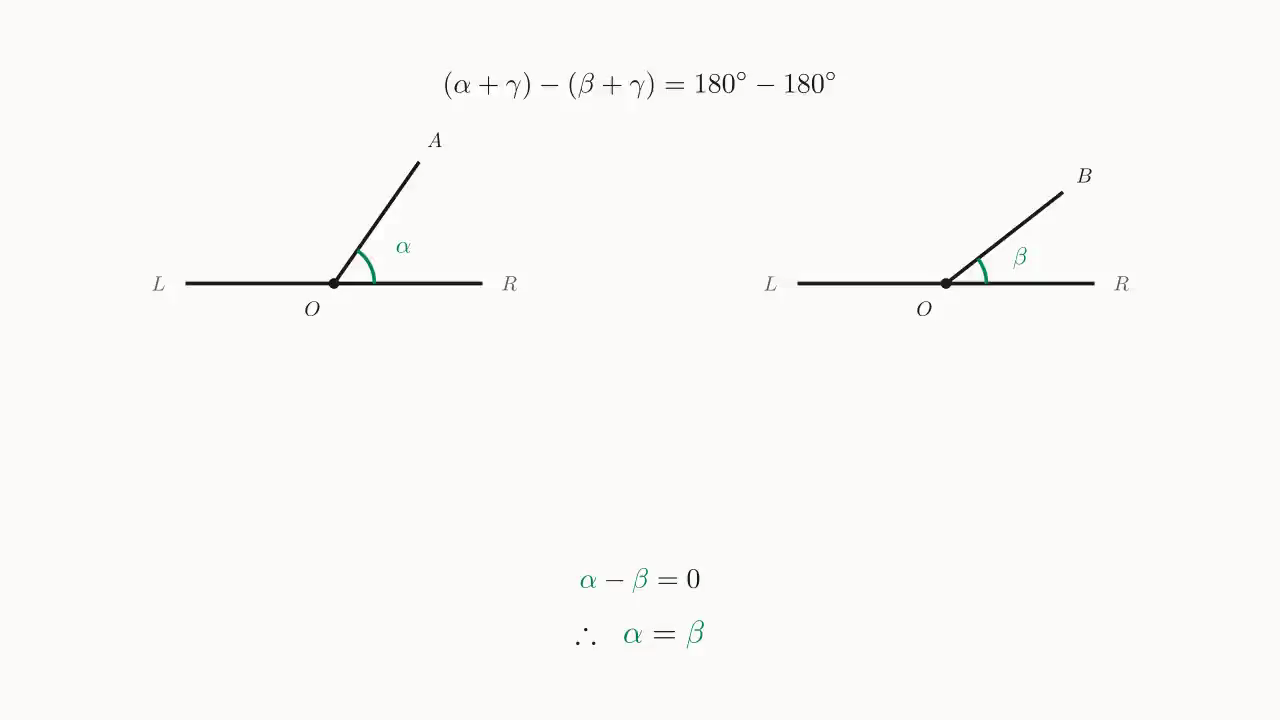
By Protractor axiom, angles are real numbers and can be added and subtracted. Subtracting the two equations:
appears on both sides and cancels — geometrically, this is erasing the same arc from both figures, after which the leftover and arcs are automatically equal. Simplifying gives , i.e. .
Immediate consequences
- Algebraization of the straight angle: for any pair that adds up to a straight angle (), the "other half" of a given piece is unique.
- Substitution of equal angles: in any expression involving the supplement of , you can substitute the supplement as a single block — it doesn't matter whether you call it or .
- Symmetry across a line: the two angles formed when a ray splits one side of a line, if each is supplementary to the same external angle, must be equal to each other — this is the smallest algebraic component used later when discussing "linear pairs" and "vertical angles".
Remarks
This conclusion is the twin of Complements of the same angle are equal (the version), with an identical proof structure — only the constant changes from to . Both rest directly on Protractor axiom: once angles are allowed to add and subtract like real numbers, "cancelling the same term" is immediately available, and geometry exits the stage.