Complements of the same angle are equal
Dependencies: Protractor axiom (angles can be treated as real numbers).
Statement
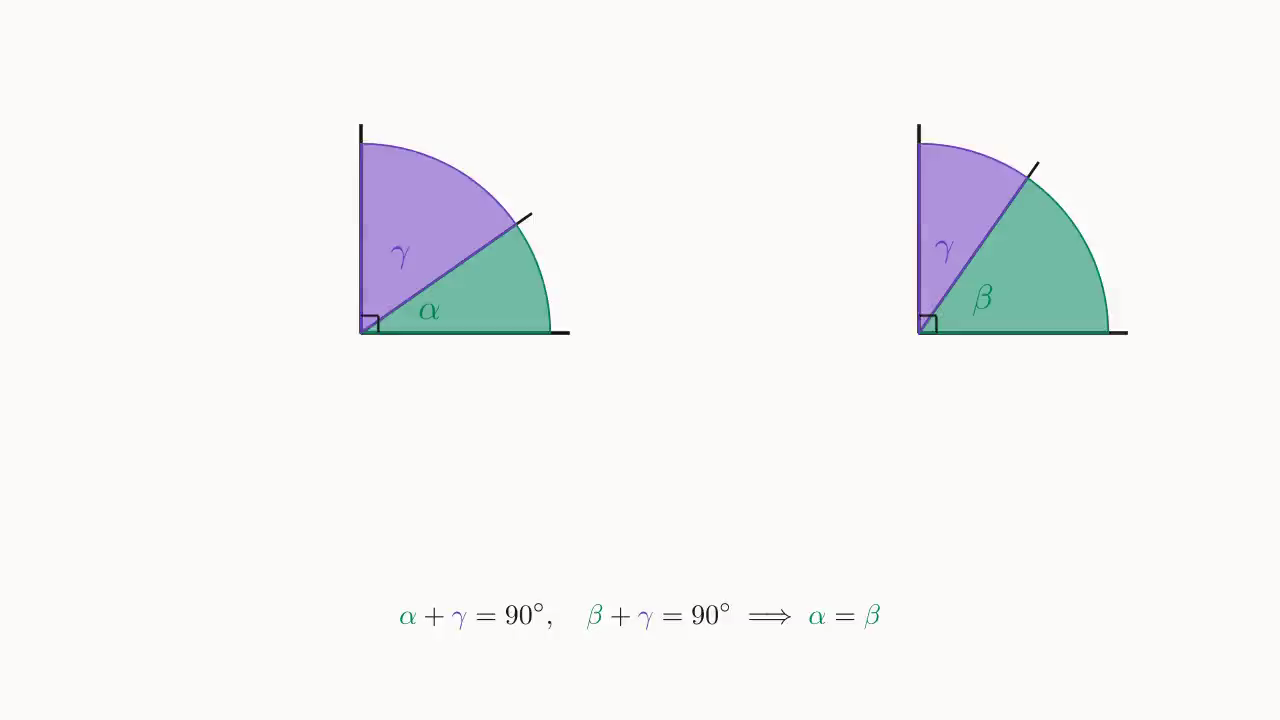
Let and both be complementary to the same angle :
Then .
Proof
Step 1: translate the figure into two equations. The right angle on the left is split into and ; the right angle on the right is split into and the same . The two 's are the same angle — that is precisely the "same angle" hypothesis of the theorem.

Step 2: subtract the two equations; the terms cancel. Protractor axiom turns each angle into a real number, so this is just ordinary arithmetic with reals. Subtracting the two equations cancels :
i.e. , hence .

Immediate consequences
- Substitutability of co-complements: in any figure containing , as long as you also verify you may swap for without changing any other angle relations. This is the cleanest version of the kind of substitution used later in right triangles (the two acute angles are complementary acute angles are equal).
- Supplements of the same angle are equal (the version) has a parallel proof: replace by and "complementary" by "supplementary"; the argument is word-for-word the same.
Remarks
The entire content of this theorem lives inside Protractor axiom: once an angle can be assigned a real number, the equality of complements is just one subtraction step in a simple linear system. The geometry is reduced to "admit that angles are real numbers"; everything else is algebra.