PRINCIPIA · THEOREM

Parallel ⇒ co-interior angles supplementary

Dependencies: Parallel ⇒ corresponding angles equal (Parallel ⇒ corresponding angles equal) and Linear pair sums to 180° (Linear pair sums to 180°).

Statement

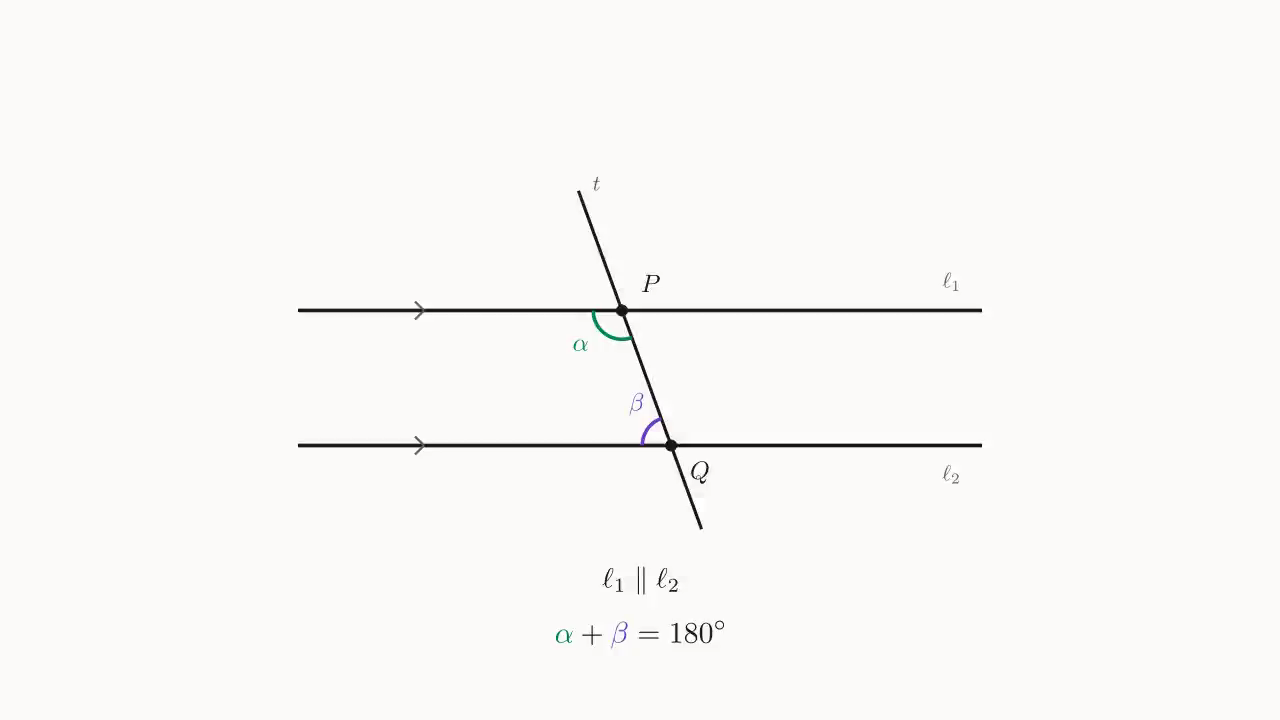
Let two lines 12\ell_1\parallel\ell_2 be cut by a third line tt, meeting at P1P\in\ell_1 and Q2Q\in\ell_2. The two interior angles enclosed by 1\ell_1 and 2\ell_2 on the same side of tt are called a pair of co-interior angles (also "consecutive interior angles"). Conclusion: each pair of co-interior angles is supplementary, i.e.
α+β=180.\alpha + \beta = 180^\circ.

Co-interior angles: \ell_1\parallel\ell_2 cut by t at P, Q; \alpha, \beta are a pair of interior angles on the same side of t, sandwiched between the two parallel lines, with \alpha+\beta=180^\circ.

Proof

The strategy is to stitch "corresponding" and "co-interior" together at QQ: the corresponding-angle equality comes from Parallel ⇒ corresponding angles equal, the linear-pair equality from Linear pair sums to 180°, and adding the two yields the result.

Step 1 (corresponding angles): by Parallel ⇒ corresponding angles equal, when 12\ell_1\parallel\ell_2 is cut by tt, corresponding angles are equal. Let α\alpha be some interior angle at PP; its corresponding angle at QQ is α=α\alpha'=\alpha.

Step 1: by parallel-corresponding-converse, \alpha at P and the corresponding \alpha' at Q are equal (both lie on the same side of t and on the same side of their respective parallel lines).

Step 2 (linear pair): at QQ, α\alpha' and the co-interior angle β\beta (on the same side of tt) share the vertex QQ and a common side along tt; their other sides are opposite rays from QQ along 2\ell_2 — the hypothesis of Linear pair sums to 180° is satisfied. Hence

α+β=180.\alpha' + \beta = 180^\circ.

Step 3 (substitute): substituting α=α\alpha'=\alpha:

α+β=180.\alpha + \beta = 180^\circ. \qquad\blacksquare

Step 2: at Q, \alpha' and \beta share \ell_2, while their outer two sides are opposite rays along t; by linear-pair, \alpha'+\beta=180^\circ. Substituting \alpha'=\alpha gives \alpha+\beta=180^\circ.

Immediate consequences

  • Same-side exterior angles supplementary: the same-side exterior angles are the vertical angles of the α\alpha, β\beta above (by Vertical angles are equal), so the same-side exterior angle sum is also 180180^\circ.

  • Criterion ⇔ property — the full set is in: together with Parallel ⇒ corresponding angles equal (corresponding angles) and Parallel ⇒ alternate angles equal (alternate interior angles), the "three pairs of angles" criteria and properties for parallel lines are now symmetrically complete: parallel ⇔ corresponding angles equal ⇔ alternate interior angles equal ⇔ co-interior angles supplementary.

  • A rectangle has 9090^\circ adjacent angles: in a rectangle the two pairs of opposite sides are parallel; adjacent angles are co-interior, so the adjacent-angle sum is 180180^\circ; combined with Parallelogram: opposite angles equal (Parallelogram: opposite angles equal), all four angles are 9090^\circ. This is the key step in the "(c)(c)\Rightarrow rectangle" branch of rectangle-equiv-conditions.

Remarks

The "main line" of this property — corresponding-angle equality + linear-pair equality + substitution — is in fact a template shared by every property of parallel lines: first build a "transport bridge" for angles between 1\ell_1 and 2\ell_2 (corresponding / alternate), then locally at QQ use Linear pair sums to 180° to combine the angles into the desired form. Using alternate interior angles as the bridge (Parallel ⇒ alternate angles equal) gives the same conclusion; we choose Parallel ⇒ corresponding angles equal because it sits closest to the axioms in the dependency graph, giving a shorter chain.

Help me make this theorem better