Parallel ⇒ alternate interior angles equal
Dependencies: Parallel ⇒ corresponding angles equal (B.05, which grabs the corresponding angles for us), and Vertical angles are equal (to flip a corresponding angle into an alternate interior angle at ).
Statement
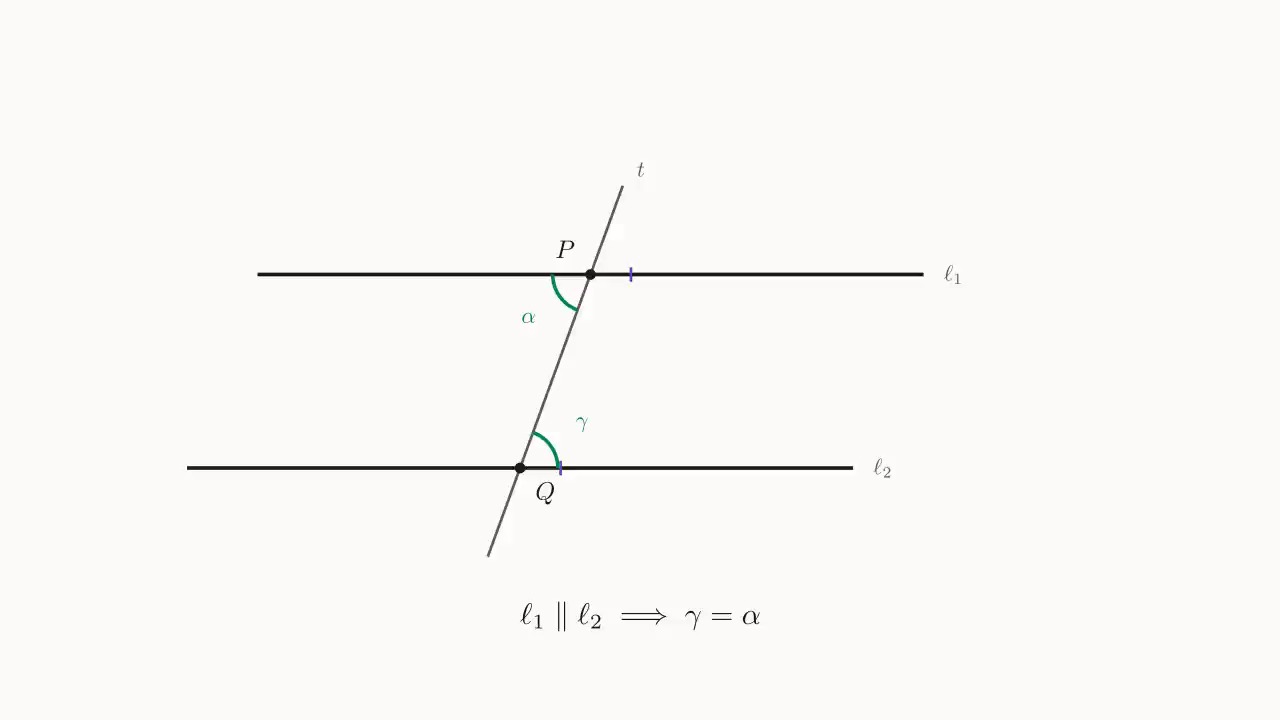
Let be cut by a third line : meets at and at . The two angles between and carved out by , lying on opposite sides of , form a pair of alternate interior angles. The two such pairs are respectively equal.
Let denote a corresponding angle at (the angle formed on a specified side by and ), let be the corresponding angle at on the same side as , and let be the vertical angle to (i.e. the one at that forms an alternate interior pair with ). Then
Proof
The whole proof is just B.05 + vertical angles in two steps.
Step 1 (corresponding angles equal): by Parallel ⇒ corresponding angles equal, .
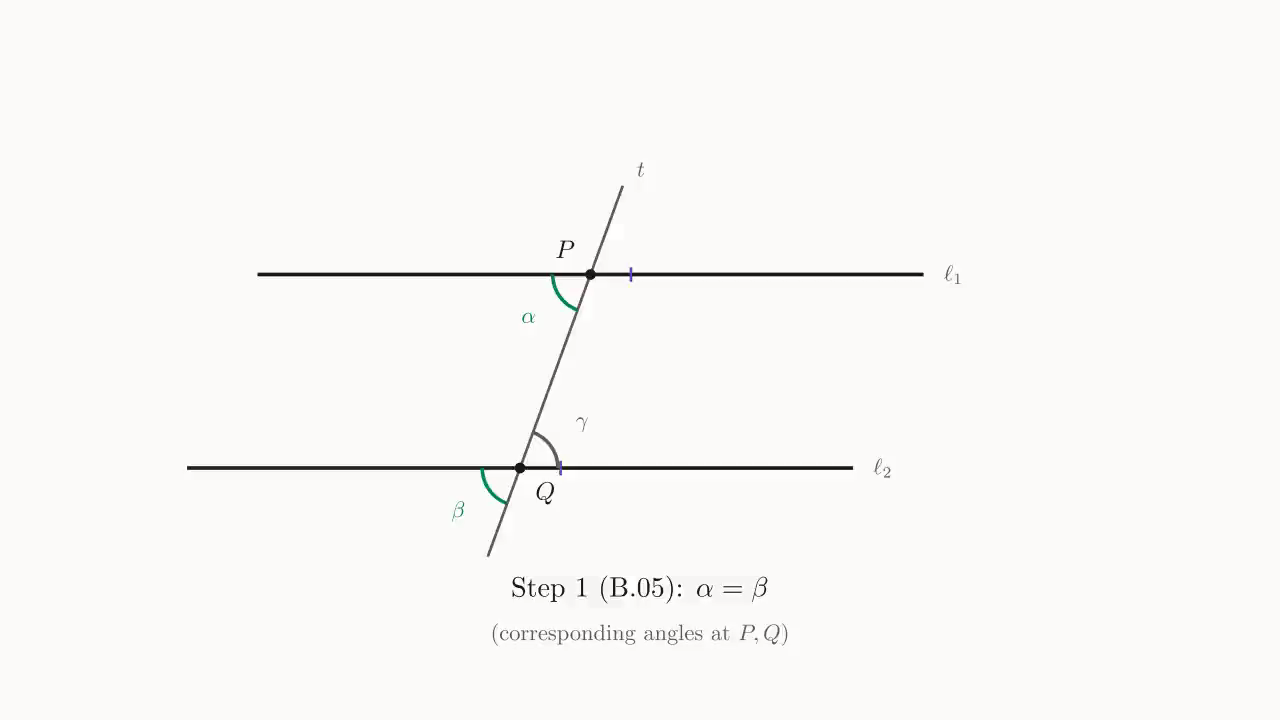
Step 2 (alternate and corresponding are vertical to each other): at , both and have as their vertex, and their sides are given by the two opposite rays from along together with the two opposite rays from along — this is exactly the definition of vertical angles. By Vertical angles are equal, .
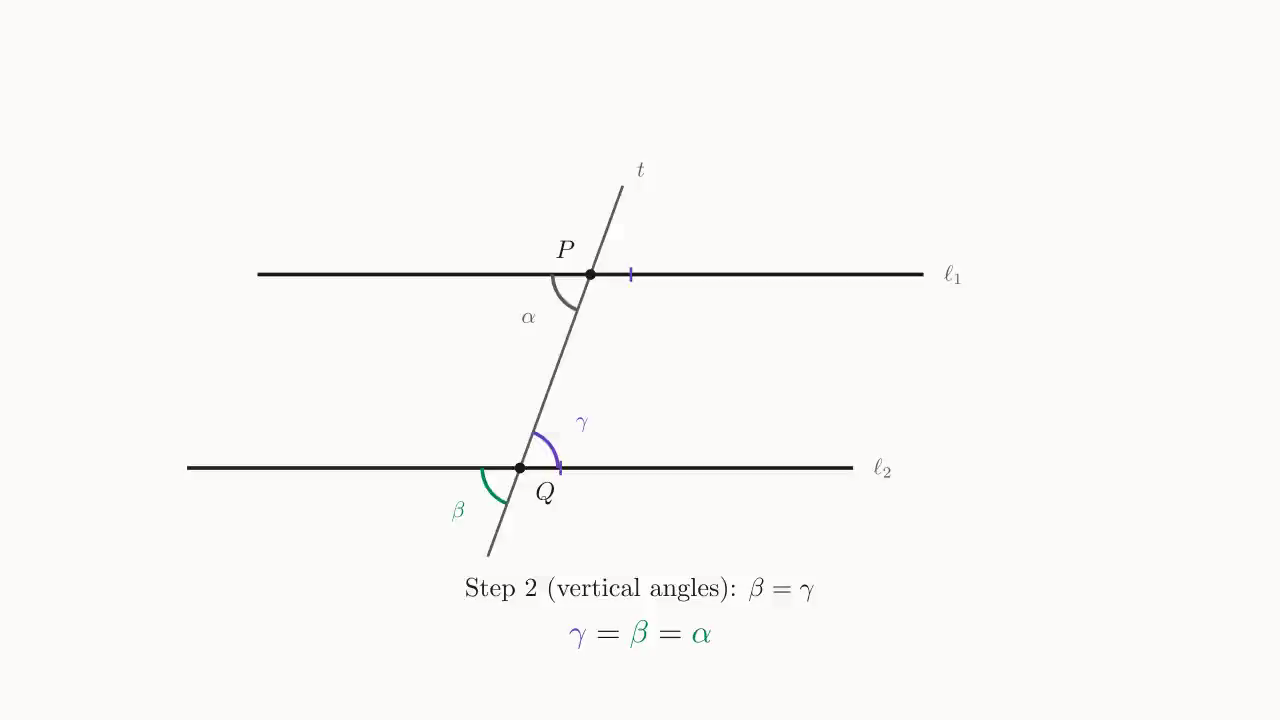
Together, .
Immediate consequences
- An alternate route to Parallel ⇒ co-interior angles supp. (B.07): from , plus the fact that the co-interior and alternate interior angles at form a linear pair (Linear pair sums to 180°), we immediately get .
- The core lemma for the angle sum of a triangle = : drawing through one vertex of the triangle a line parallel to the opposite side, this theorem is the unique tool that "transports" the three interior angles onto that parallel line.
- Construction ≡ algebraization of geometry: equal alternate interior angles let us copy any angle on to for free — together with the angle conditions of SSS / SAS, this is the entry point for many proofs of parallelogram properties, similar triangles, the Basic proportionality (intercept theorem) theorem (BPT), and so on.
Remarks
B.05 grabs the corresponding angles; this theorem flips them in place; pushing on to B.07 only needs one more linear pair. The three twin theorems (B.05 / B.06 / B.07) share the same "angle name converter" — that is why subsequent proofs cite them together so often.
Euclid's Elements I.29 lumps "equal alternate interior angles" and "equal corresponding angles" into a single proposition, and uses contradiction (assume not equal ⇒ co-interior angle sum ⇒ the fifth postulate forces the lines to meet ⇒ contradiction). We split it into the three layers B.05 → B.06 → B.07; each layer is a direct construction, making the dependency chain unidirectional and contradiction-free.