PRINCIPIA · THEOREM

Transitivity of parallelism

Dependencies: Through a point off a line, exactly one parallel exists (Playfair).

Statement

Let 1\ell_1, 2\ell_2, 3\ell_3 be three lines in the plane. If

12and23,\ell_1 \parallel \ell_2 \quad\text{and}\quad \ell_2 \parallel \ell_3,

then 13\ell_1 \parallel \ell_3.

Here we adopt the convention "coincident or non-intersecting = parallel" — every line is parallel to itself.
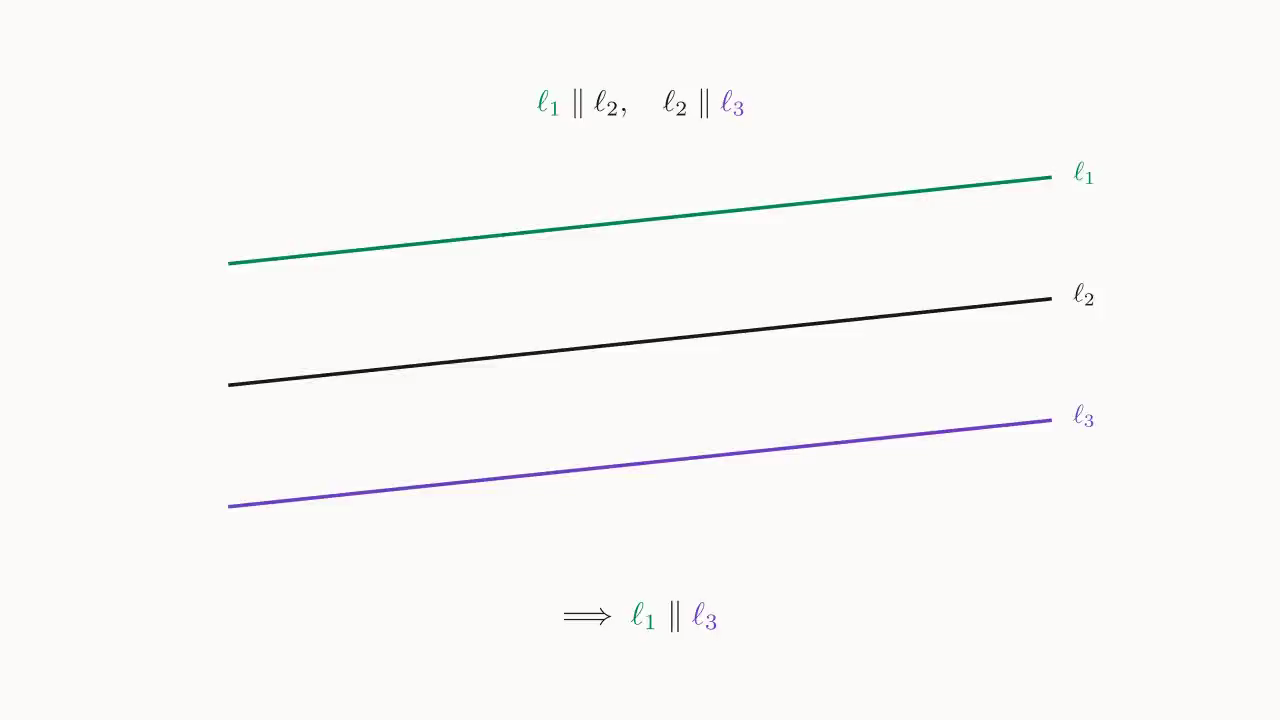
Transitivity of parallelism: \ell_1 \parallel \ell_2 and \ell_2 \parallel \ell_3 ⇒ \ell_1 \parallel \ell_3

Proof

By contradiction. Suppose 1∦3\ell_1 \not\parallel \ell_3. By the definition of parallelism, this means 13\ell_1 \neq \ell_3 and the two must intersect; let PP be the intersection point.

Consider the lines through PP parallel to 2\ell_2. On the one hand, since 12\ell_1 \parallel \ell_2 and P1P\in\ell_1, 1\ell_1 is such a line; on the other hand, 23\ell_2 \parallel \ell_3 (parallelism is symmetric) and P3P\in\ell_3, so 3\ell_3 is also such a line.

Hence at least two distinct lines through PP, namely 1\ell_1 and 3\ell_3, are both parallel to 2\ell_2 — contradicting uniqueness of parallels. So the original assumption fails, and 13\ell_1 \parallel \ell_3. \blacksquare

Contradiction: if \ell_1 meets \ell_3 at P, then both \ell_1 and \ell_3 pass through P and are \parallel \ell_2 — colliding with uniqueness of parallels

Immediate consequences

  • Parallelism is an equivalence relation: reflexivity follows from the definition (every line coincides with itself, hence is parallel to itself); symmetry is a direct consequence of the definition; transitivity is precisely this theorem. Classifying all lines in the plane by "parallel to" partitions them into classes, each called a direction, and "direction" becomes a well-defined notion.

  • Direction is preserved under translation: translating the entire figure by some vector sends each line to a line parallel to the original (this can be obtained by the later "draw a parallel through a point"). Combined with this theorem, two parallel lines remain parallel under translation — the foundation for the rigid relations of "parallelograms" later on.

Remarks

The proof uses the symmetry of parallelism (2332\ell_2 \parallel \ell_3 \Rightarrow \ell_3 \parallel \ell_2), which follows directly from the symmetric definition "coincident or non-intersecting" — no separate theorem required.

Historically, the transitivity of parallelism was often listed as a direct corollary of the "parallel postulate"; in our system, the substantive work is handed to uniqueness of parallels, and this theorem only uses contradiction to translate "two parallels" into "two parallels through PP", at which point uniqueness suffices.

Help me make this theorem better