PRINCIPIA · THEOREM

Perpendicular segment is shortest

Dependencies: perpendicular from a point (Perpendicular from a point to a line exists and is unique), Exterior angle > either non-adjacent interior angle (Exterior angle > either non-adjacent interior angle).

Statement

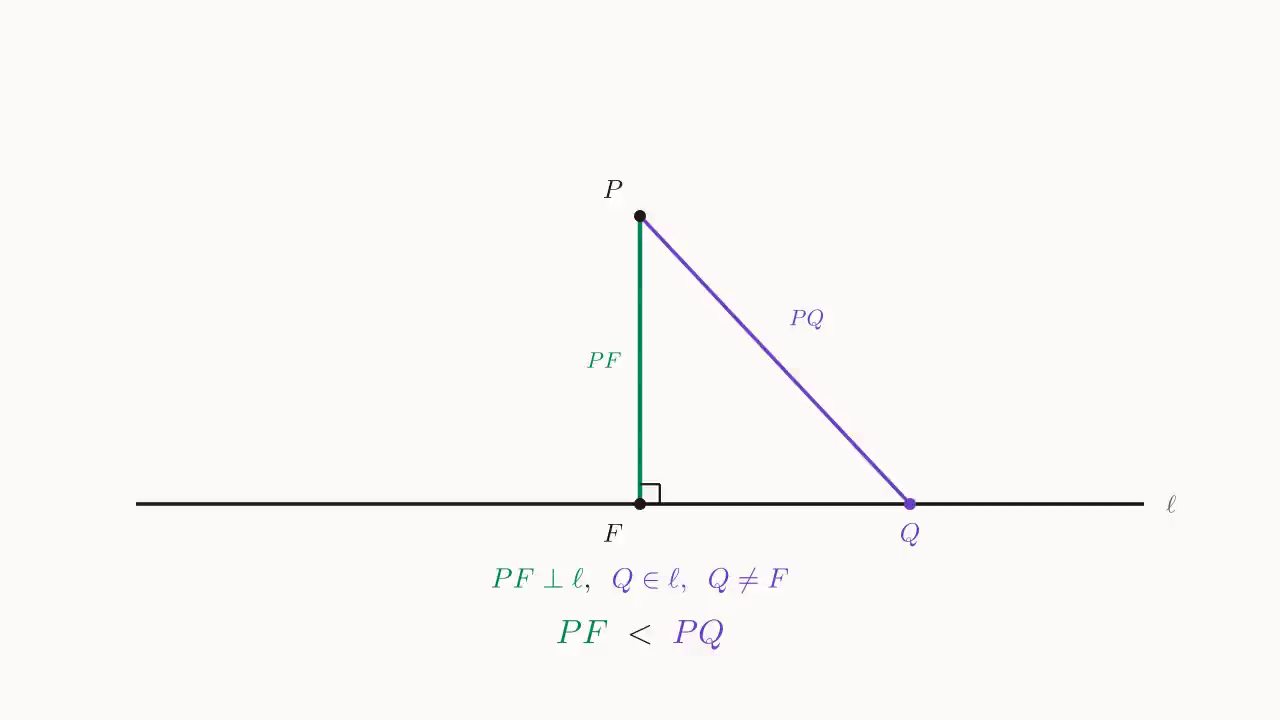
Let PP be a point not on a line \ell. Drop a perpendicular from PP to \ell with foot FF (existence and uniqueness guaranteed by perpendicular from a point). Then for any point QFQ\neq F on \ell,

PF<PQ.PF < PQ.

In other words: among all the segments from PP to points of \ell, the perpendicular segment PFPF is the shortest.

Perpendicular segment is shortest schematic: P is off \ell, PF \perp \ell at F; for any Q\neq F on \ell, PF < PQ

Proof

Examine the triangle PFQ\triangle PFQ. Since PFPF\perp\ell (by perpendicular from a point), PFQ=90\angle PFQ = 90^\circ.

Apply Exterior angle > either non-adjacent interior angle to PFQ\triangle PFQ: extending \ell beyond QQ produces an exterior angle, and we conclude that PQF\angle PQF must be strictly less than the exterior angle of a non-adjacent interior angle, hence PQF<90\angle PQF < 90^\circ; similarly FPQ<90\angle FPQ < 90^\circ. Thus

PFQ=90  >  PQF,PFQ=90  >  FPQ.\angle PFQ = 90^\circ\;>\;\angle PQF,\qquad \angle PFQ = 90^\circ\;>\;\angle FPQ.

Step 1: \angle PFQ = 90^\circ (by perp-from-point) + exterior-angle inequality ⇒ \angle P, \angle Q < 90^\circ

That is, F\angle F is the unique largest angle in PFQ\triangle PFQ. By Bigger angle ↔ longer opposite side (the side opposite the largest angle is the longest), and since the side opposite F\angle F is PQPQ, we have

PQ>PF.PQ > PF. \qquad\blacksquare

Step 2: \angle F = 90^\circ is the unique largest angle ⇒ by angle-side-inequality (larger angle opposite longer side), the opposite side PQ is the longest, hence PQ > PF

Immediate consequences

  • Definition of "distance from a point to a line": from now on we can define "the distance from point PP to line \ell" as PFPF — this is the infimum of the distances from PP to the points of \ell, and the infimum is attained (exactly when Q=FQ=F).

  • Unique minimum: PQPQ, viewed as a function of the position of QQ on \ell, is strictly monotonic on each of the two pieces split at FF — sliding QQ from FF to either side of \ell strictly increases the distance. This simultaneously gives "the distance-minimizing point is unique".

  • Downstream applications: the standard proof of tangent ⊥ radius (Tangent is perpendicular to the radius at the point of tangency) uses this theorem: if a line through a point TT on a circle is not perpendicular to the radius OTOT, then OO has a foot FF on that line with distance strictly less than OTOT, so the line crosses into the interior of the circle — and therefore must meet the circle at a second point, hence is not a tangent.

Remarks

The final step in the proof — the longest side is opposite the largest angle — uses another independent middle-school geometry theorem Bigger angle ↔ longer opposite side ("Bigger angle ↔ longer opposite side"), which has not yet been written in Principia (planned for Wave 3a). For now, this entry simply invokes Bigger angle ↔ longer opposite side as a known fact; once Bigger angle ↔ longer opposite side is online, it should be added to this entry's meta.yaml.deps so the DAG verifier can complete this edge.

Apart from this last step, the entire proof uses only Perpendicular from a point to a line exists and is unique (guaranteeing F=90\angle F = 90^\circ) and Exterior angle > either non-adjacent interior angle (guaranteeing the other two angles are strictly <90< 90^\circ); these two already pin down "F\angle F is the unique largest angle in PFQ\triangle PFQ" completely. In other words, the geometric core of "the perpendicular segment is shortest" is the exterior-angle inequality — the size relations are all in place, all that remains is the final step of translating "angle size" back to "side length".

Help me make this theorem better