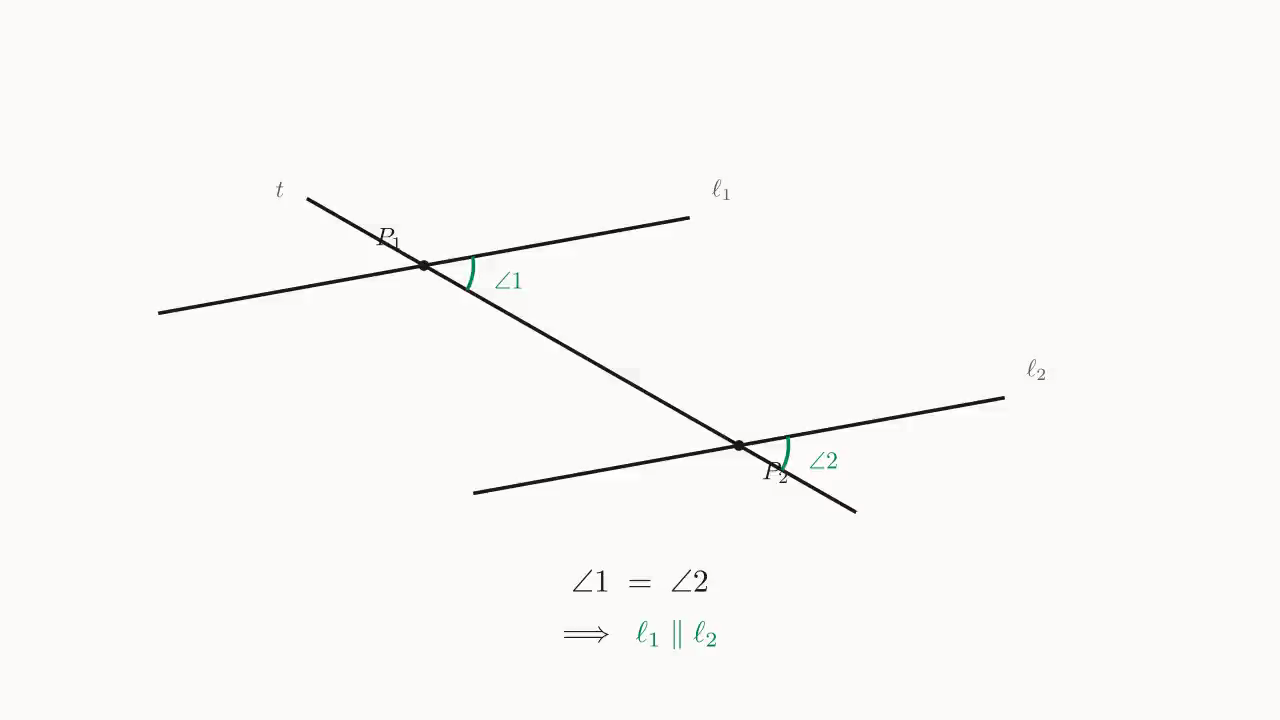
Equal corresponding angles ⇒ the two lines are parallel
Dependencies: Exterior angle > either non-adjacent interior angle (Euclid I.16, a result of neutral geometry); Protractor axiom (angle additivity).
Statement
Let line cut lines , at points , (). The angle at formed by and , together with the angle at formed by and in exactly the corresponding position (same side of , same side of the respective transversal line), is called a pair of corresponding angles, denoted , . The theorem asserts:
By Vertical angles are equal we immediately get Equal alternate angles ⇒ parallel and Co-interior angles supp. ⇒ parallel — the three are essentially the same statement.
Proof
By contradiction. Suppose ; then the two lines meet at some point , giving (, are not collinear with outside , so the three points are not collinear).
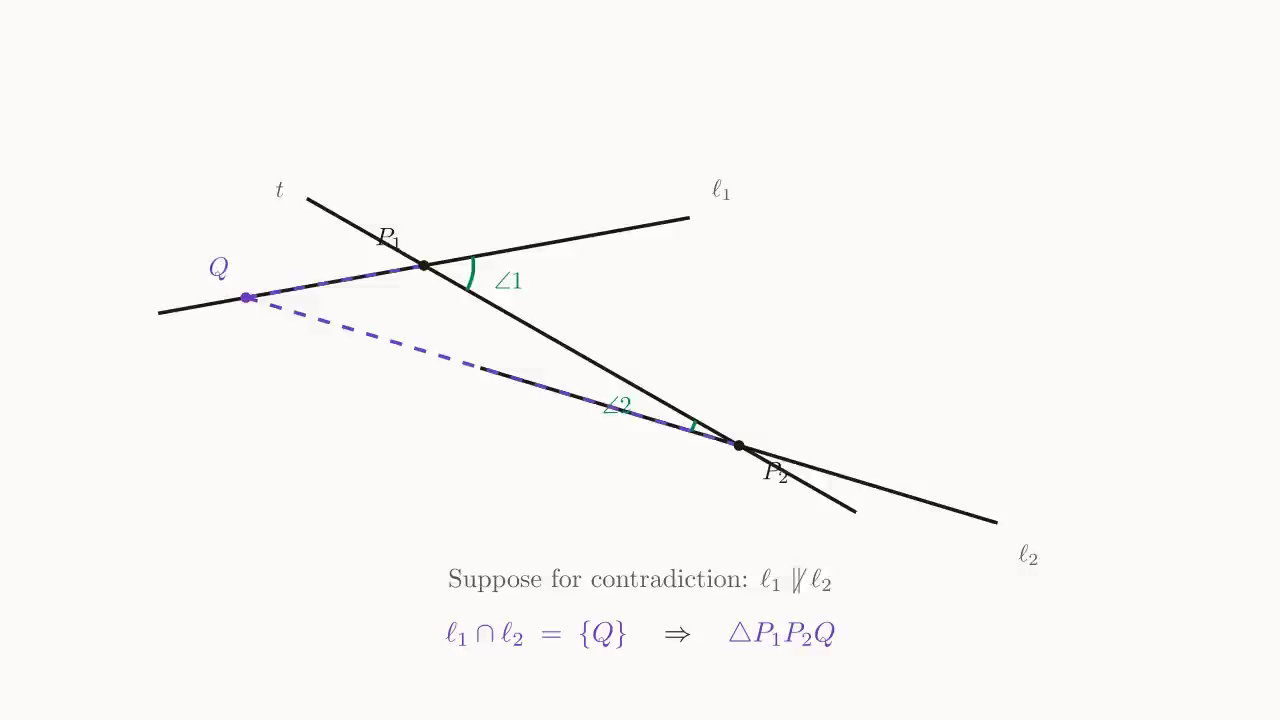
Without loss of generality, suppose lies on one side of , with , being the corresponding angles on the other side of . At , and the interior angle of the triangle form a linear pair (they piece together along into ), so is precisely the exterior angle of at (on one side of ). At , is the interior angle of the triangle itself — the non-adjacent interior angle to .
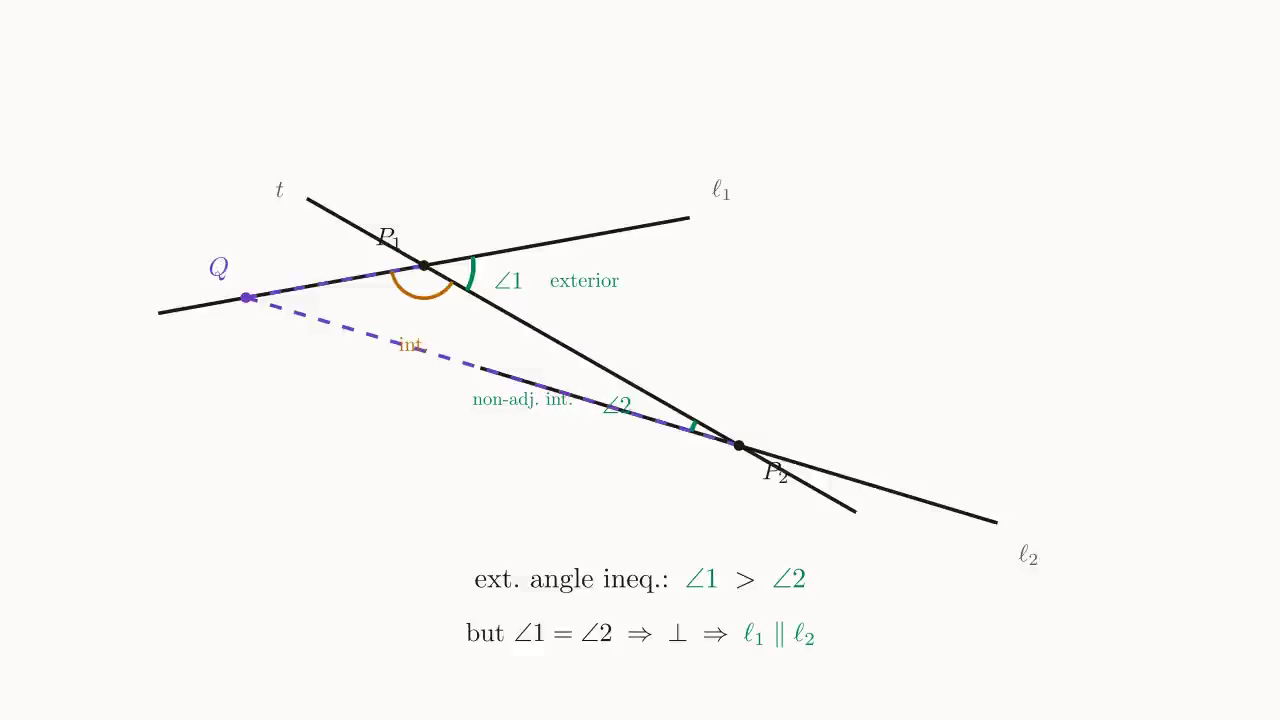
By the triangle exterior-angle inequality:
This contradicts the hypothesis . Hence .
Immediate consequences
- Alternate interior / co-interior angles: applying Vertical angles are equal once at flips to the other side, immediately giving "Equal alternate angles ⇒ parallel"; one more application of "linear-pair sum = " gives "Co-interior angles supp. ⇒ parallel".
- Drawing a parallel through a point off the line: given a line and a point not on , draw through , then draw through ; the corresponding angles formed by across and are both , so by this theorem — this gives the existence of parallel lines (without invoking the parallel postulate).
- Bridging forward and backward: this theorem is the upper limit of L2's "neutral geometry": going one step further (corresponding angles equal two lines parallel) requires the parallel postulate, the work of L3.
Remarks
This is "half" of Euclid I.28 — proving only the direction. The direction (Parallel ⇒ corresponding angles equal) is I.29, which must use the fifth postulate; the present section, together with Exterior angle > either non-adjacent interior angle and uniqueness of the perpendicular, all still belongs to "neutral geometry" — equally valid in hyperbolic geometry.
The pairing " is the exterior angle, is the non-adjacent interior angle" used in the proof depends on the positional definition of corresponding angles: same side of , same side of the respective transversal — if is on one side of , then the corresponding angles on the other side of are exactly the "exterior at / interior at " pairing. Switching to the other pair of corresponding angles (the one on 's side) swaps the roles in the proof; the conclusion is unchanged.