Co-interior angles supplementary ⇒ parallel
Dependencies: Corresponding/alternate angles ⇔ lines parallel, Linear pair sums to 180°.
Statement
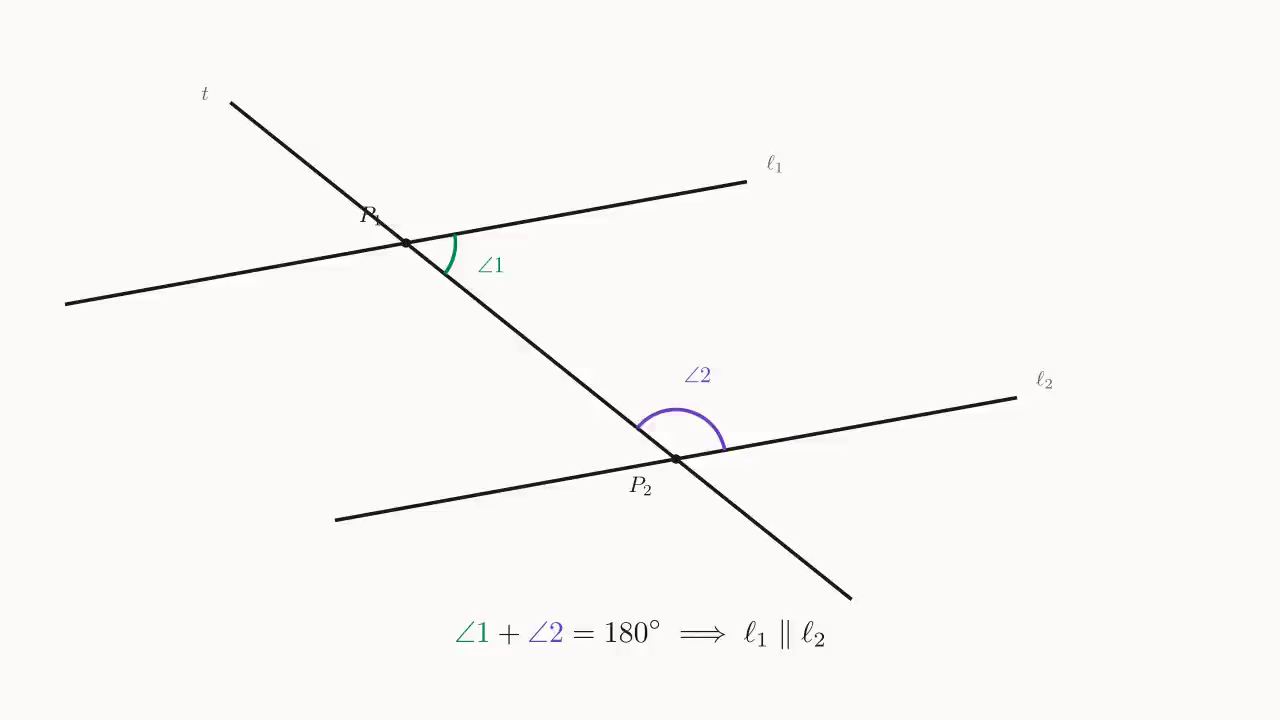
Let line cut lines , at points , (). On a single side of , the angle formed at by and , together with the angle formed at by and , is called a pair of co-interior angles — they lie between the two transversal lines, on the same side of . The theorem asserts:
Proof
We only need Linear pair sums to 180° and Corresponding/alternate angles ⇔ lines parallel. Flip along to the other side of , and it coincides with in the corresponding-angle position.
Step 1: at , flip along into the linear-pair angle .
At , let denote the angle that pairs with along to form a linear pair (it lies on the opposite side of ). By Linear pair sums to 180°:

Step 2: substitute the hypothesis to merge and into a corresponding-angles equality.
Substituting the hypothesis (i.e. ):
By the positional definition of "corresponding angles": lies on the side of opposite to and on the same side of as before; together with at (on the same side of and on the same side of its respective transversal line), they form precisely a pair of corresponding angles. Equal corresponding angles, by Corresponding/alternate angles ⇔ lines parallel, give .

Immediate consequences
-
The three criteria are essentially identical: Corresponding/alternate angles ⇔ lines parallel, Equal alternate angles ⇒ parallel, and co-interior angles supplementary ⇒ parallel all derive from one another by an algebraic shuffle of a linear pair / vertical angle at ; they characterize the same fact — "the angles cut on the two lines agree".
-
Perpendicularity and parallelism: if and , then , and the co-interior sum is exactly , so . This gives the most direct construction route for "drawing a parallel through an external point".
-
Bridging forward and backward: this section together with Corresponding/alternate angles ⇔ lines parallel belongs to "neutral geometry" — the direction holds in hyperbolic and elliptic geometry too; only the converse (Parallel ⇒ co-interior angles supp.) requires the parallel postulate.
Remarks
There is no "figure manipulation" in the proof — flipping to is just a single linear-pair algebraic step: . The whole technique is structurally identical to Vertical angles are equal — both arrange for to appear in two equations so that subtracting cancels it.
This conclusion is the other half of Euclid I.28: I.28 simultaneously proves "equal corresponding angles ⇒ parallel" and "co-interior angles supplementary ⇒ parallel". We hand the latter to the former, so that the triangle exterior-angle inequality, the "heavy weapon" of neutral geometry, is used only once — at Corresponding/alternate angles ⇔ lines parallel — while the other two criteria are derived from it by purely algebraic shuffling.