Equal alternate interior angles ⇒ the two lines are parallel
Dependencies: Corresponding/alternate angles ⇔ lines parallel, Vertical angles are equal.
Statement
Let line cut lines , at distinct points , . At , forms two angles with ; the angle at that lies on the opposite side of and on the opposite side of the transversal forms with the angle at a pair of alternate interior angles — denote them (at ) and (at ). The theorem asserts:
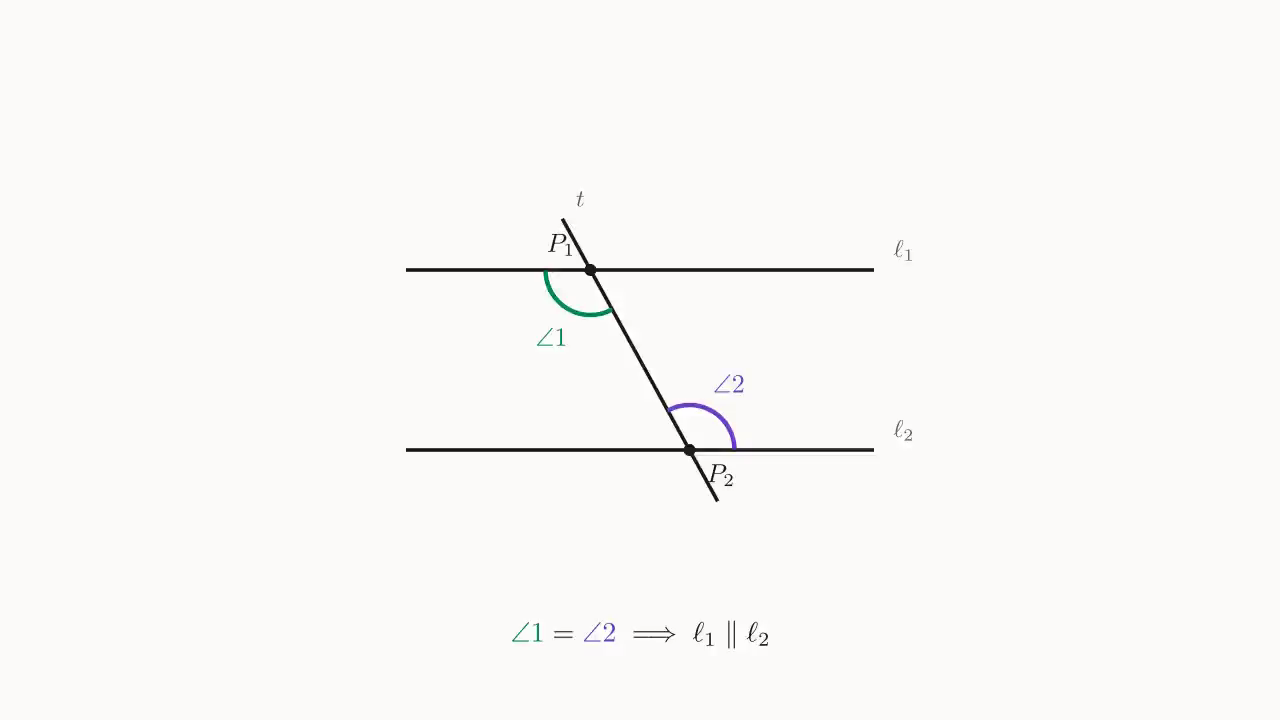
Proof
Step 1: At , flip into its vertical angle .
By Vertical angles are equal (Vertical angles are equal), equals the angle at obtained by extending both and to the opposite side:
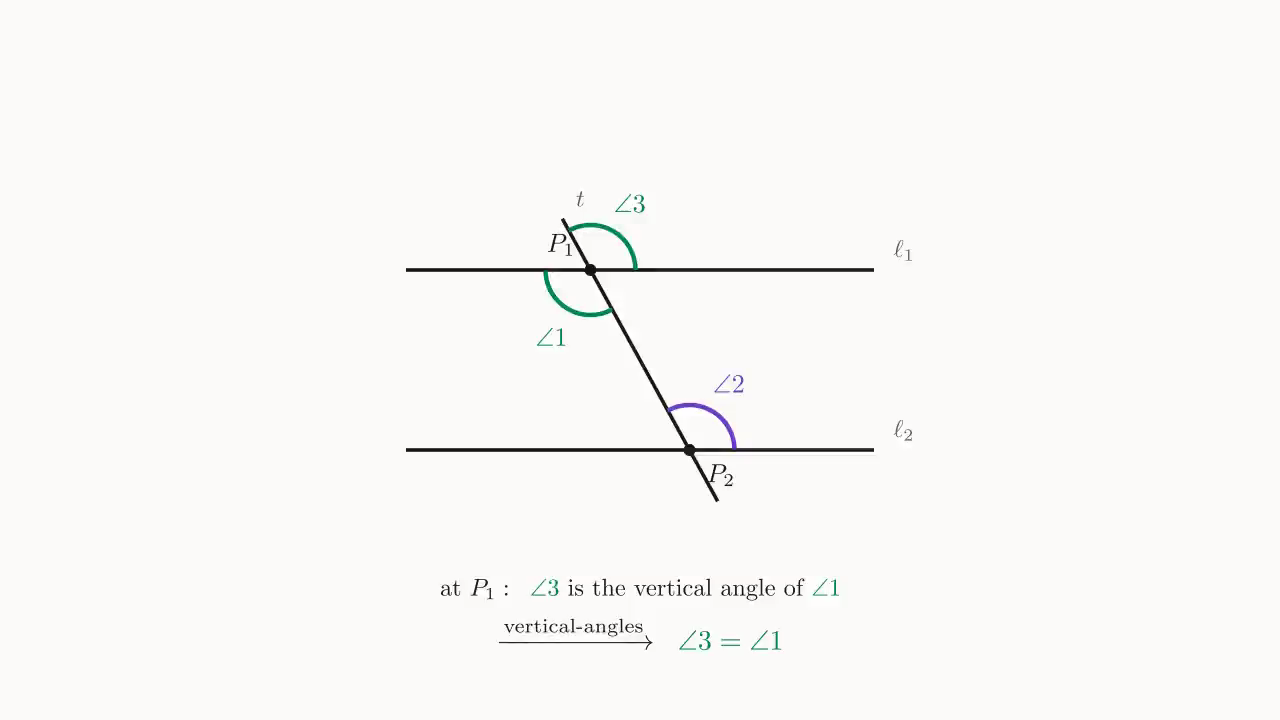
Step 2: and are now corresponding angles; invoke the corresponding-angles criterion for parallel lines.
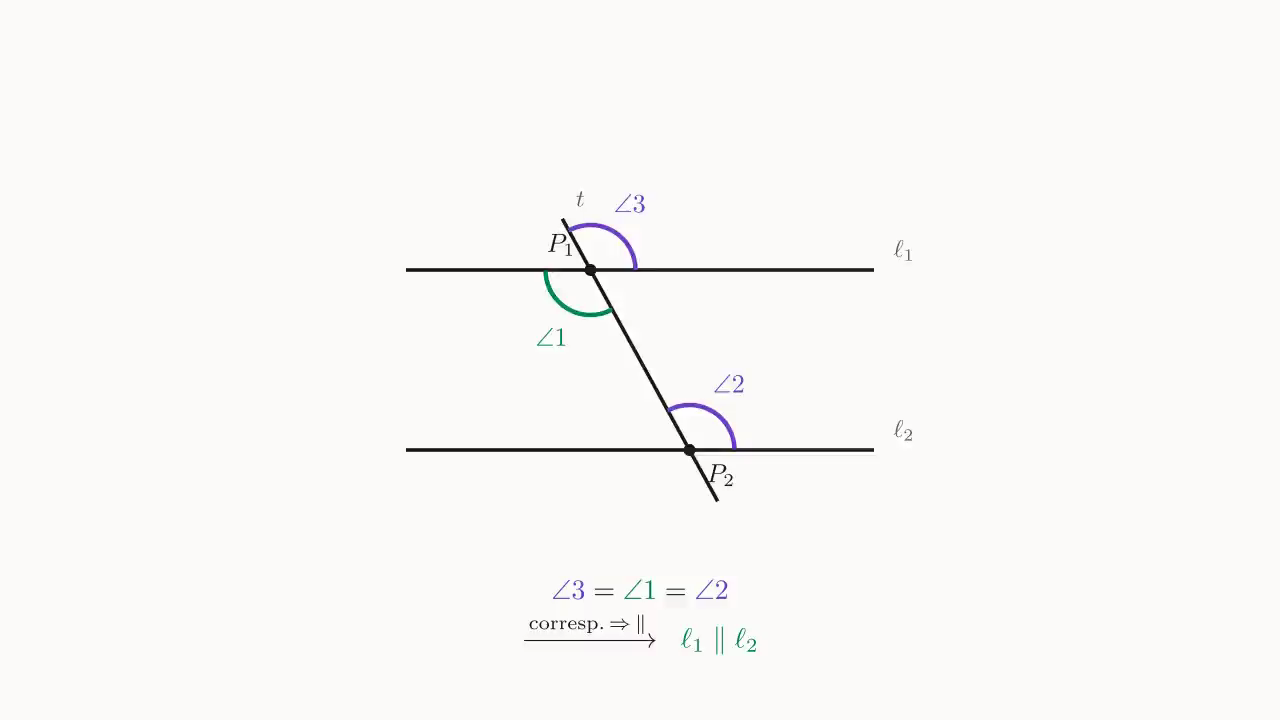
Note that now (at , on the "upper side of + right side of ") and (at , on the "upper side of + right side of ") sit in identical positions relative to the transversal and their respective lines — they are precisely a pair of corresponding angles. Combining the hypothesis with Step 1:
That is, the corresponding angles and are equal; by Corresponding/alternate angles ⇔ lines parallel (Corresponding/alternate angles ⇔ lines parallel) we conclude .
Immediate consequences
- Co-interior angles supp. ⇒ parallel: if the interior angles on the same side at and sum to , then by "linear-pair sum = " we may replace the interior angle at with its linear-pair partner — the latter forms with the interior angle at a pair of equal alternate interior angles, and the present theorem yields parallelism.
- "Z-shape" parallel test: drawing a Z (or reverse Z), the two horizontal strokes are crossed by the diagonal, with the angles in the "hooks" at top and bottom forming a pair of alternate interior angles; equality of these two angles locks the horizontal strokes parallel.
- Bridging forward and backward: together with Corresponding/alternate angles ⇔ lines parallel, the three (corresponding / alternate / co-interior) say the same thing — they convert into one another via a single Vertical angles are equal or Linear pair sums to 180°.
Remarks
The proof uses Vertical angles are equal only once: turn into , which is corresponding to , then invoke the previous theorem. The whole step is "position transform + known criterion" — no new geometric object is introduced.
This conclusion, along with corresponding angles ⇒ parallel and Co-interior angles supp. ⇒ parallel, still belongs to "neutral geometry" (no parallel postulate required). Its converse ( alternate interior angles equal) does require the fifth postulate, and is left to L3.