Butterfly theorem
Dependencies: Inscribed angles on same arc are equal; angle in a semicircle is right (inscribed angles on the same arc are equal), Opposite angles of a cyclic quadrilateral are supplementary (Opposite angles of a cyclic quadrilateral are supplementary), AA similarity (AA similarity), Intersecting chords: PA·PB = PC·PD (the "power" identity at an interior point), Perpendicular from a point to a line exists and is unique (perpendicular from a point + foot).
Statement
Let be a circle, a chord, and the midpoint of . Through , draw two arbitrary chords , (with endpoints on ). Let the two diagonals
meet at and respectively. Then also bisects :
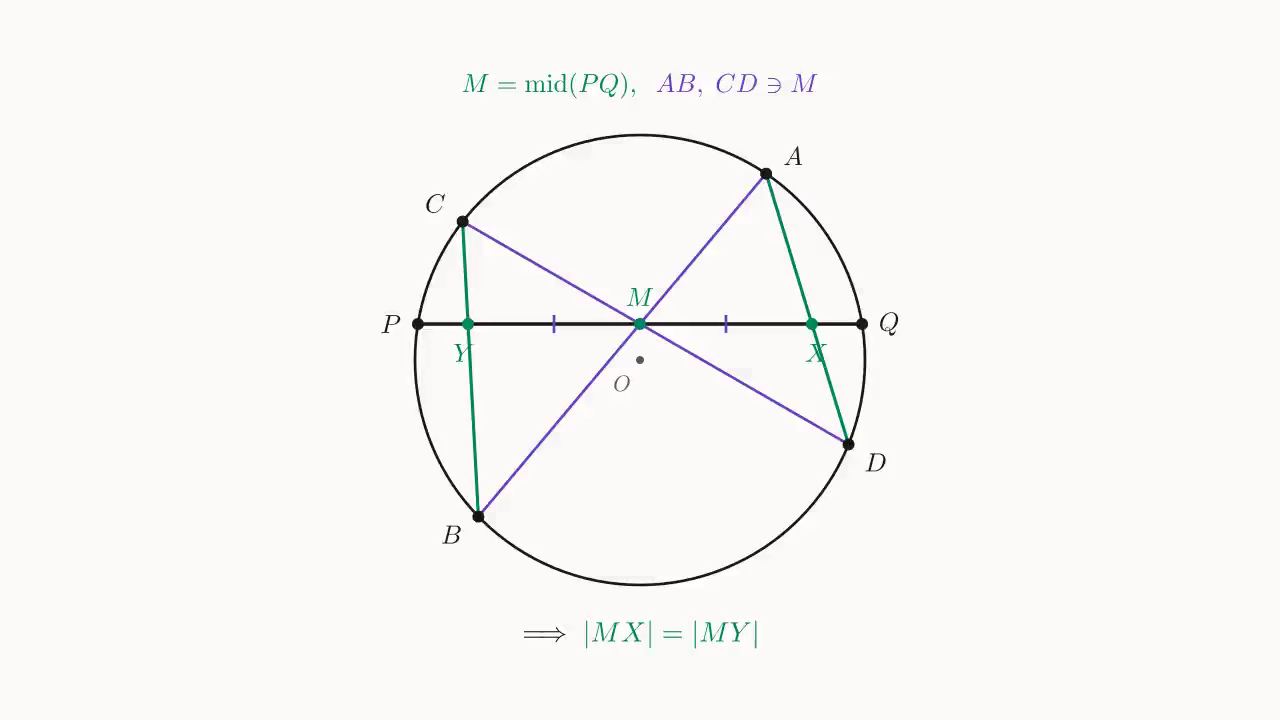
Commonly known as the butterfly theorem — together with , the four chords , , , form a figure resembling a butterfly with outstretched wings, and "the midpoint bisects the central rib " is its core symmetry.
Unlock the complete proofs forever
Matching GeoSnap, 10 foundational theorems are completely free. Unlock every other proof, animation, and consequence with one $10 purchase.
Sign in to unlock