PRINCIPIA · THEOREM
Reflection: axis ⊥ bisects each pair of corresponding points
Depends on: Perpendicular bisector ⇔ equidistant from endpoints, SSS congruence.
Statement
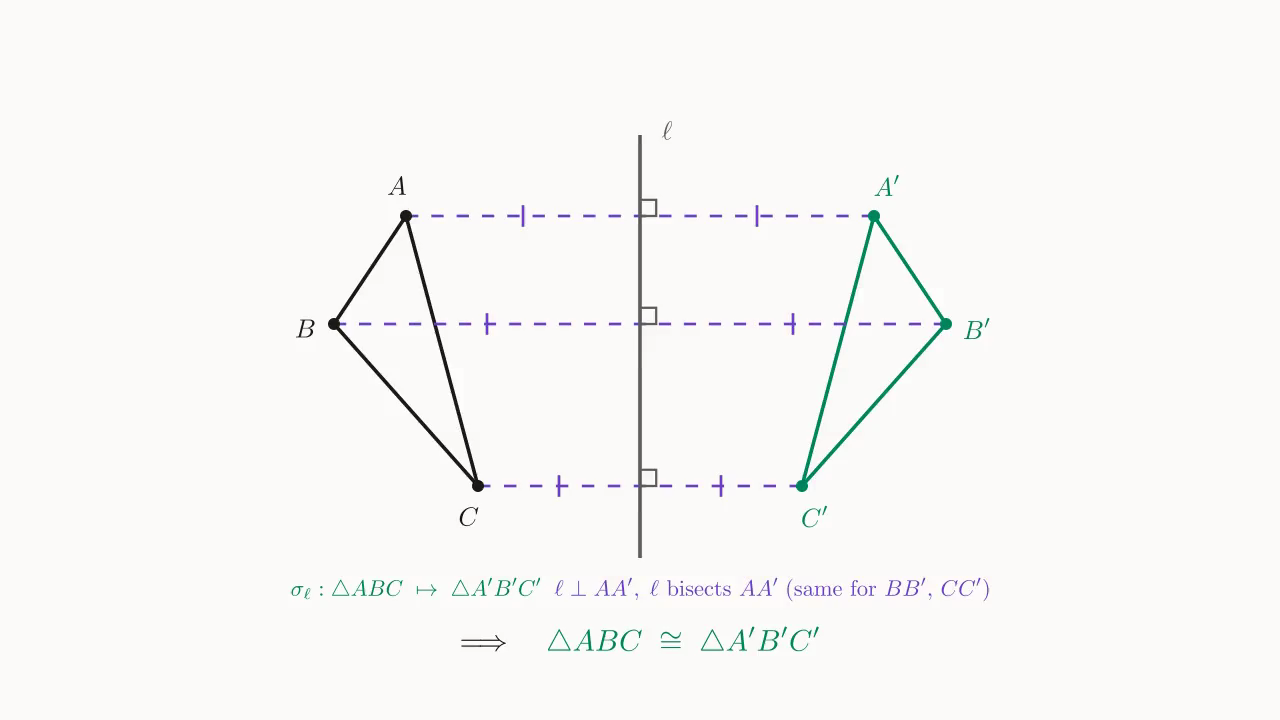
Let be a line in the plane, and denote by the reflection across : each point maps to such that is the perpendicular bisector of segment — this is the geometric definition of reflection.
Then preserves distances and angles: for any pair of points , and their images , ,
In other words, reflection is a congruence transformation — it carries each figure as a whole to the other side of , preserving lengths and angles.
10 foundational theorems free · one-time unlock for the rest
Unlock the complete proofs forever
Matching GeoSnap, 10 foundational theorems are completely free. Unlock every other proof, animation, and consequence with one $10 purchase.
Sign in to unlockHelp me make this theorem better