Composition of the three transformations = isometry
Dependencies: Perpendicular bisector ⇔ equidistant from endpoints (perpendicular bisector ⇔ equidistance), Translation properties, Rotation properties, Reflection properties, Point symmetry (the four "properties" theorems K.01–K.04).
Statement
Let be a map of the plane. If for every pair of points , ,
then is called an isometry (a distance-preserving map, a rigid motion). This theorem ties the abstract notion of "isometry" to the four concrete, constructible basic transformations in a single sentence:
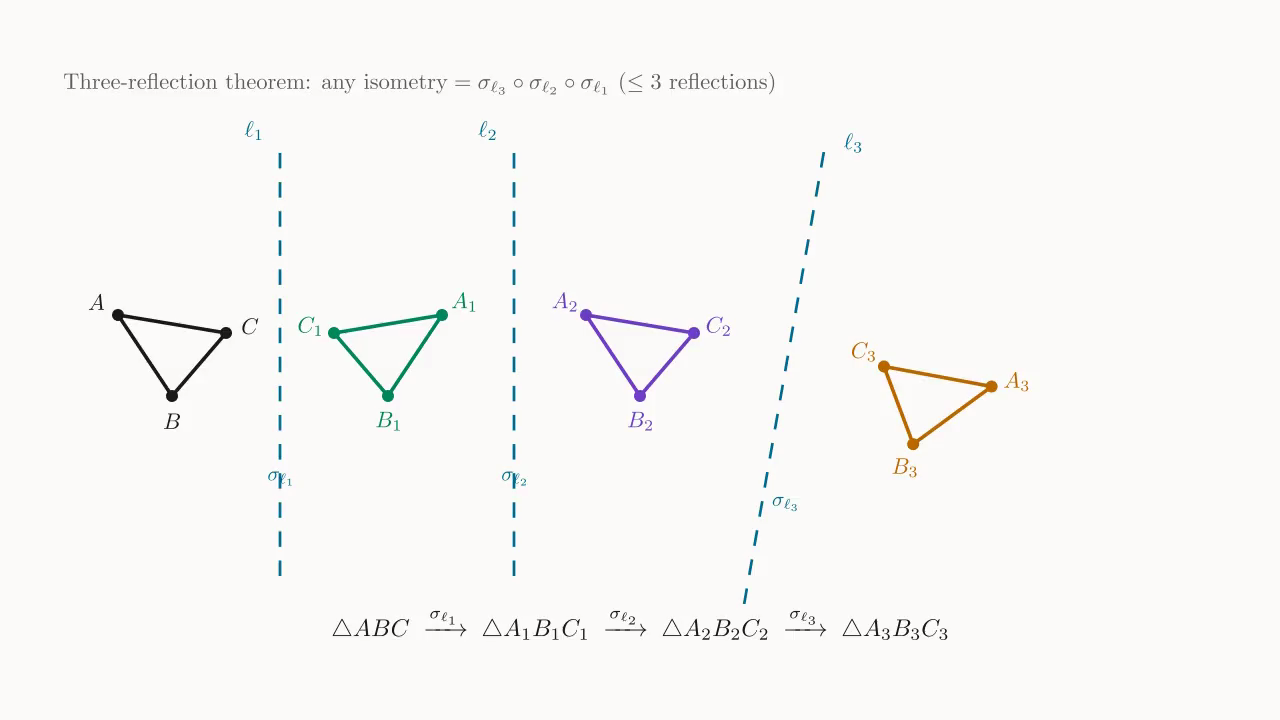
Translation, rotation, reflection (and any finite composition of these) = the planar isometries; every planar isometry can be written as the composition of at most reflections.
In particular, the isometry group is generated by all reflections, and every element is a product of at most three reflections.
Unlock the complete proofs forever
Matching GeoSnap, 10 foundational theorems are completely free. Unlock every other proof, animation, and consequence with one $10 purchase.
Sign in to unlock