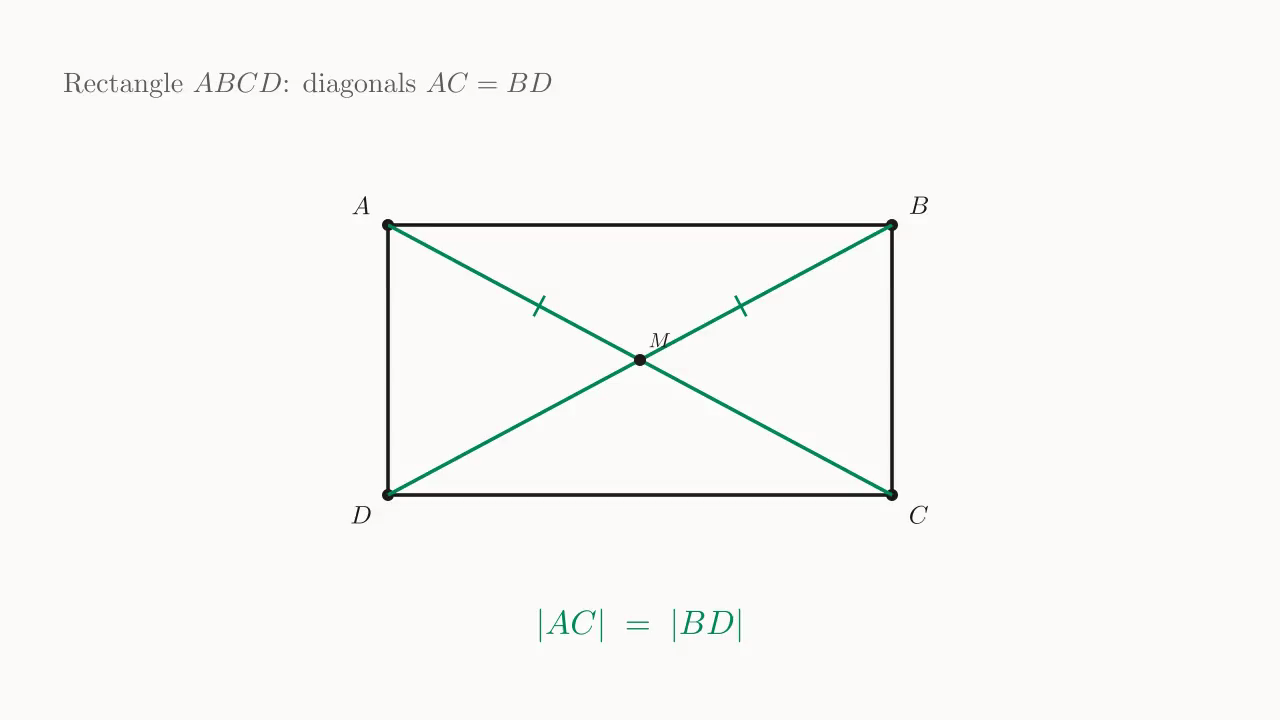
Rectangle: equal diagonals
Depends on: SAS congruence, Parallelogram properties (opposite sides equal, diagonals bisect each other) (opposite sides equal). The definition of a rectangle (four right angles) is invoked directly from its primitive definition.
Statement
Let be a rectangle, with vertices labelled in order (, , , going around the rectangle, with adjacent labels at adjacent vertices). Its two diagonals are and . Then the two diagonals have equal lengths:
By the definition of a rectangle, is simultaneously a parallelogram (two pairs of opposite sides parallel) and has all four interior angles equal to . These two facts are all the "extra information" used in the proof below.
Unlock the complete proofs forever
Matching GeoSnap, 10 foundational theorems are completely free. Unlock every other proof, animation, and consequence with one $10 purchase.
Sign in to unlock