Solving the right triangle
Dependencies: Definition of sin / cos / tan, Pythagorean theorem, Triangle interior angles sum to 180°.
Statement
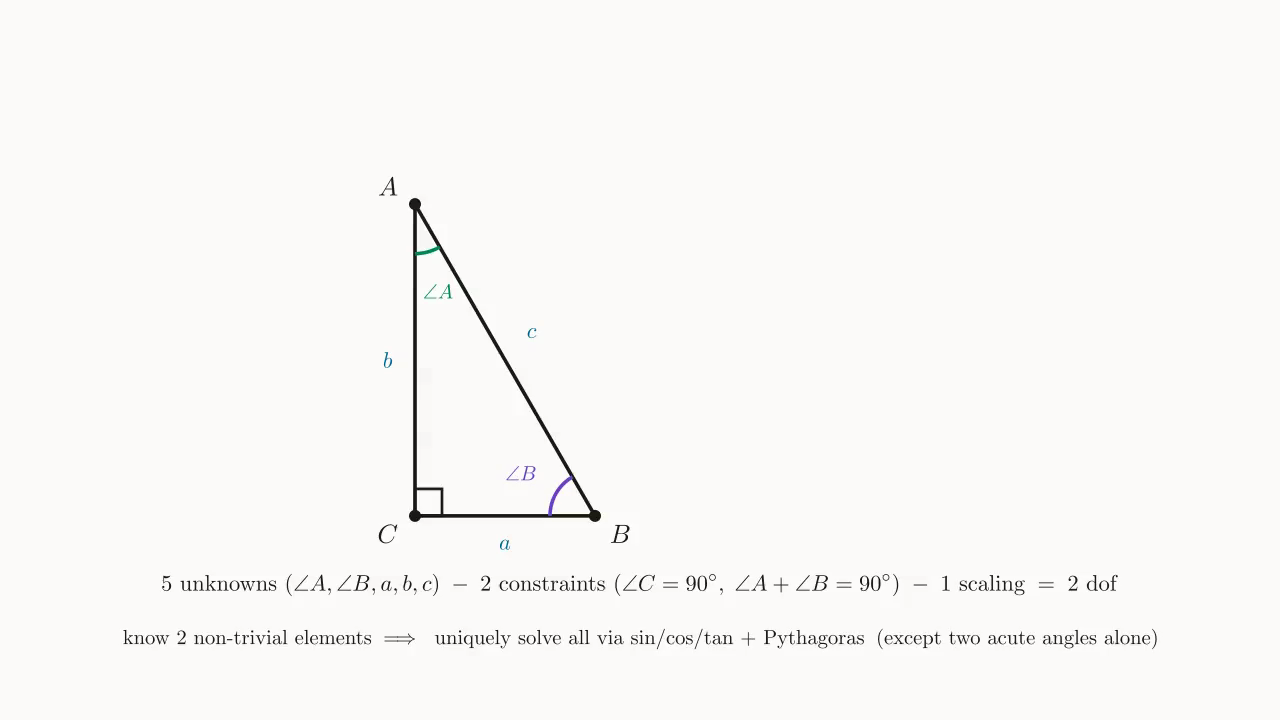
A right triangle () has 5 unknowns in total: two acute angles , and three sides (opposite ), (adjacent to ), (the hypotenuse). These 5 quantities are subject to two structural constraints:
After removing the two constraints, 3 free parameters remain; subtracting one more for the "overall similarity-scaling" degree of freedom leaves an effective degree of freedom equal to 2.
Conclusion. Specifying any 2 non-trivial elements — provided the 2 are not both acute angles — uniquely determines the remaining three quantities via Definition of sin / cos / tan and Pythagorean theorem. The three concrete branches:
- (a) One acute angle + one side: the other acute angle ; the remaining two sides come directly from , , .
- (b) Two sides: use Pythagorean theorem to find the third side, then read off the two acute angles via inverse trig functions.
- (c) Two acute angles: insufficient degrees of freedom (locks only the shape, not the size), unsolvable.
Unlock the complete proofs forever
Matching GeoSnap, 10 foundational theorems are completely free. Unlock every other proof, animation, and consequence with one $10 purchase.
Sign in to unlock