Menelaus's theorem
Dependencies: basic proportionality theorem (Basic proportionality (intercept theorem)), uniqueness of parallels (Through a point off a line, exactly one parallel exists (Playfair)).
Statement
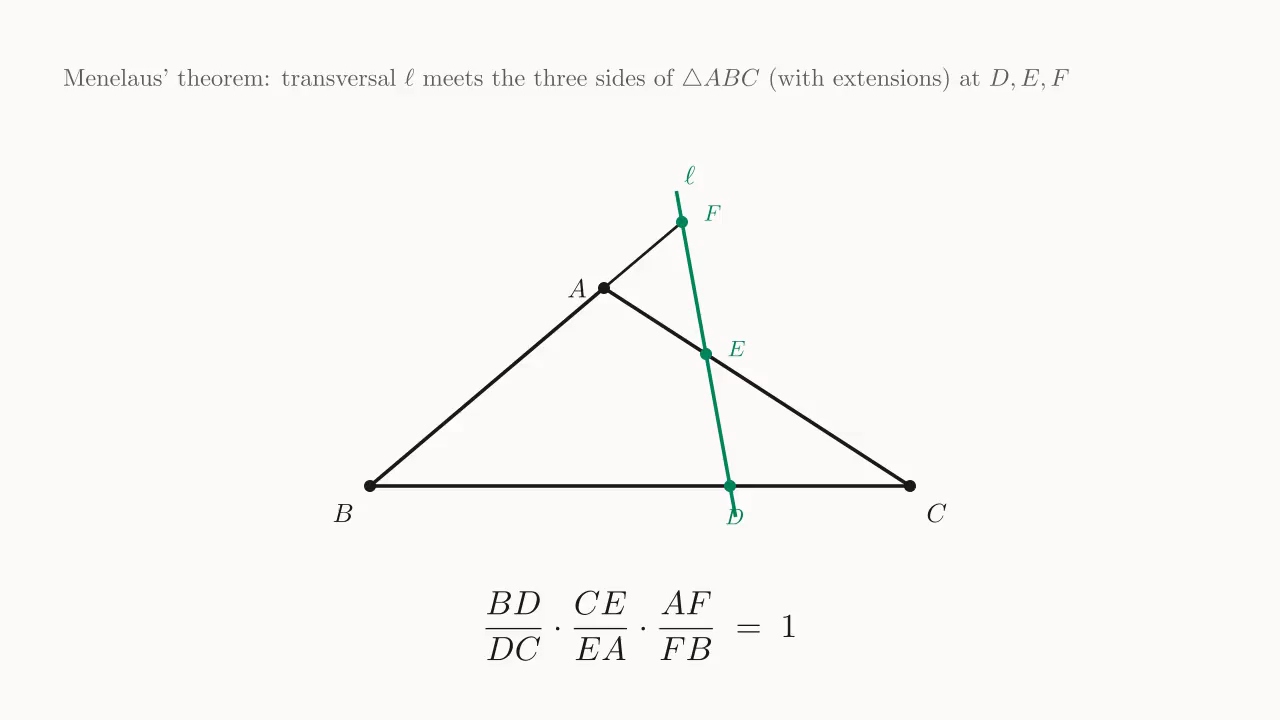
Let be given, and let a transversal meet the lines containing the three sides at points , , — concretely:
with the convention that at least one of , , lies on a side's extension (otherwise cannot both pass through the triangle and meet the interiors of all three sides). Then the product of the three division ratios equals (unsigned):
Using signed ratios (taking signs along a fixed direction), the product equals — exactly the "dual" of the given by Ceva's theorem for the concurrent case.
Unlock the complete proofs forever
Matching GeoSnap, 10 foundational theorems are completely free. Unlock every other proof, animation, and consequence with one $10 purchase.
Sign in to unlock