Power of a Point
For any point in the plane, the "power" with respect to a fixed circle is an invariant; the product of the two segments cut by any chord (or tangent / secant) through equals the absolute value of .
Power of a Point — unifies "chord / secant / tangent through a fixed point" into a single product identity.
Definition of the power
For any point in the plane and a fixed circle (radius ), define the power of with respect to as
- outside the circle ⇒
- on the circle ⇒
- inside the circle ⇒
The absolute value of the power has a clean geometric meaning — it is exactly the "product of the two segments cut on any chord / secant / tangent through ".
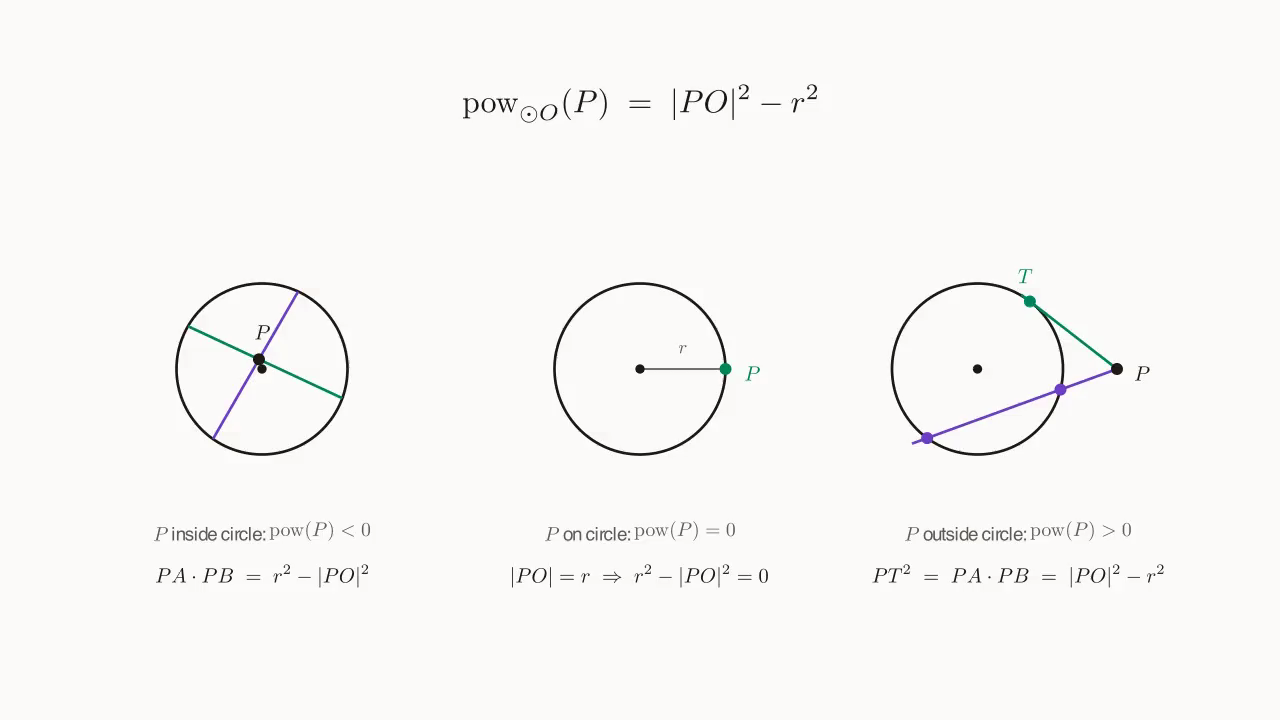
Three configurations (one theorem, three geometric guises)
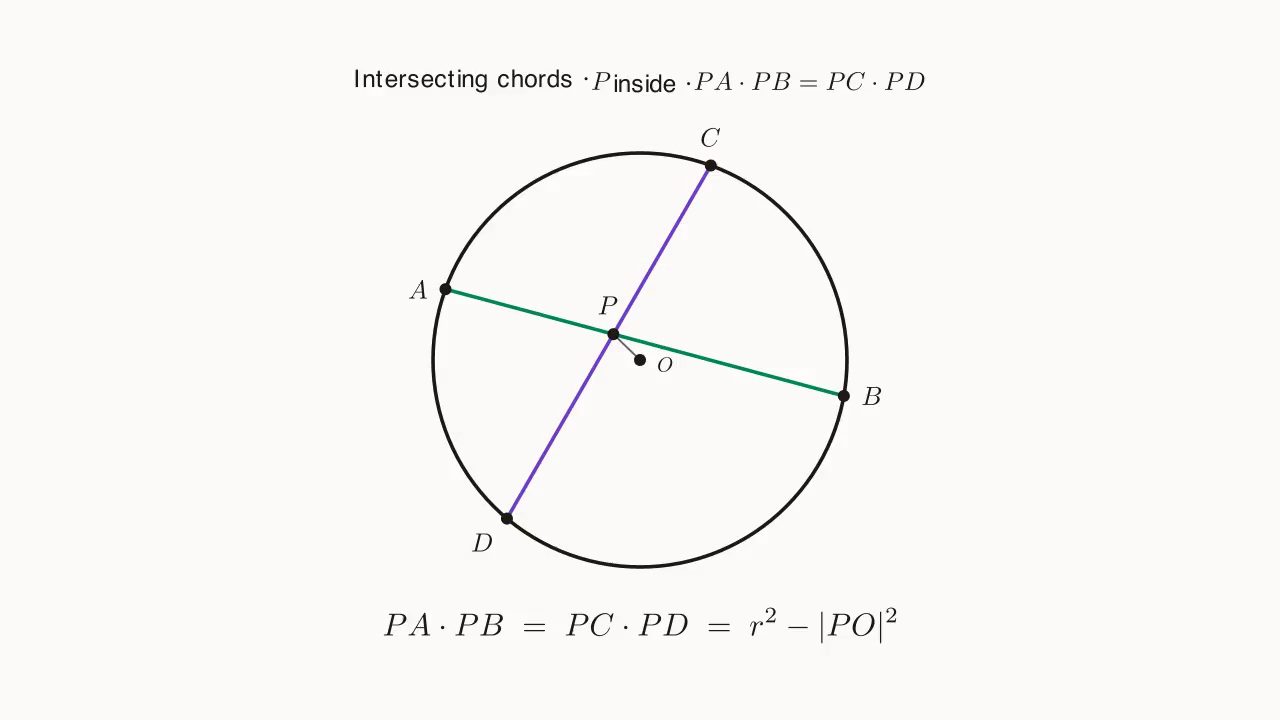
Configuration 1 · Intersecting chords ( inside)
Chord and chord meet at an interior point :
Proof in Intersecting chords: PA·PB = PC·PD — draw auxiliary chords ; vertical angles + same-arc inscribed angles ⇒ ⇒ ratio ⇒ equal products.
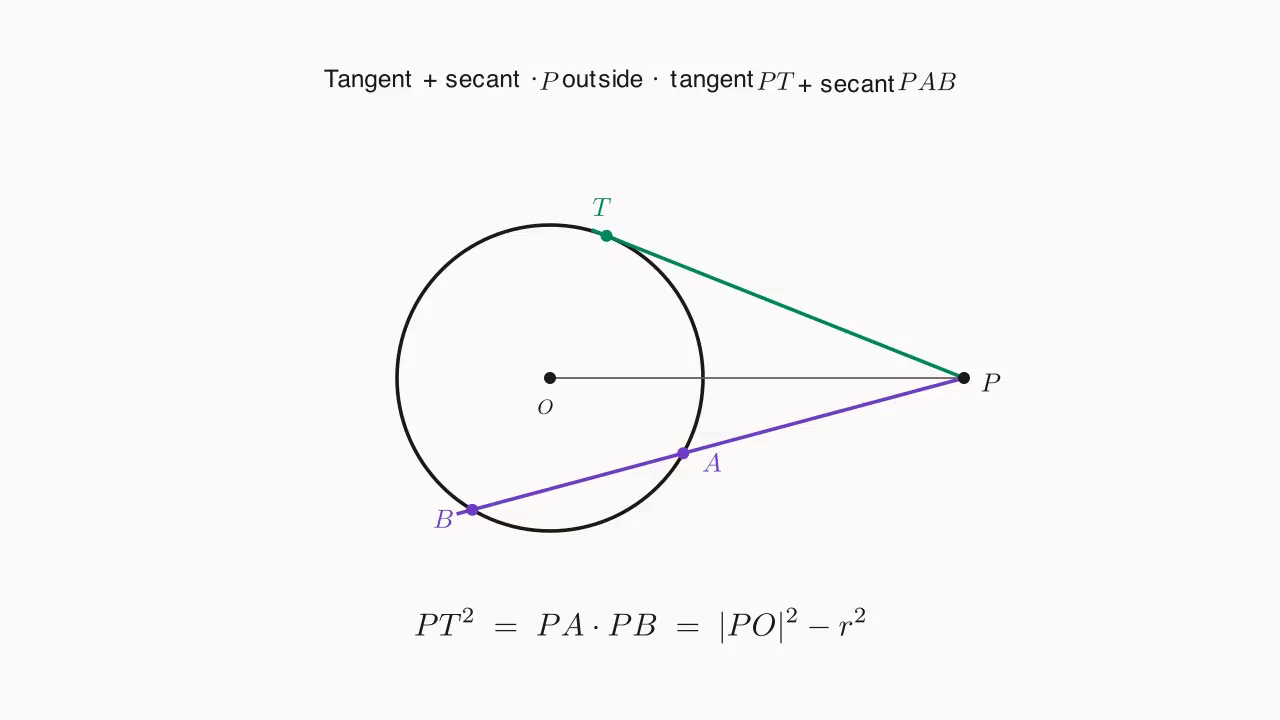
Configuration 2 · Tangent + secant ( outside)
From draw a tangent (touching at ) and a secant (cutting at ):
Proof in Secant–tangent: tangent² = secant·external — tangent-chord angle + shared angle ⇒ ⇒ .
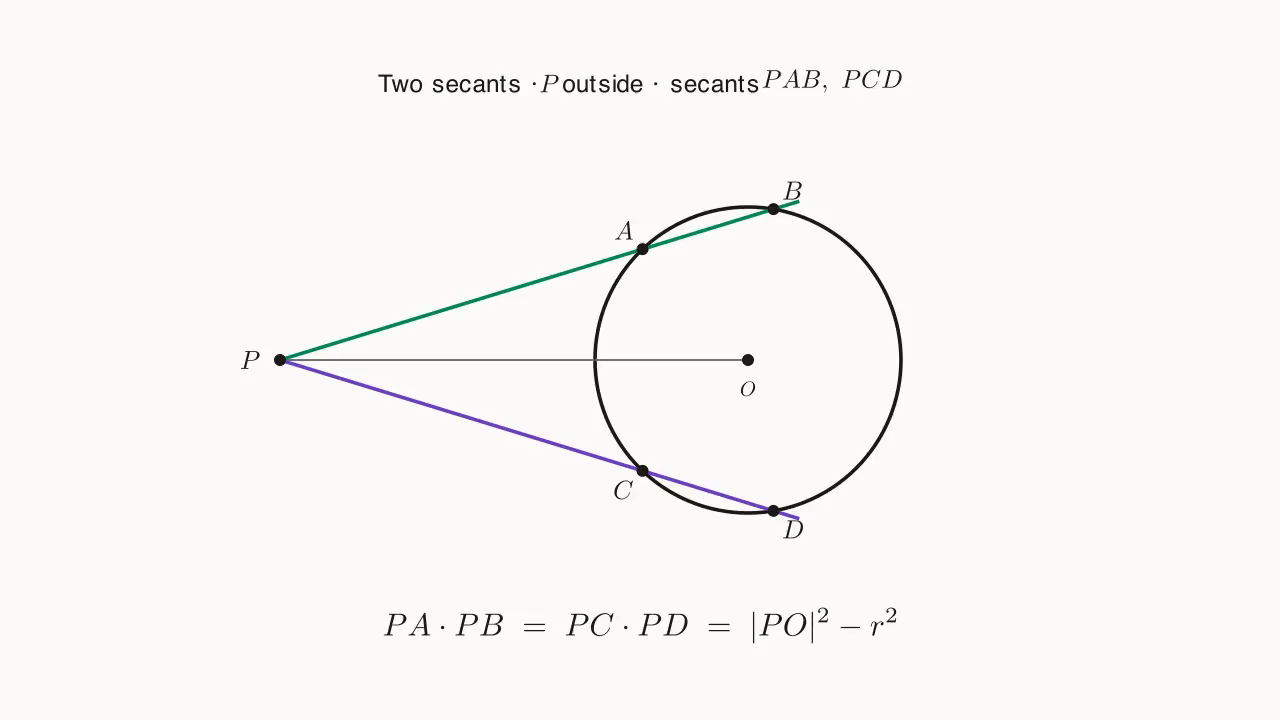
Configuration 3 · Two secants ( outside)
From draw two secants and :
Proof in Two-secants product equality — same structure as the intersecting-chords version, with vertical angles replaced by a shared angle.
How to recognize / when to use
- The problem has two chords or secants through a common point and asks about a product of lengths or one unknown length → think Power of a Point
- The problem has a tangent + secant sharing an endpoint → use directly
- Finding the extremum of a product on a moving chord through a fixed external point → the power is constant, independent of how the chord rotates
- Converse: given in the same configuration, the converse of this theorem proves the four points are concyclic.
Applications
To be added.
Related
- Intersecting chords: PA·PB = PC·PD / Secant–tangent: tangent² = secant·external / Two-secants product equality — rigorous proofs of the three configurations
- Tangent–chord angle = inscribed — the core lemma for the tangent-secant configuration
- AA similarity — the shared termination point of all three configurations' reasoning
- Miller's theorem — uses to locate the tangent point of the max-angle circle