Miller's theorem
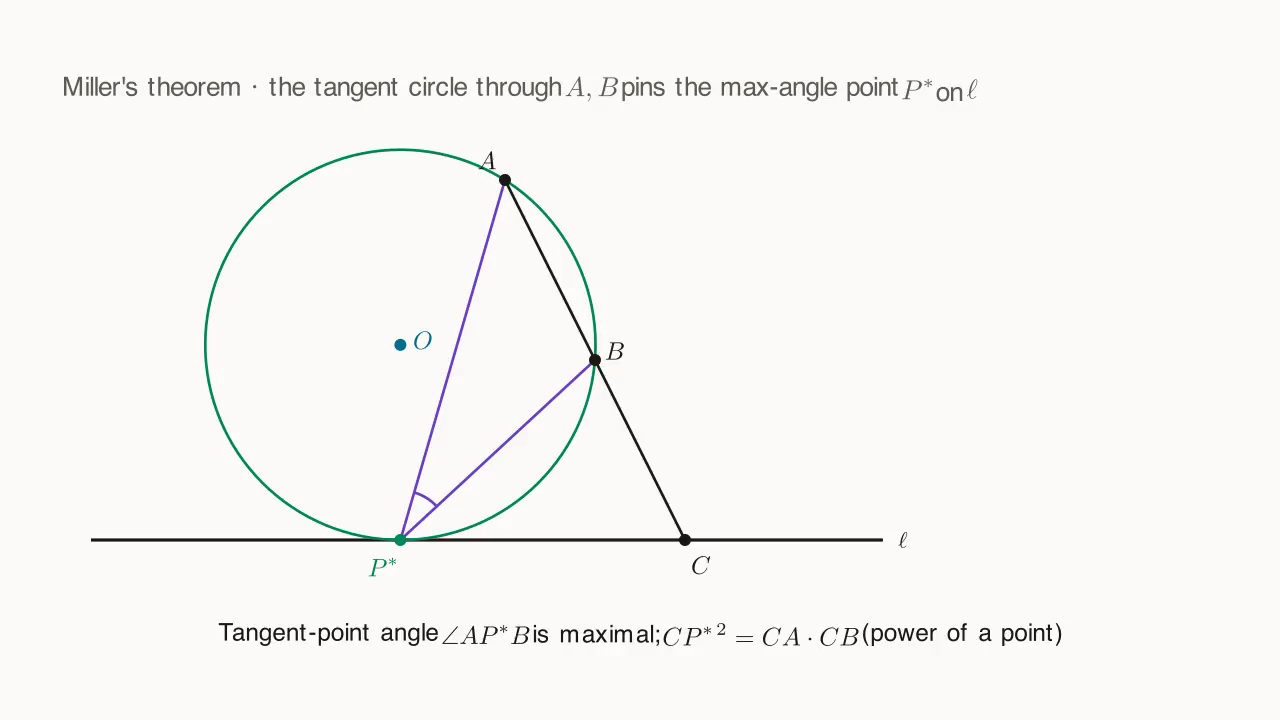
For two fixed points on the same side of a line with a moving point , the maximum of is attained at the tangent point of the circle through that is tangent to .
Miller's theorem (Regiomontanus's problem) — the classical solution to the "maximum viewing angle" problem.
Universal form
Classical model
- Moving point : on a line
- Fixed points : two fixed points on the same side of
- Key constraint: must be on the same side of ; on opposite sides there is no maximum (the angle is already at the intersection of with — a degenerate case)
Historically posed by the German mathematician Johannes Müller (latinised as Regiomontanus, 1471) and one of the earliest extremal-geometry problems in the literature.
Conclusion
Draw the circle through tangent to — there are two such circles; pick the one on the same side as . Let be the tangent point. Then is the maximum viewing angle, and
The tangent-point location follows from [[power-of-a-point]]: if meets line at (i.e. the extension of crosses ), then
Proof (same-arc inscribed angle + triangle exterior angle)
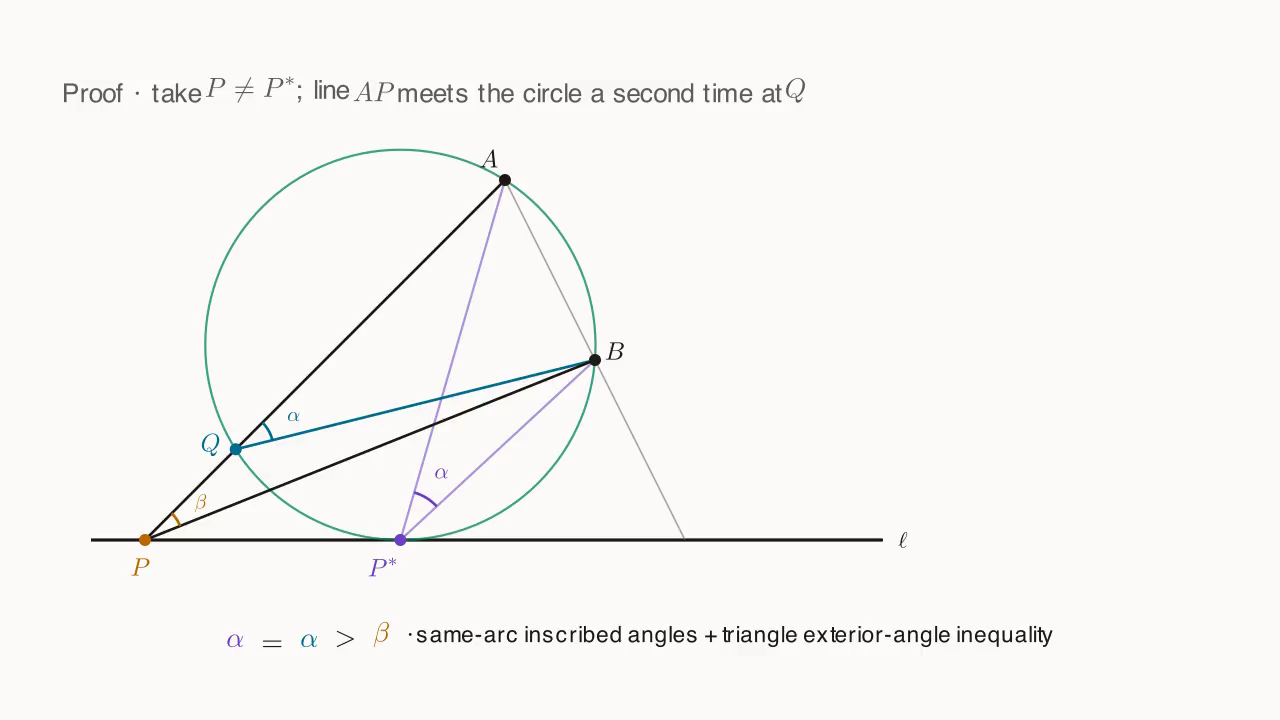
Take any non-tangent on (); we show .
Step 1 · Construct the secant. Let line meet circle a second time at (since is tangent to at , it meets the circle only at ; for , the line through and must meet the circle a second time).
Step 2 · Same-arc inscribed angles. In , the inscribed angles and subtend the same chord (since lie on on the same side as ). By Inscribed angles on same arc are equal; angle in a semicircle is right:
Step 3 · Triangle exterior angle. In , is the exterior angle at vertex (with collinear; depending on the configuration lies between and or between and , but in both cases the exterior-angle inequality Exterior angle > either non-adjacent interior angle gives the same conclusion):
Step 4 · Chain them together.
Since was arbitrary, gives the unique maximum viewing angle.
Geometric intuition
Think of "the angle at which sees " as "the inscribed angle at when lies on some circle through ". Larger angle ⇔ smaller-radius circle ⇔ the circle hugs closer to . The moment the circle is tangent to , hugging any tighter would push the circle across , and a larger angle's circle simply does not meet — so the tangent circle's angle is the supremum, attained at the tangent point.
When to use / mnemonic
- "Find a point on some line that maximizes the angle at which sees two fixed points" → Miller's theorem
- "Baseline + two observation points (e.g. base + top of a statue), find the best viewing spot" → real-world Miller
- Note the distinction: if are on opposite sides of , no maximum exists (the angle hits at the intersection of with — degenerate).
- If the moving point lies on a circle instead of a line, the problem is still about inscribed angles on the same arc, but the Miller construction no longer applies — just use Inscribed angles on same arc are equal; angle in a semicircle is right to compare directly.
Applications
To be added.
Related
- Inscribed angles on same arc are equal; angle in a semicircle is right — same-arc inscribed angles, the core of the proof
- Exterior angle > either non-adjacent interior angle — triangle exterior-angle inequality
- [[power-of-a-point]] — pinpoints the tangent point via
- Hidden circle — the more general "fixed chord + fixed angle ⇒ circle" model