Hidden circle
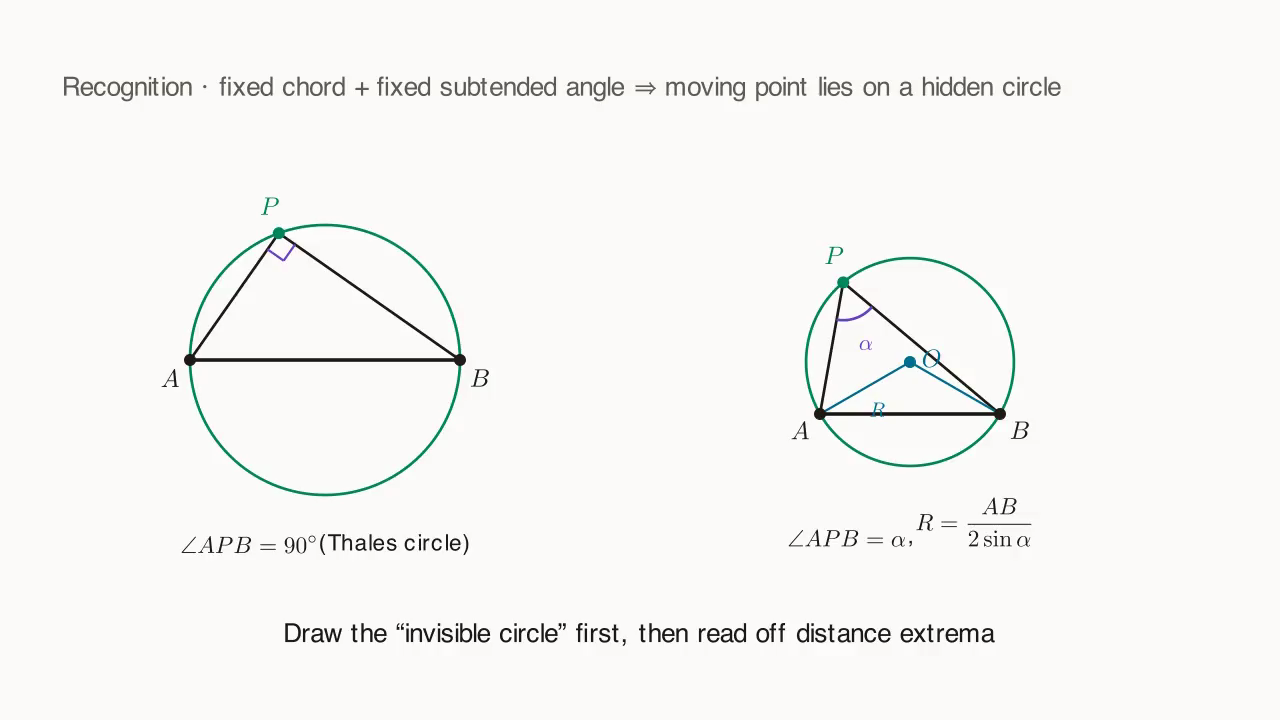
When a moving point sees a fixed chord at a fixed angle (90° included), the locus of is a fixed circle — draw the "invisible" circle, and distance extrema reduce to "moving point on a circle to a fixed point (or line)".
Hidden circle — a circle the problem never draws, but a moving point silently traces. Spot it and an "angle constraint" turns into a "circle constraint" — the solution path snaps into focus.
Core recognition
A moving point + a fixed chord (two fixed points) + has a fixed value lies on a fixed circle.
| Inscribed angle | Locus circle |
|---|---|
| Circle with as diameter (immediate from Thales converse) | |
| (any fixed angle) | Circle with as chord and radius (inscribed-angle theorem, Central angle is twice the inscribed angle on the same arc) |
| acute / obtuse | stays on one side of ; acute → major-arc side, obtuse → minor-arc side |
The two standard triggers
Trigger 1 · Thales ()
The problem says: "the moving point is the right-angle vertex of some right triangle, and the two endpoints of the right-angle legs are fixed" → lies on the circle with the hypotenuse as diameter.
The proof is Thales converse — by the right-triangle median to the hypotenuse (Right triangle: median to hypotenuse = half hypotenuse), 's distance to the midpoint of the hypotenuse is constant, so lies on the circle centred at that midpoint with radius half the hypotenuse.
Trigger 2 · Inscribed angle ( fixed)
The problem says: "the moving point sees a fixed chord at a fixed angle " → lies on a circle with as chord and radius .
The proof is the converse of Inscribed angles on same arc are equal; angle in a semicircle is right — inscribed angles on the same arc are equal; conversely, if angles subtended by a common chord are equal then the vertices lie on the same arc.
Special-angle table:
| (degenerates to Thales) | |
Usage (recognise → draw circle → read off the extremum)
A hidden circle usually shows up in a two-step chain:
-
Step 1: identify "angle constraint" as "the locus is a circle" — draw the hidden circle , mark its centre and radius ;
-
Step 2: read "distance from to a third point (or line )" off the circle :
- a fixed point: , (equality when are collinear)
- a fixed line: , (equality where the perpendicular from meets the circle)
When to use / mnemonic
- "Moving point + fixed chord + fixed-value subtended angle" ⇒ draw a hidden circle immediately
- "Moving point is the right-angle vertex of some right triangle with fixed leg endpoints" ⇒ hidden circle (Thales variant)
- Compound recognition: the problem disguises the fixed angle as "two fixed leg lengths + a fixed third side + law of cosines gives the included angle" → compute the angle, then apply the same template
- Reverse use: given that a moving point lies on a known circle, prove some angle is constant → equal inscribed angles on the same arc hand it to you (see Inscribed angles on same arc are equal; angle in a semicircle is right)
Pitfalls
- Same-side vs opposite-side branches: the same fixed chord + same fixed angle correspond to two arcs (one on each side of the chord). Which arc lives on is locked by other constraints in the problem; forgetting the distinction yields a "ghost extremum" from the symmetric solution.
- Range of the subtended angle: acute → major-arc side; obtuse → minor-arc side; degenerates to the whole circle on diameter (minus the endpoints ).
- Spotting that the subtended angle is constant: the problem rarely says so explicitly. Common disguises: fixed side ratios + law of cosines, baked-in figures (square / rectangle vertices give right angles), or the equal base angles of an isosceles triangle after an auxiliary construction.
- Radius formula only holds when the angle is constant: if varies with , the locus is not a circle — do not apply the formula.
Applications
To be added.
Related
- Thales: angle on a diameter = 90° / Thales converse — the standard trigger
- Central angle is twice the inscribed angle on the same arc / Inscribed angles on same arc are equal; angle in a semicircle is right — the inscribed-angle basis for general (radius formula + equal angles on the same arc)
- Right triangle: median to hypotenuse = half hypotenuse — equivalent formulation of the Thales variant
- [[miller-theorem]] — extremal use of the hidden circle (maximum viewing angle)
- Melon-and-bean (spiral similarity) — "follower point also lies on a hidden circle" — locus-transfer variant of the hidden circle