Melon-and-bean (spiral similarity)
Two similar (not necessarily congruent) triangles sharing a vertex give a spiral similarity — a composite of rotation by and dilation by centred at the shared vertex. The two "hand" segments satisfy with the angle between them equal to ; the locus of a moving point retains its shape under this transformation ("plant melons, harvest melons").
When to use
- Two triangles sharing a vertex with unequal leg lengths — one weaker hypothesis than [[hand-in-hand]] (which requires isosceles)
- The problem says "rotate by about fixed point while scaling by " — this is the canonical language of spiral similarity
- A moving point yields a moving point via "rotate + scale" about a fixed point ; find the locus of (same shape as 's)
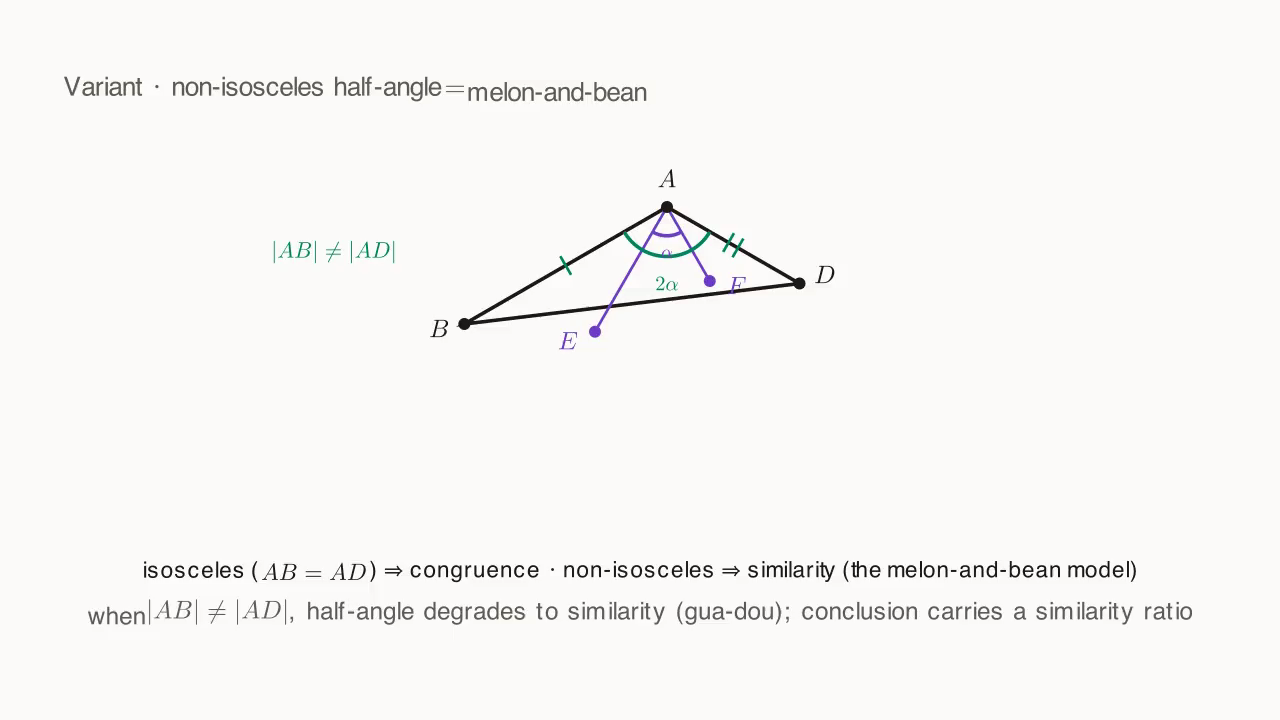
- The half-angle model on a non-isosceles triangle ([[half-angle]] requires ; without that, congruence degrades to similarity)
- The rotational view of "K-shape similarity" ([[one-line-three-equal-angles]])
Core move
Shared vertex + shared apex angle + matching leg ratios = a similar pair of "hands". Rotation angle shared apex angle ; scaling ratio ratio of adjacent leg lengths; the locus shape of determines the locus shape of ("plant melons, harvest melons; plant beans, harvest beans" — guā dòu in Chinese).
Construction
Let (sharing vertex , , ), with scale :
- Common-angle addition / subtraction:
- Rearrange the ratio: from get ("swap means and extremes")
- SAS similarity: (matching ratio of sides + matching angle), with ratio
- Read the conclusion:
- "Hand"-segment ratio: (no longer equal lengths, but proportional)
- Angle between "hands": the angle between and equals (same as the shared apex angle — consistent with [[hand-in-hand]])
Why it works
The spiral similarity "rotate by about , scale by " is a composite transformation: rotation + dilation. It sends and simultaneously . The transformation preserves:
- Angles: the angle between any two segments is unchanged
- Ratios: the ratio of any two segment lengths is unchanged
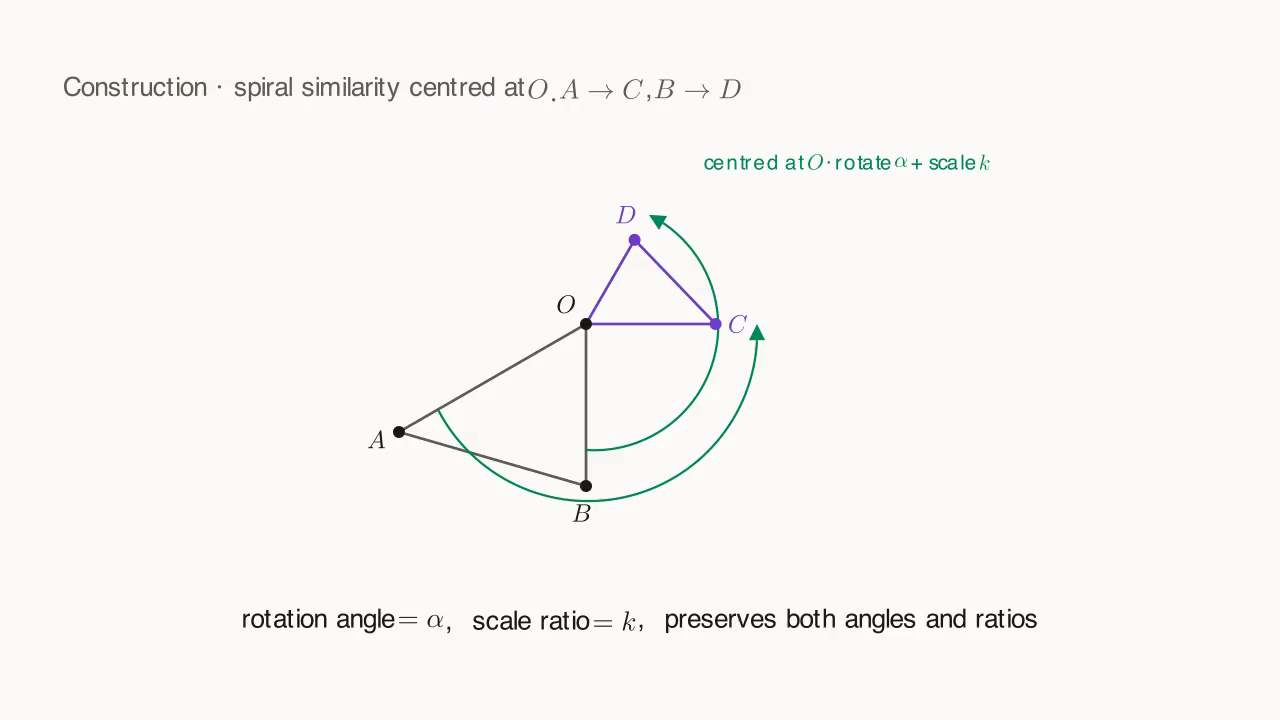
By composition, the angle between and is always and the length ratio is always .
This is the geometric essence of the "melon-and-bean principle": after one spiral similarity, the locus of has the same shape as the locus of — "plant melons, harvest melons; plant beans, harvest beans". Concretely:
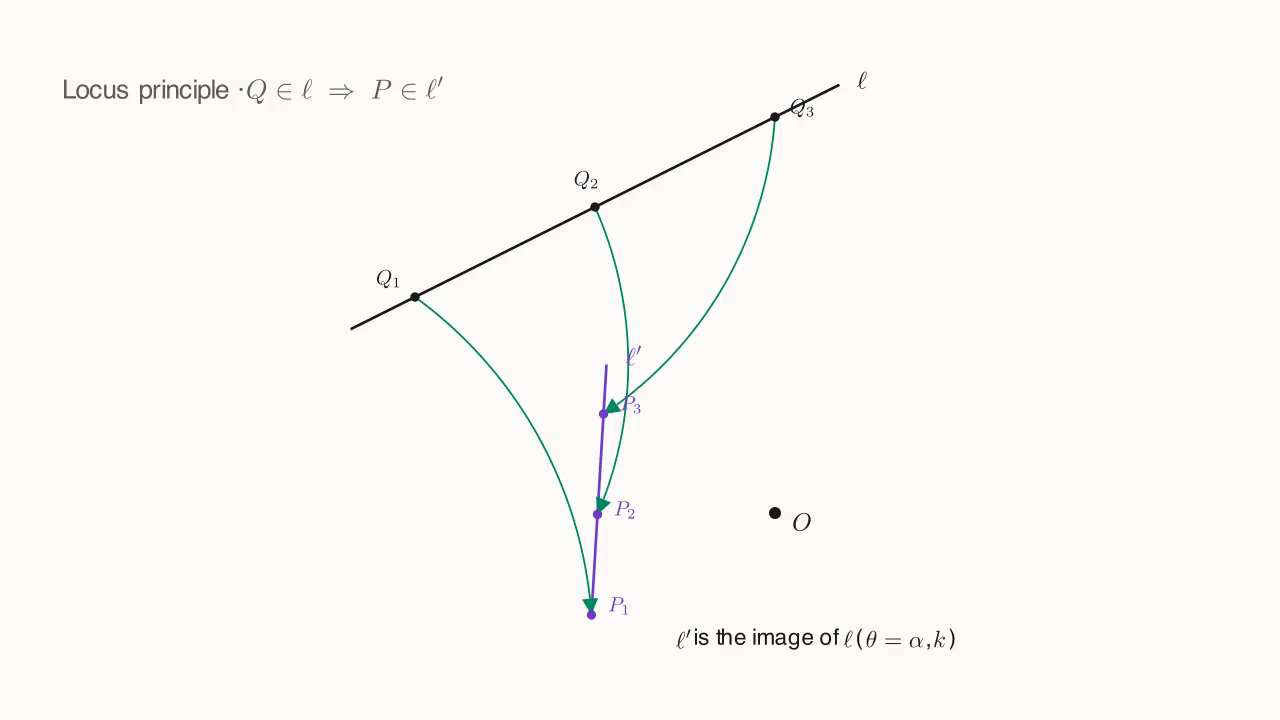
- on a line on a line (the image of under the spiral similarity)
- on a circle on a circle (radius scaled by , centre is the image of )
Worked examples
- Right triangles () and () share vertex , with ; show and (the shared-apex special case)
- Non-isosceles half-angle variant: a non-isosceles triangle with apex (); (, ); the relation between and is no longer equality but a weighted equality with a similarity ratio
- Locus problem: slides on a line ; is obtained from by rotating about and scaling by ; find the locus of (answer: another line )
Variants / generalizations
- Degenerate to congruence (): similarity ratio is , the spiral similarity reduces to "pure rotation" — i.e. the [[hand-in-hand]] model; the angle formula is unchanged
- Degenerate to dilation (): zero rotation, pure scaling — reduces to a dilation centred at ; corresponding-point connectors are concurrent at
- Non-isosceles version of the half-angle model: [[half-angle]]'s "two polyline pieces splice into a single straight segment" holds in the isosceles case; without isosceles, the splice is a polyline weighted by the similarity ratio, which this model handles
- Auto-detection of the rotation centre: given two corresponding segments , the centre of the spiral similarity is uniquely determined by the geometric condition that and must simultaneously be similar ("four points concyclic + line intersection" construction)
- Locus principle (the "melon-and-bean"): the geometric basis for "locus analysis" in moving-point optimization — in essence, the middle-school version of "linear transformations preserve shape"