Square tests
Dependencies: Parallelogram tests, Rectangle tests, Rhombus tests.
Statement
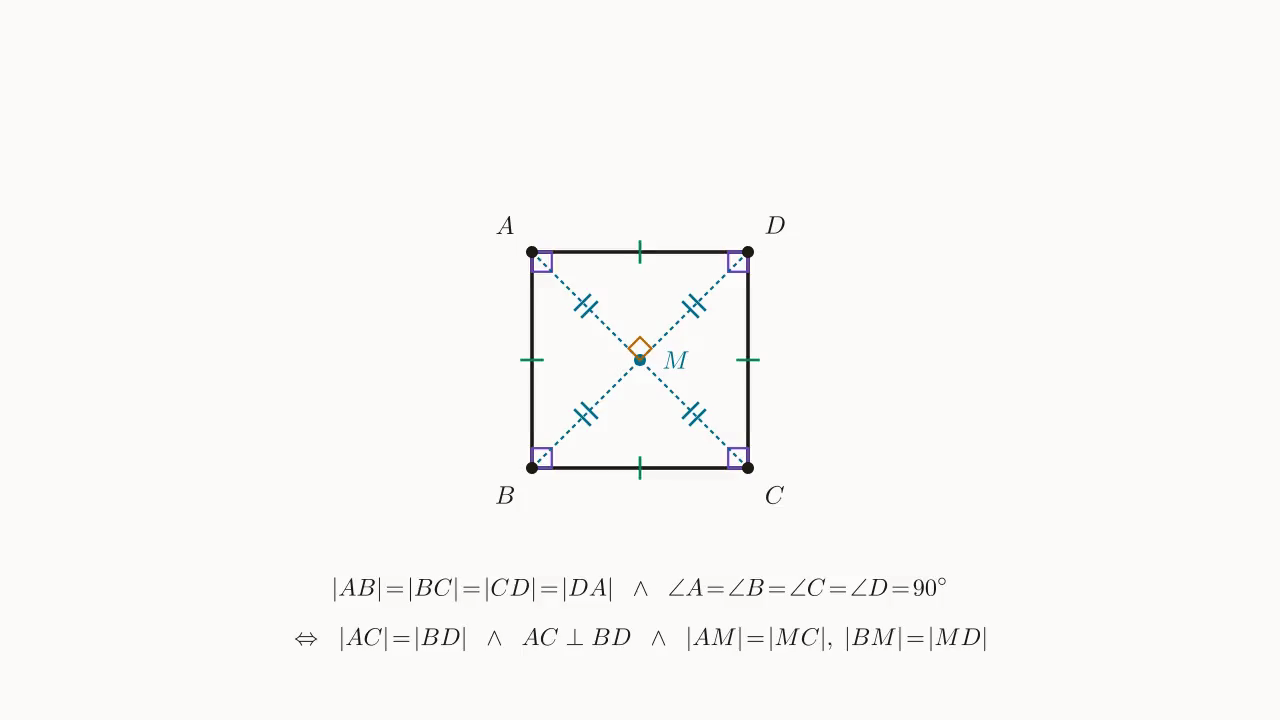
Let be a quadrilateral (vertices in cyclic order). The following three conditions are mutually equivalent, and each can serve as a test for " is a square":
(a) A rectangle with a pair of equal adjacent sides: is a rectangle and ; (b) A rhombus with one right angle: is a rhombus and ; (c) Diagonals equal and perpendicular bisectors of each other: let the diagonals , meet at ; then , , , and .
A more intuitive way to put it: square = rectangle ∩ rhombus. The essence of every test is to first use the four parallelogram tests to lock as a parallelogram, then layer on the "special angle" or "special side length" condition required by the rectangle and rhombus sides respectively; the double upgrade yields a square.
Unlock the complete proofs forever
Matching GeoSnap, 10 foundational theorems are completely free. Unlock every other proof, animation, and consequence with one $10 purchase.
Sign in to unlock