PRINCIPIA · THEOREM
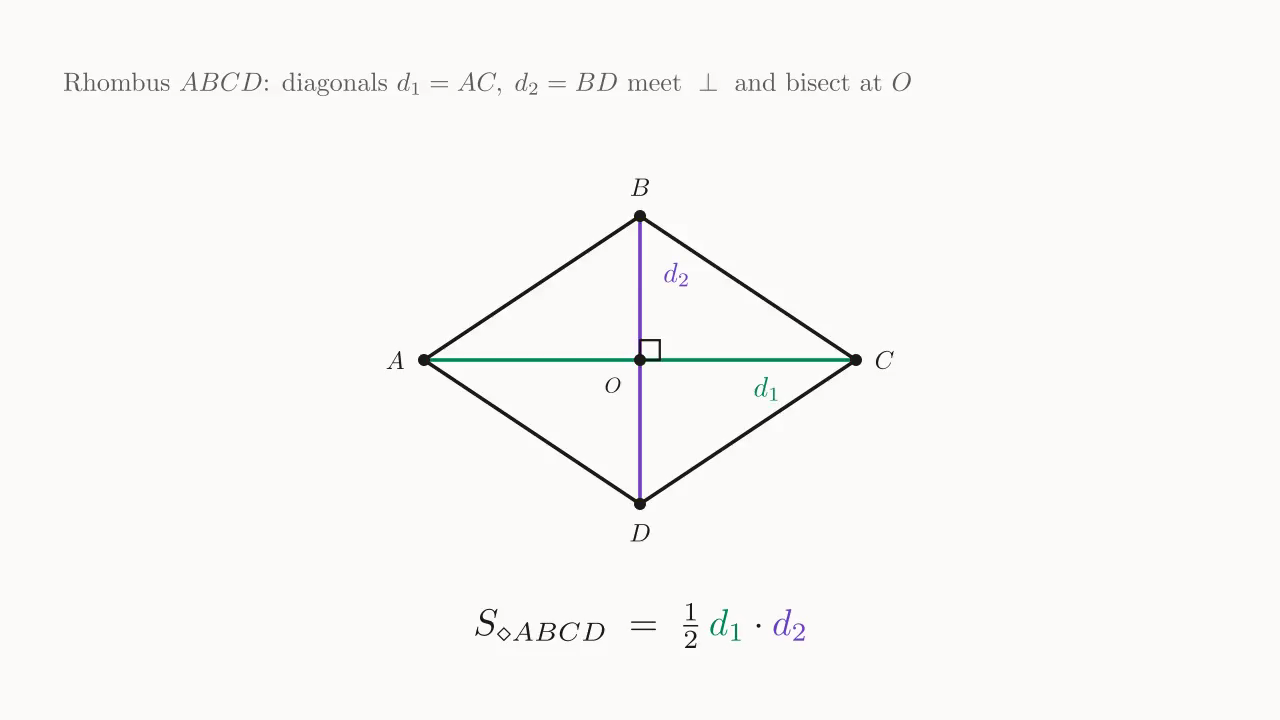
Rhombus area = ½ · d₁ · d₂
Dependencies: Rhombus: diagonals ⊥-bisect, Triangle area = ½ × base × height.
Statement
Let be a rhombus with diagonals and , of lengths and respectively. They meet at a point . Then the area of the rhombus is
Unlike a parallelogram or rectangle, whose area is usually expressed as base × height, the rhombus formula is written directly in terms of the two diagonals — so once the diagonals are measured, the area follows immediately.
10 foundational theorems free · one-time unlock for the rest
Unlock the complete proofs forever
Matching GeoSnap, 10 foundational theorems are completely free. Unlock every other proof, animation, and consequence with one $10 purchase.
Sign in to unlockHelp me make this theorem better