PRINCIPIA · THEOREM
Triangle incircle — existence and uniqueness
Dependencies: Three angle bisectors meet (incenter) (the three angle bisectors meet at ), Angle bisector ⇔ equidistant from sides (on the line equidistant from the two sides), Tangent test (a radius through the touch point the radius the line tangent line).
Statement
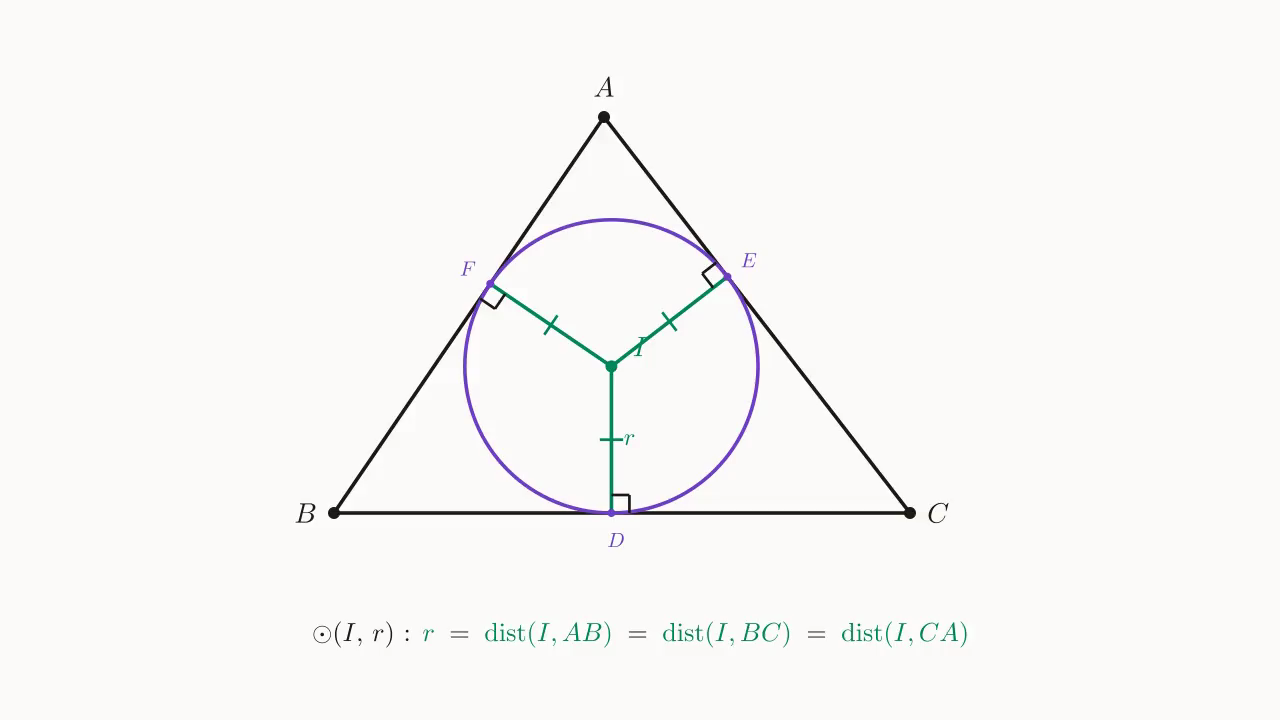
Let be a non-degenerate triangle, and let be its incenter (given by Three angle bisectors meet (incenter)). Let
Then the circle centered at with radius is tangent to all three sides , , . This circle is called the incircle of , and the three contact points , , are exactly the feet of the perpendiculars from to the three sides.
10 foundational theorems free · one-time unlock for the rest
Unlock the complete proofs forever
Matching GeoSnap, 10 foundational theorems are completely free. Unlock every other proof, animation, and consequence with one $10 purchase.
Sign in to unlockHelp me make this theorem better