Three excircles (excenters) exist — one interior bisector + two exterior bisectors are concurrent
Dependencies: Angle bisector ⇔ equidistant from sides (including its converse: a point equidistant from the two sides of an angle lies on its bisector), External angle bisector property (a point on the exterior bisector is equidistant from the opposite side and the extension of an adjacent side).
Statement
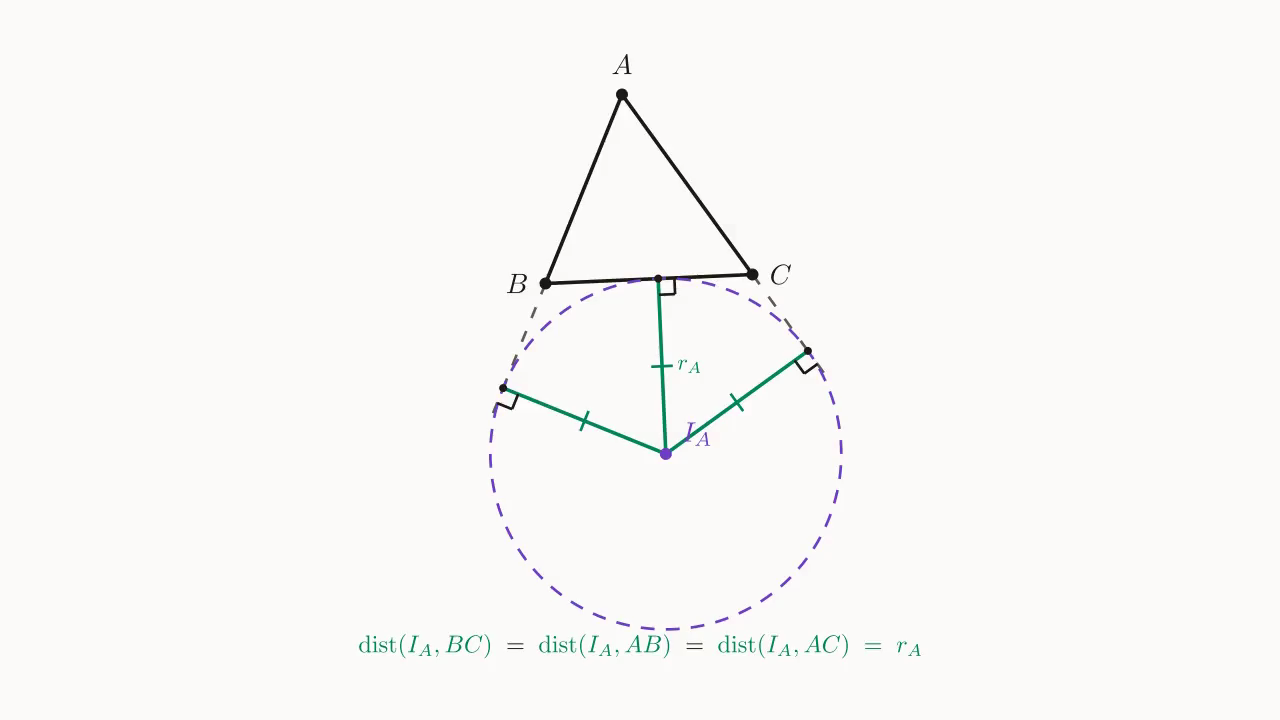
Let be a non-degenerate triangle. Fix a vertex (say ); then the interior bisector of and the exterior bisectors of and all meet at a single point . This point is called the excenter of opposite vertex . Equivalently, is at equal distance from the three lines , , :
Denote this common distance by ; then the circle centered at with radius is simultaneously tangent to the interior of side , to the extension of beyond , and to the extension of beyond — this is the excircle of . Each of the three vertices yields an excenter, so there are three excenters , , and three excircles.
Unlock the complete proofs forever
Matching GeoSnap, 10 foundational theorems are completely free. Unlock every other proof, animation, and consequence with one $10 purchase.
Sign in to unlock