Geometric mean / altitude-on-hypotenuse theorem
Dependencies: AA similarity.
Statement
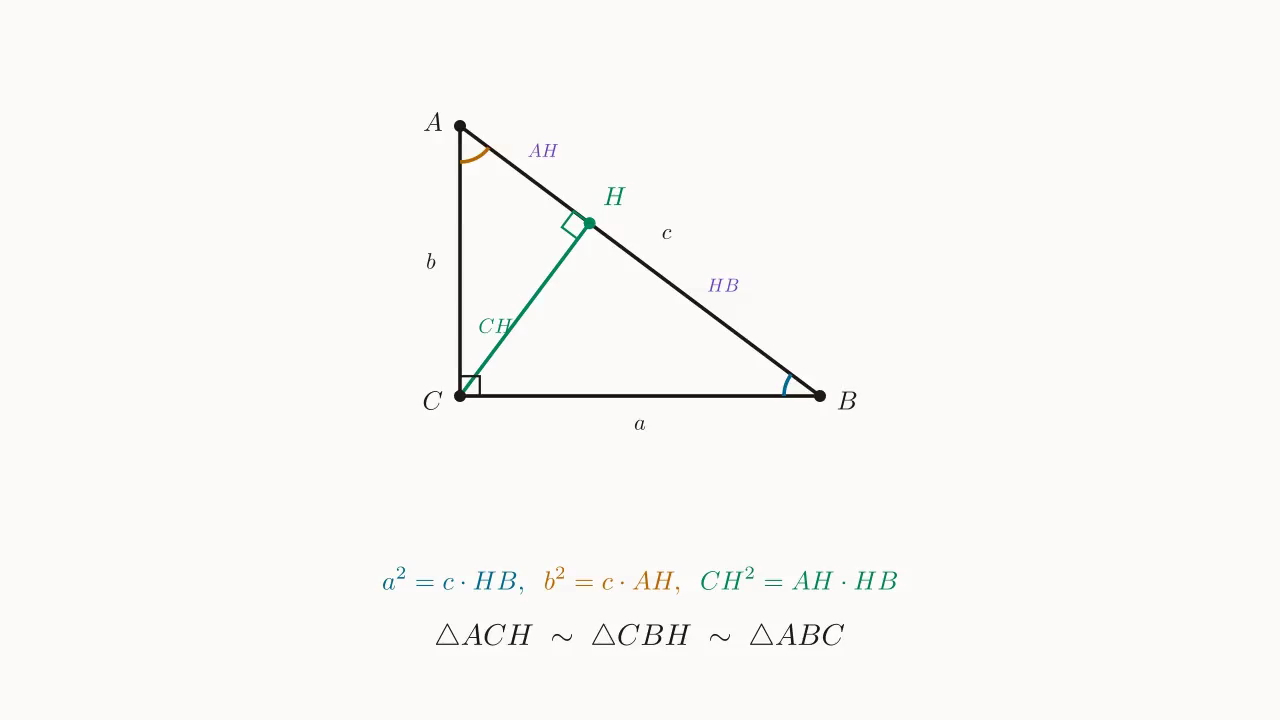
Suppose has a right angle at , i.e. . Denote the three sides by , , . Drop a perpendicular from the vertex to the hypotenuse , with foot , i.e. at .
Then the altitude to the hypotenuse splits the right triangle into two small triangles similar to the original:
From this triple similarity one immediately reads off three length identities — together they are called the altitude-on-hypotenuse theorem:
The first two say "the square of each leg equals its projection onto the hypotenuse times the whole hypotenuse"; the third says "the altitude to the hypotenuse is the geometric mean of the two segments into which the hypotenuse is divided".
Unlock the complete proofs forever
Matching GeoSnap, 10 foundational theorems are completely free. Unlock every other proof, animation, and consequence with one $10 purchase.
Sign in to unlock