Triangle inequality
Between any two points in the plane, the straight segment is shortest; any polyline length is at least the straight-segment distance between its endpoints, with equality iff all points are collinear in order.
Triangle inequality — the geometric fact at the core of moving-point optimization.
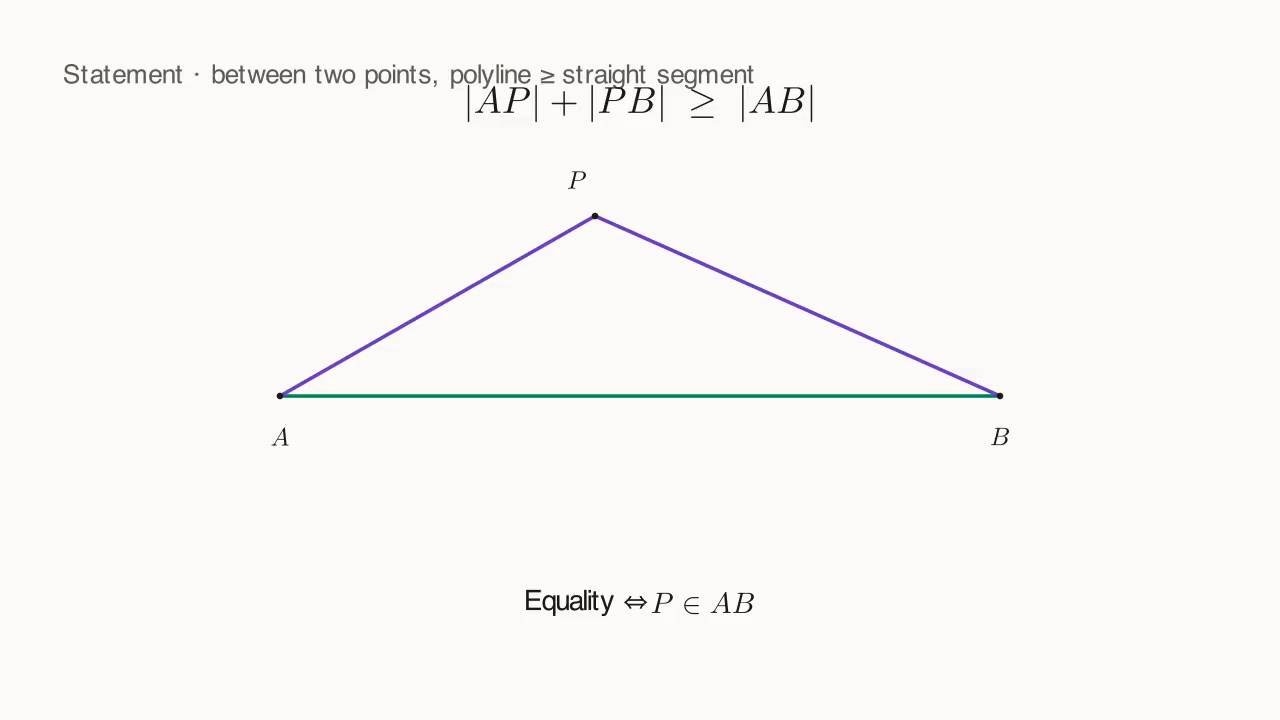
Statement
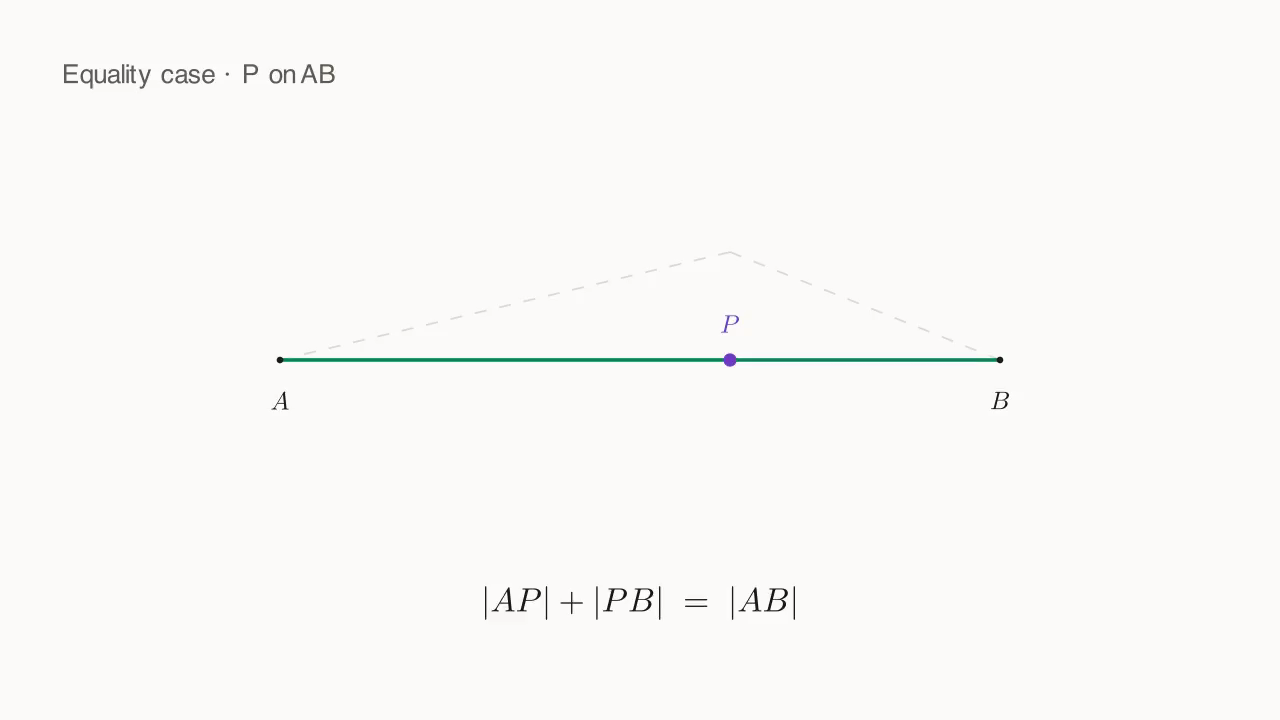
Let be fixed points in the plane. For any point :
with equality iff lies on segment .
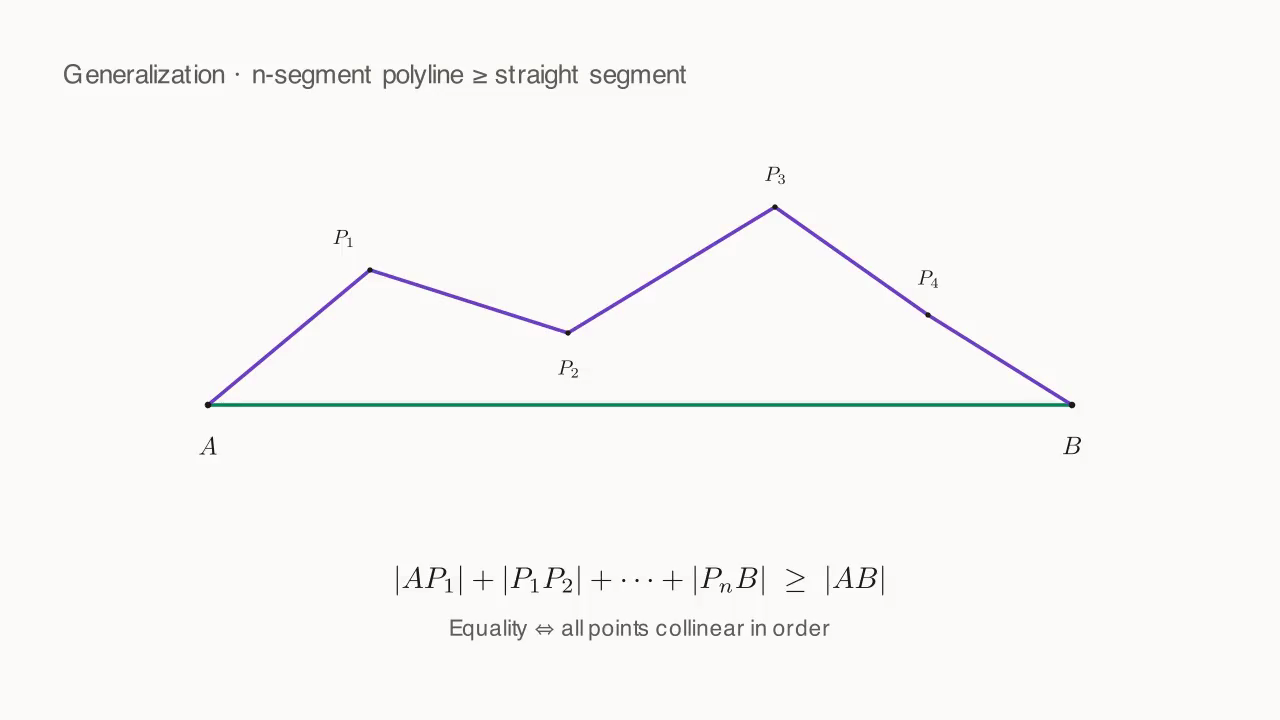
More generally, for a polyline :
with equality iff all points lie on the segment in order.
Why it matters
This unassuming inequality powers a huge family of "moving-point minimization" problems: a geometric transformation (reflect, rotate, scale) turns the target into the length of some polyline, after which this inequality squeezes the polyline back down to a straight segment — and that gives the minimum.
Downstream models:
- General Drinking Horse (axial-symmetry shortest path) — reflection folds "two segments" into one polyline
- Fermat point — a 60° rotation turns "three segments" into a polyline
- Apollonius circle — similarity turns "weighted distance" into a plain-distance term
Equality case at a glance