Fermat point
theorem
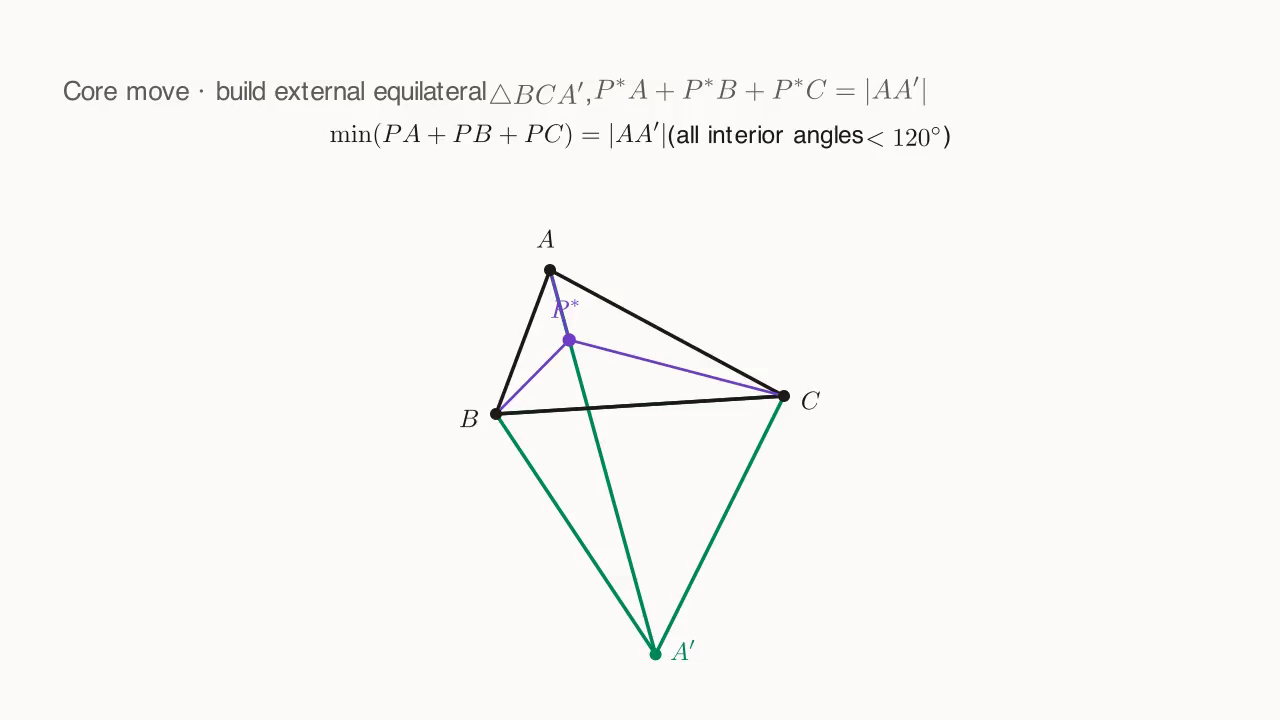
The point inside a triangle that minimizes the sum of distances to its three vertices; when every interior angle is below 120°, the Fermat point sees all three vertices at 120° apart, and the minimum is computed via the 60° rotation construction.
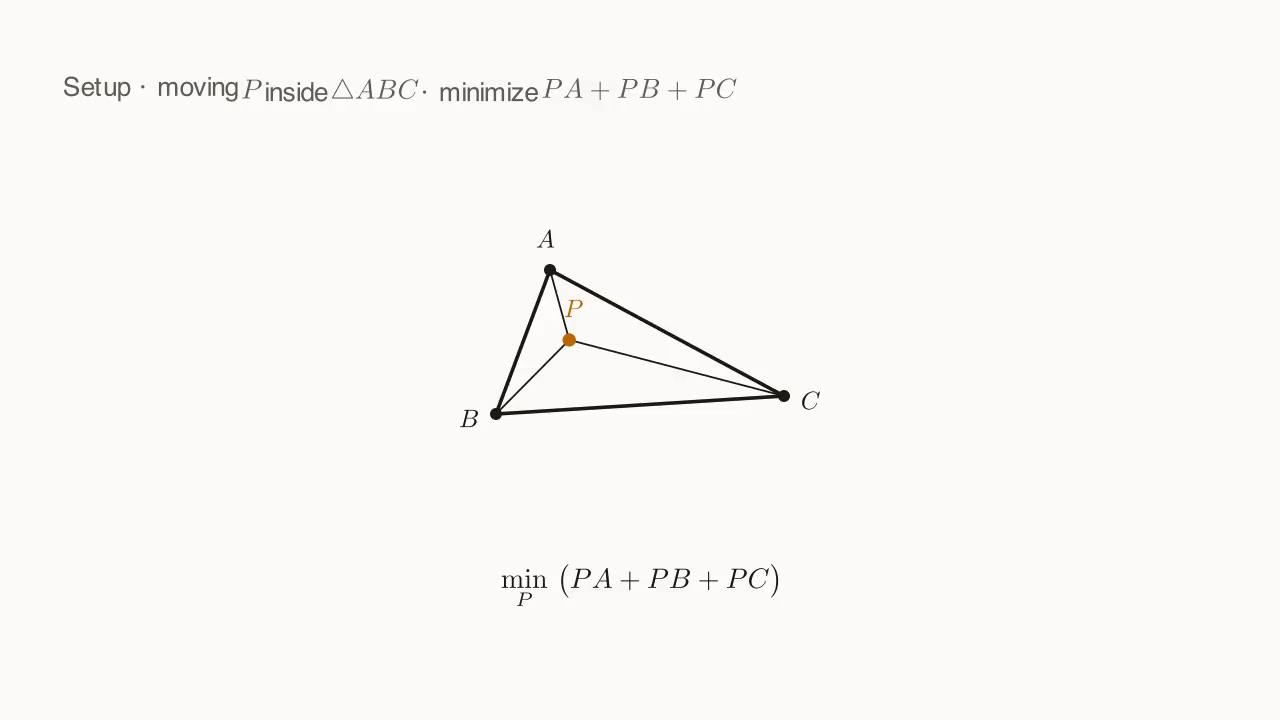
Fermat point — the point inside a triangle that minimizes the sum of distances to the three vertices.
Universal form
Classical model
- Moving point : anywhere in the plane (interior and boundary of included)
- Fixed points : the three vertices of
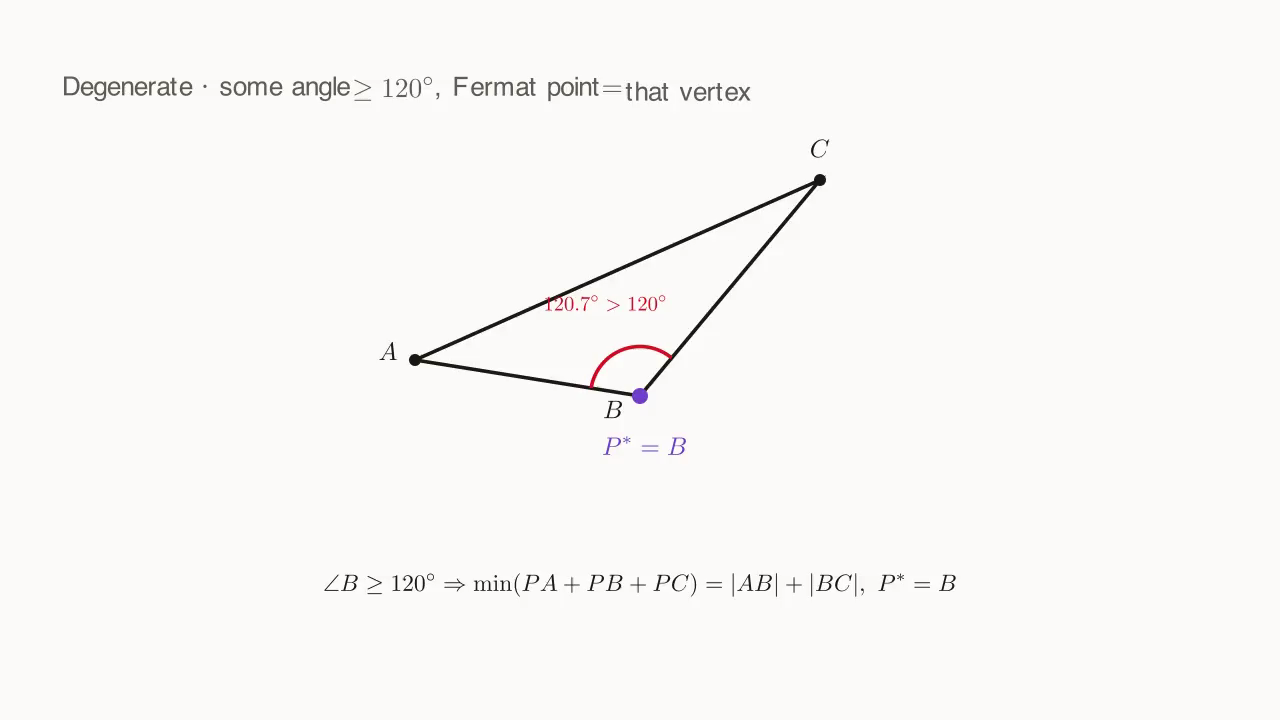
- Key constraint: all three weights are (use Weighted Fermat Point (rotation + scaling lemma) if weighted); when some interior angle is , the optimal point degenerates to that vertex
Conclusion
| Condition | Optimal | Angles at |
|---|---|---|
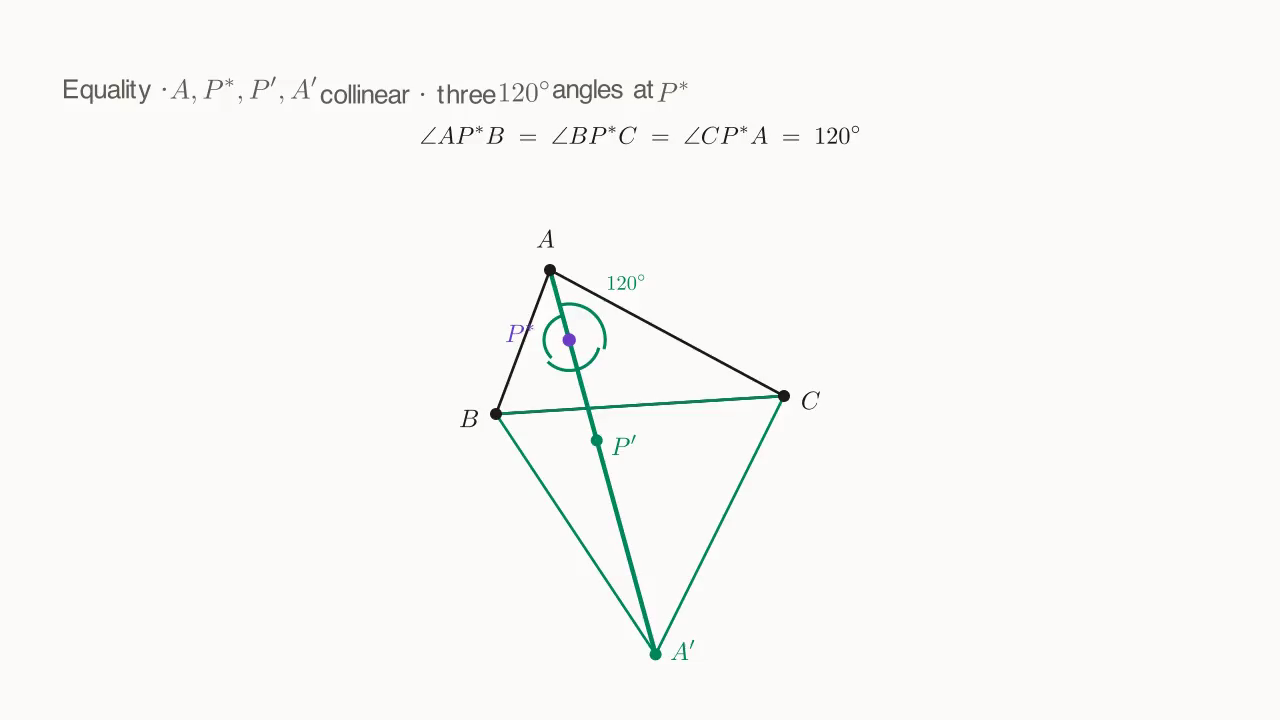
| All interior angles | Fermat point (strictly inside the triangle) | |
| Some angle | The obtuse vertex | — |
The 60° rotation construction (the standard recipe)
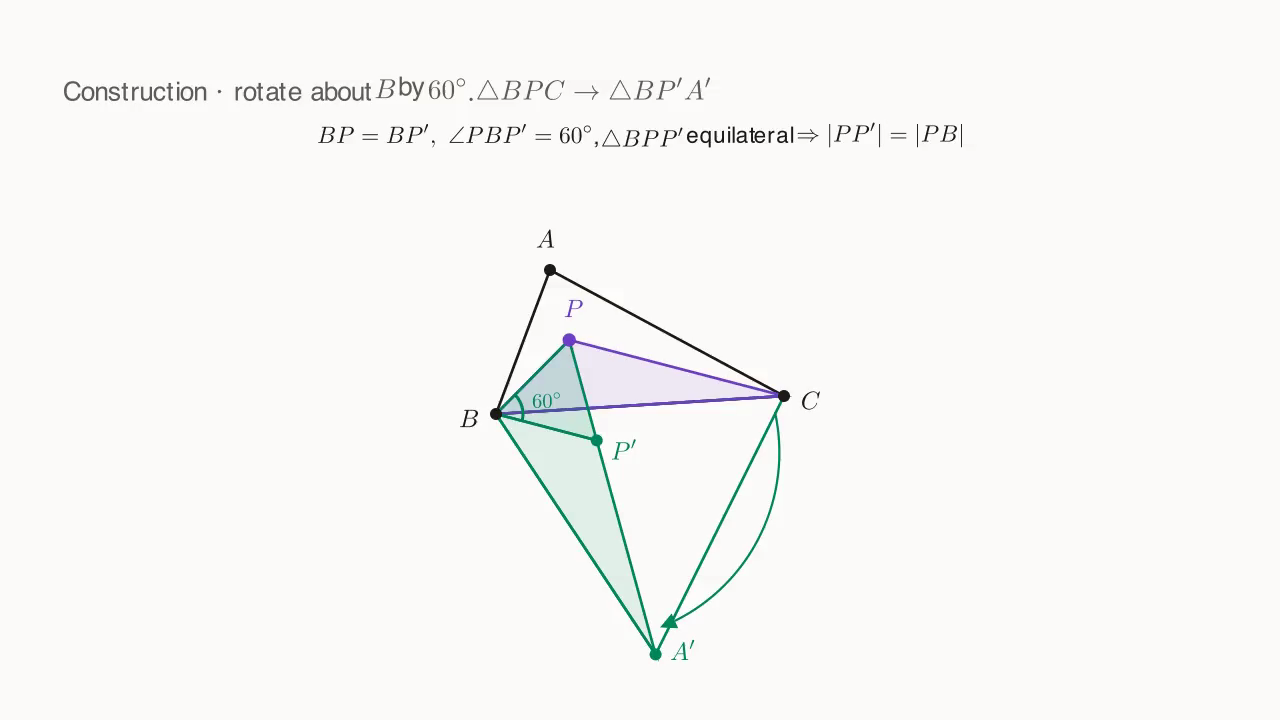
On any side of (say ), build an equilateral outside . Then:
Proof sketch: rotate about clockwise by : , . Then:
- is equilateral ( with included angle ) ⇒
- Rotation preserves length ⇒
- Hence
The right-hand side is the length of the polyline from to . By [[triangle-inequality]]:
with equality when are collinear — at which point is the Fermat point.
Applications
- [[0002-fermat-point]] — the standard isosceles-acute-triangle problem