Apollonius circle
theorem
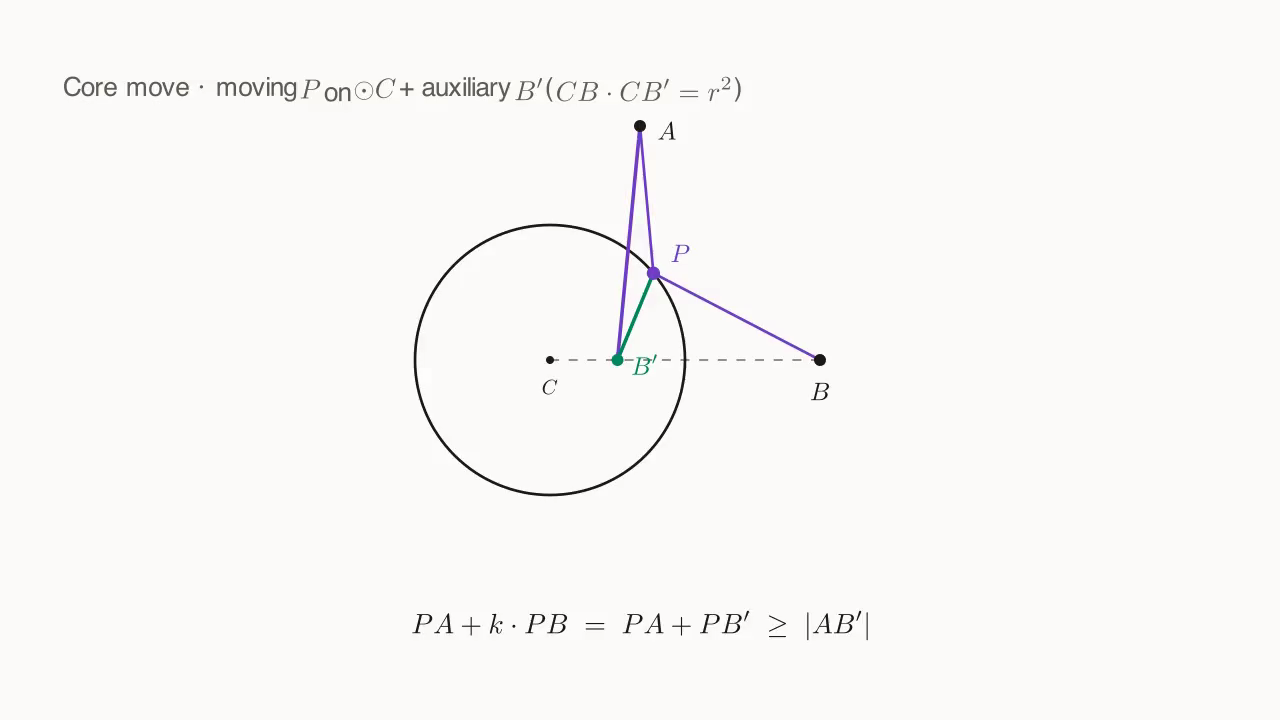
The locus of points whose distances to two fixed points have a constant ratio k≠1 is a circle; commonly used to construct an auxiliary point that converts "weighted-distance extrema" into plain-distance form.
Apollonius circle — a similarity tool that converts "weighted distance" into "unit-weight distance".
Universal form
Classical model
- Moving point : on a circle (radius )
- Fixed point : anywhere outside the circle
- Fixed point : outside the circle, distinct from the centre
- Key constraint: (if not, rescale the figure first via similarity; otherwise this is not an Apollonius-circle problem)
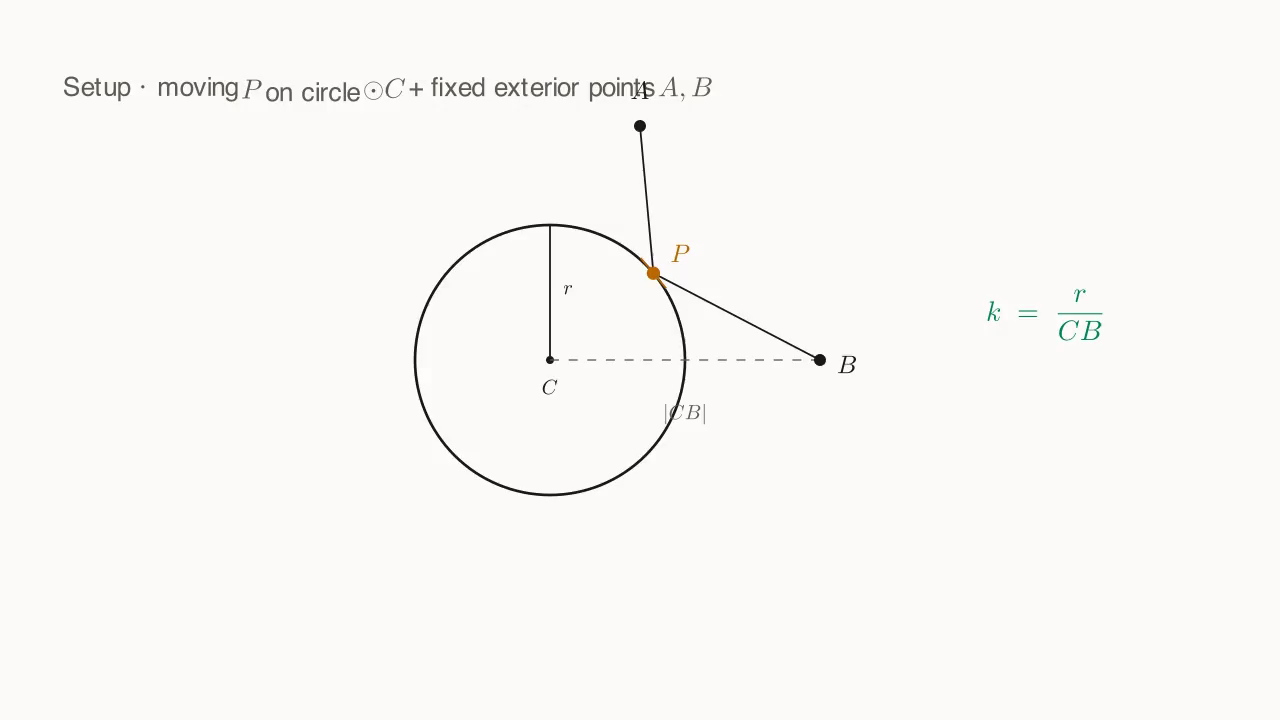
Construction and proof
-
On ray , take an auxiliary point with
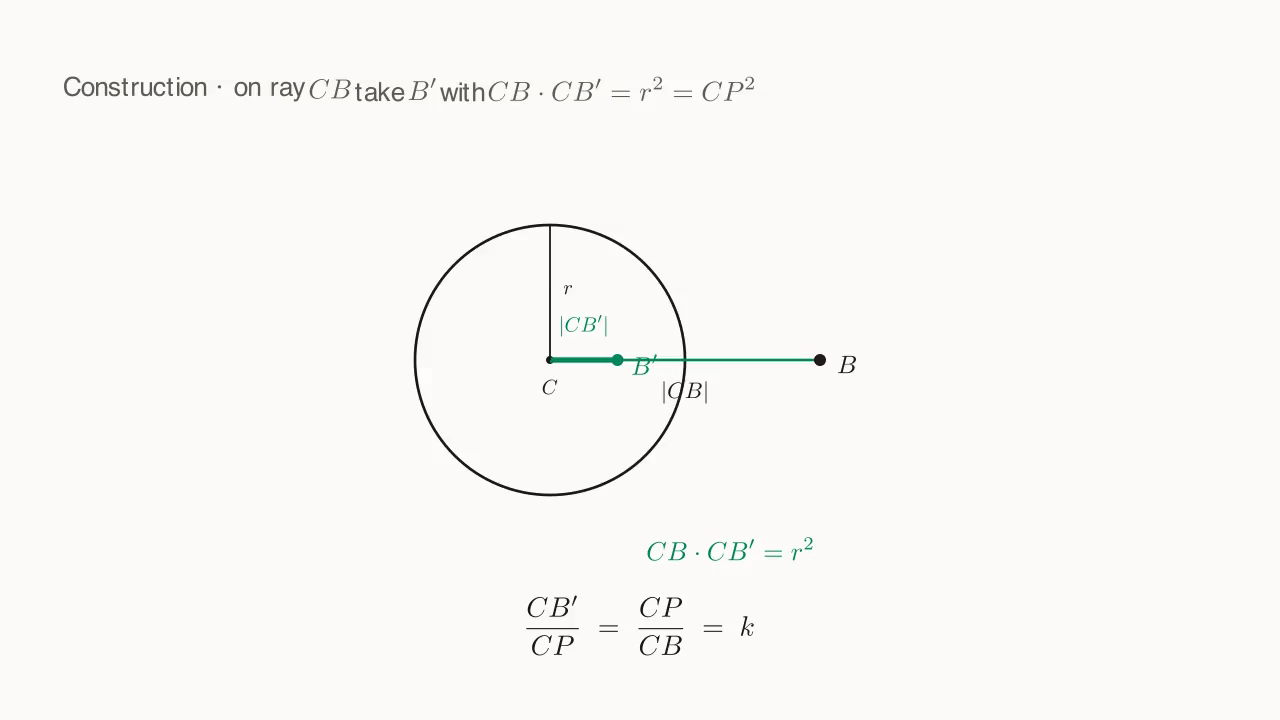
-
By and the shared angle ,
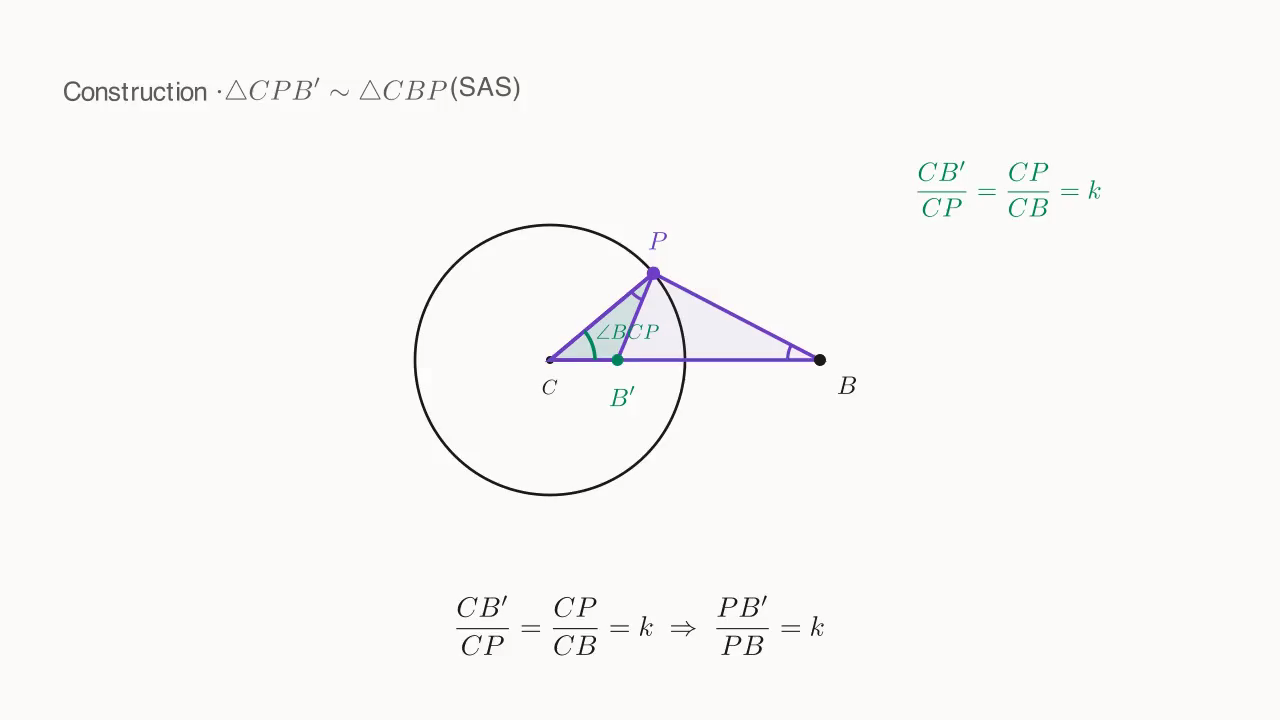
-
The similarity ratio gives , so
for every on the circle — this is the key invariant.
-
Therefore ([[triangle-inequality]]), with equality when are collinear and lies between and .
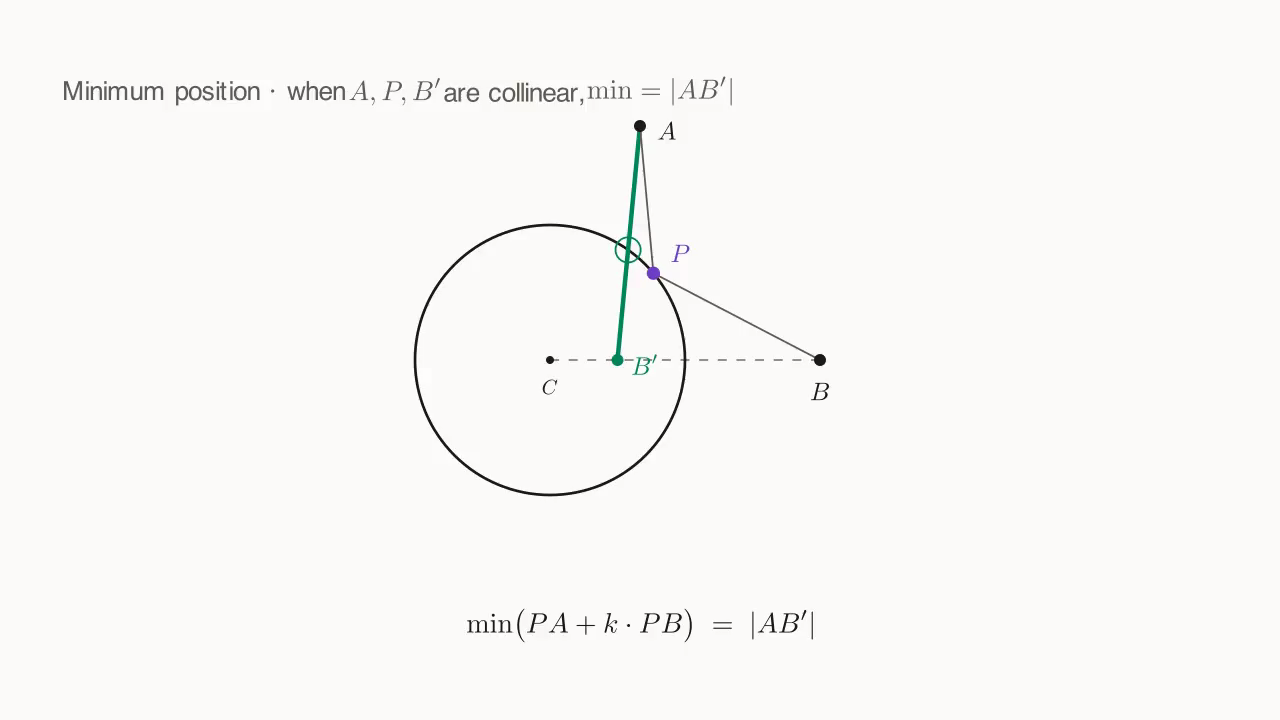
Answer
where is computed directly from the geometry of .
Applications
- [[0003-apollonius-circle]] — the standard right-triangle-plus-circle problem