Spiral similarity
The composition of "rotation by about a fixed point" with "central dilation by from the same point"; a similarity transformation that simultaneously absorbs one rotation angle and one scaling factor — the core tool for "weighted-distance + angle" minimization.
Spiral similarity — the composite of "rotation about a fixed point" and "central dilation about the same point". A Swiss-army tool for problems whose target is a weighted sum of distances.
Definition
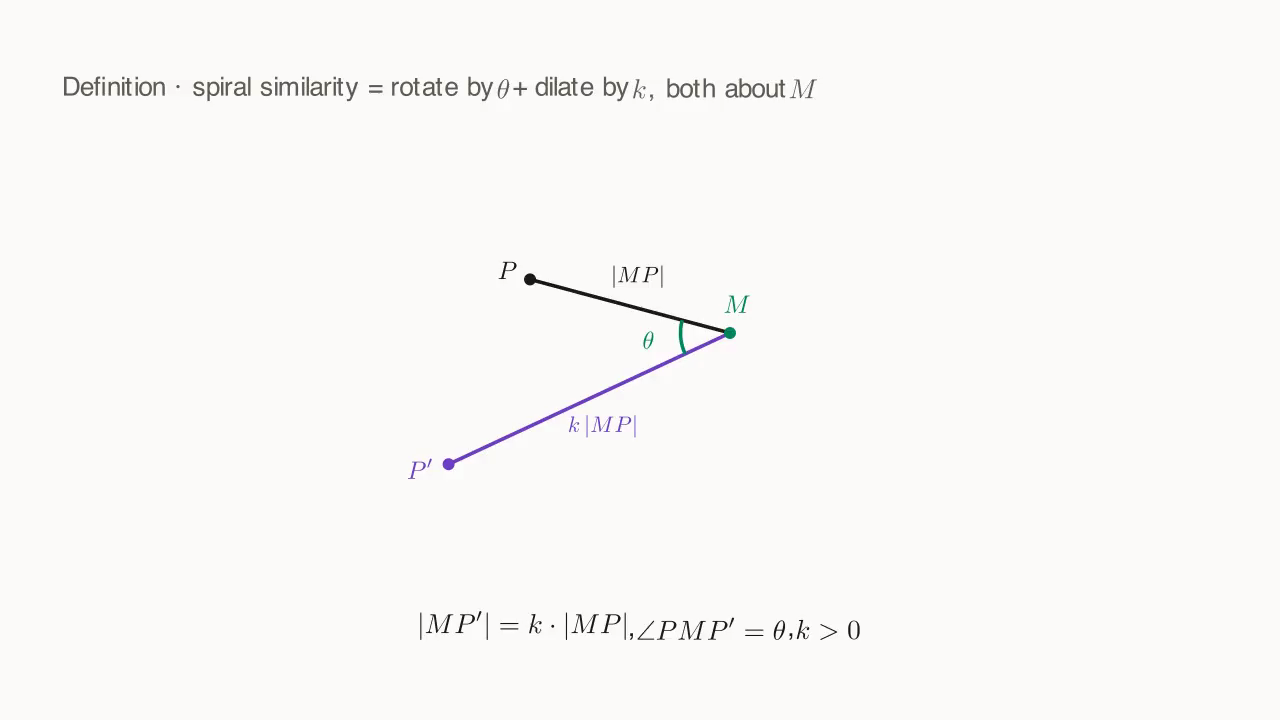
A spiral similarity in the plane is determined by three parameters:
- a centre (a fixed point)
- a rotation angle
- a dilation ratio
It sends any point to with
Equivalently, compose Rotation properties (rotate by around ) with Homothety (central similarity) (dilate from by factor ). The two factors commute when they share their centre, so "rotate then dilate" equals "dilate then rotate".
Key properties
- Conformal: a spiral similarity is a similarity transformation — it preserves all angles and scales every distance by the same factor .
- Unique determination: given two points and two images (with ), there is a unique spiral similarity sending and . The centre is fixed by "perpendicular bisectors of the two segment pairs + matched rotation arcs".
- SAS similarity comes for free: if and satisfy and , then they are SAS-similar (see SSS and SAS similarity tests), and the spiral similarity above sends one to the other.
When to use
When the problem displays both of the following:
- Weighted target with an angle: minimise or similar, with weights NOT in the "lookup table" ;
- Two coupled moving points: two moving points slide on different lines / circles, but are locked together by some ratio .
In such a problem, rotating-and-scaling about a shared vertex glues two weighted segments into a single polyline, after which [[triangle-inequality]] closes it out.
Classical uses
Use 1 · Weighted Fermat point with arbitrary weights
Target minimised, with all three weights arbitrary (not in the table). Spin around one of the weight endpoints (say ) by angle and scale by , sending the whole to . Then
- dilation ratio ;
- rotation angle comes from the law of cosines: .
Minimum target .
See Weighted Fermat Point (rotation + scaling lemma) (special weights) for the natural generalisation.
Use 2 · Minimum of a segment between two moving points
Target , where are two moving points (sliding on adjacent sides of a triangle) coupled by .
Find a fixed pivot such that the spiral similarity sends (rotation angle , dilation ratio ); then , and the target becomes (equality when the three points are collinear).
An equilateral triangle with , makes degenerate to a right triangle — a common configuration when locating by hand.
Pitfalls
- Wrong centre / wrong weighted endpoint: the centre of the spiral similarity must be the point shared by the two moving points, or the common endpoint of the two weighted segments. Pick the wrong one and you do not get the SAS similarity you need.
- Signed rotation angle: is signed. The "clockwise vs counter-clockwise" choice in the problem decides which side of the figure the image lands on; the wrong choice still produces a similar figure but moves the equality configuration.
- Direction of : or depending on which coefficient in the target you want to eliminate. Write down the weighted sum first, decide which coefficient to absorb, then pick .
- does not reduce to pure rotation: pure rotation () gives SAS congruence; spiral similarity with only gives SAS similarity — you get "ratios of corresponding sides ", not equal corresponding sides.
Applications
To be added.
Related
- Rotation properties / Homothety (central similarity) — the two factors of the composition
- SSS and SAS similarity tests — the criterion that verifies a spiral similarity
- [[triangle-inequality]] — closes out the assembled polyline
- Fermat point / Weighted Fermat Point (rotation + scaling lemma) — the pure-rotation and special-weight degenerations
- Hand-in-hand model (shared-vertex isosceles) — the middle-school name for pure rotation ()