Hand-in-hand model (shared-vertex isosceles)
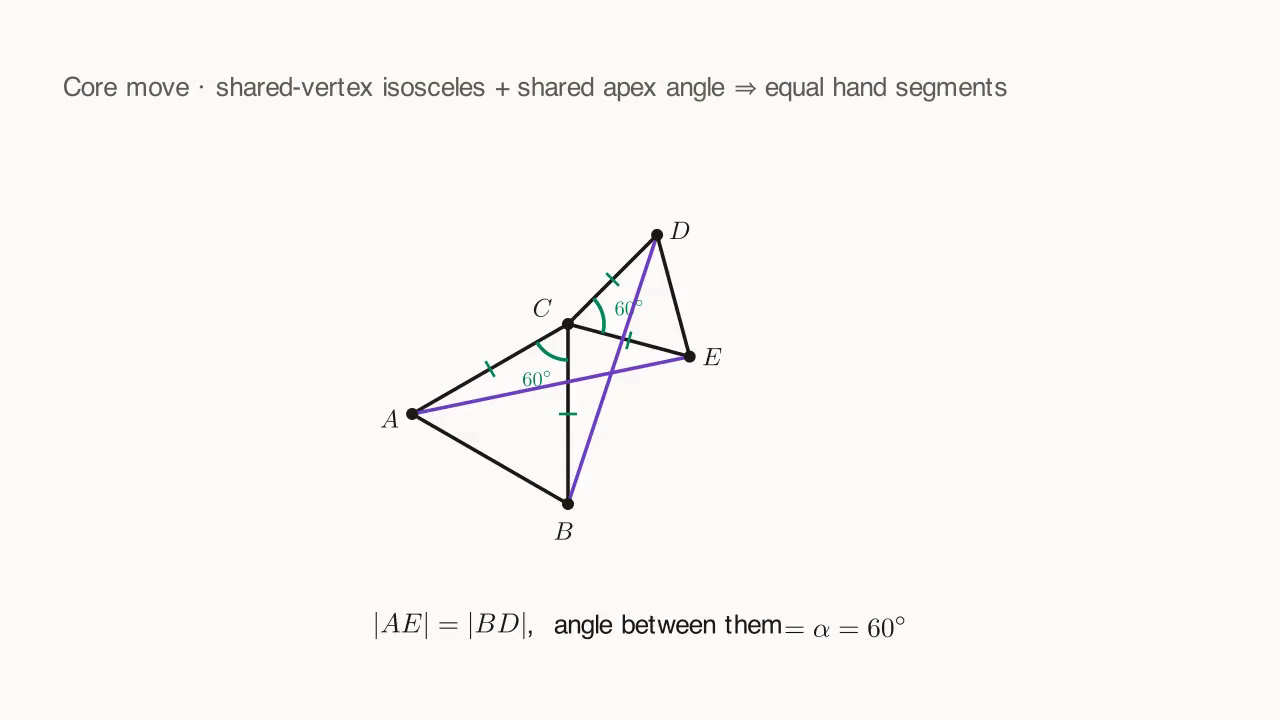
Two isosceles triangles sharing a vertex; joining each pair of outer endpoints ("hands") produces a SAS-congruent pair of triangles, so the two "hand" segments are equal and the angle between them equals the shared apex angle.
When to use
- The problem features two isosceles triangles sharing a vertex (most common: two equilateral triangles, two isosceles right triangles, or two isosceles triangles with the same apex angle)
- You need to show two "cross-diagonals" are equal, or find the angle between them, or relate one length to another
- "Rotate △ABC by α° about some point" — rotation about a point + isosceles condition = hand-in-hand
Core move
Shared vertex + shared apex angle = a congruent pair of "hands". The two cross-diagonals are equal in length, and the angle between them equals the shared apex angle.
Construction
Let △CAB and △CDE share vertex C, and both be isosceles with apex angle α (CA = CB, CD = CE, ∠ACB = ∠DCE = α).
-
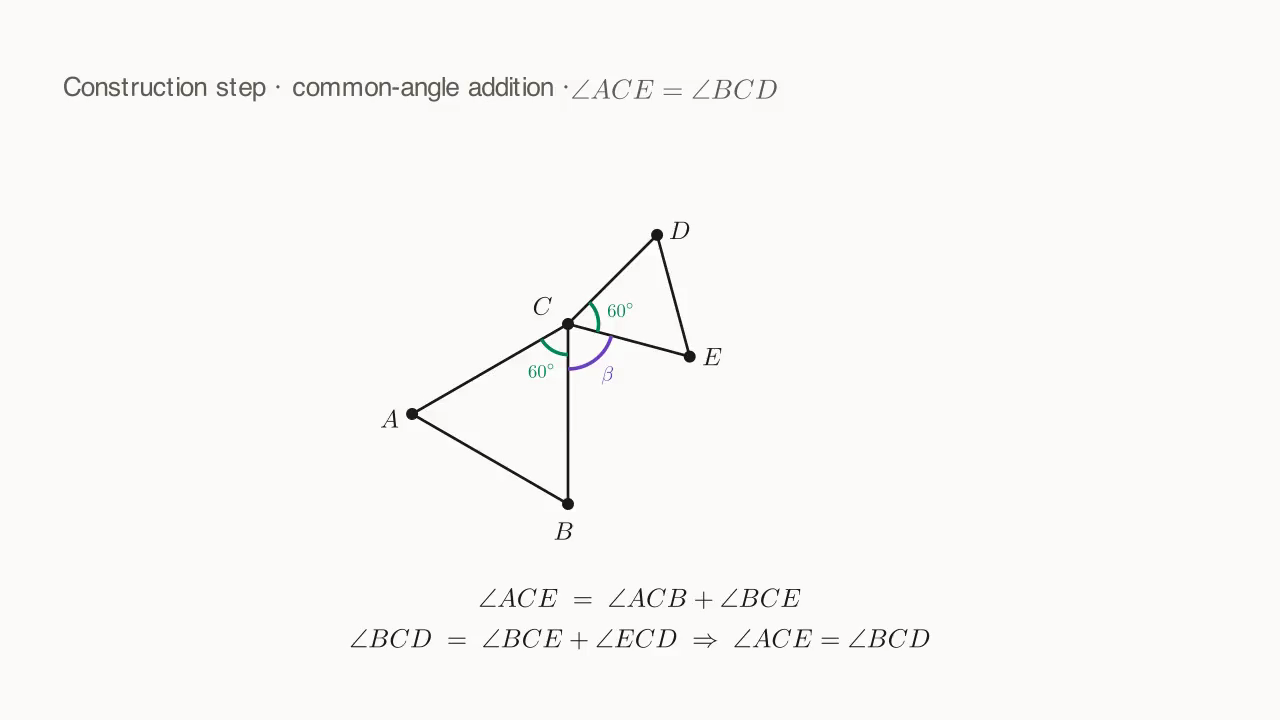
Find the shared angle: decompose ∠ACE as ∠ACB + ∠BCE or ∠ACD + ∠DCE, giving ∠ACE = ∠BCD ("common-angle addition / subtraction").
-
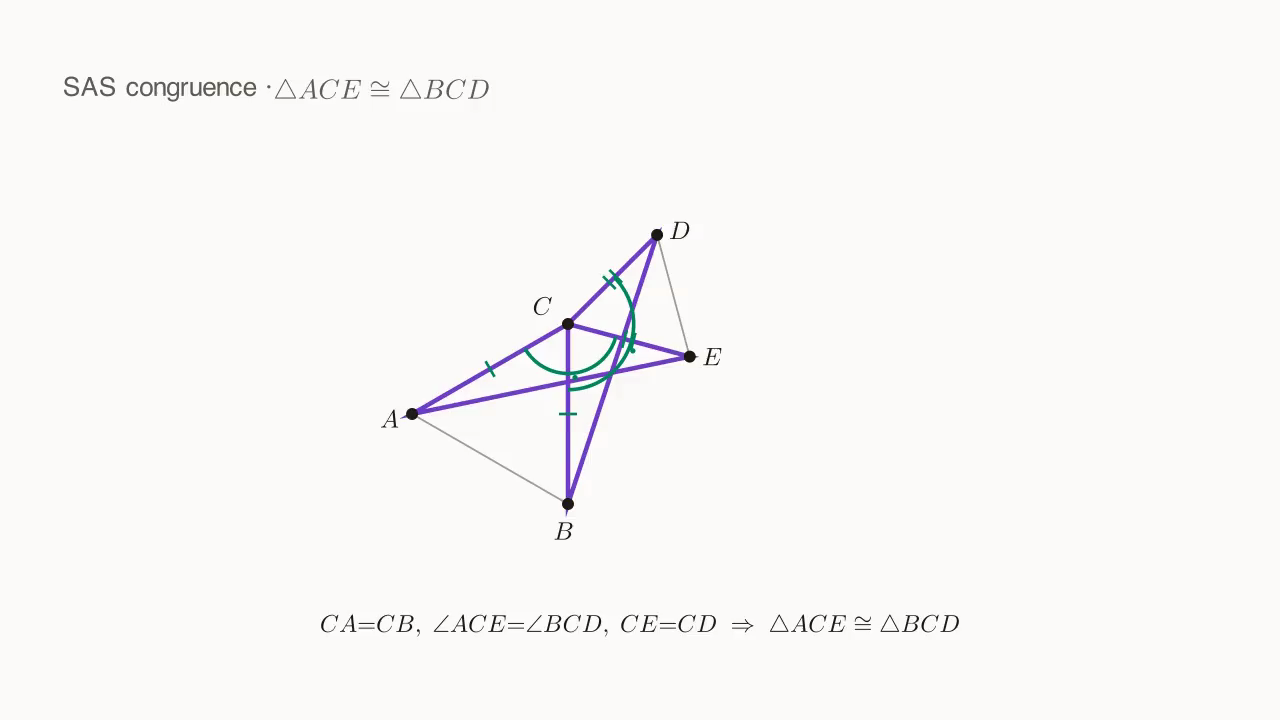
Corresponding sides: CA = CB (first isosceles), CE = CD (second isosceles).
-
SAS gives congruence: △ACE ≅ △BCD.
-
Read the conclusion: AE = BD (the two "hands" are equal length); ∠AEC = ∠BDC (useful for chasing angles).
-
Chase the angle: the angle between AE and BD equals α (the shared apex angle) — usually via "bow-tie" or "vertical-angle exterior of opposite triangles".
Why it works
Both isosceles triangles rotate about C by angle α — taking A → B and simultaneously E → D (or in reverse). Rotation preserves distance and angle, so AE = BD; the angle between two segments after rotation always equals the rotation angle α. SAS just writes this rotation fact as a congruence.
Worked examples
- Equilateral △ABC and equilateral △CDE share vertex C (with D, E outside △ABC): show AE = BD and ∠APE = 60° (where P is the intersection of AE and BD).
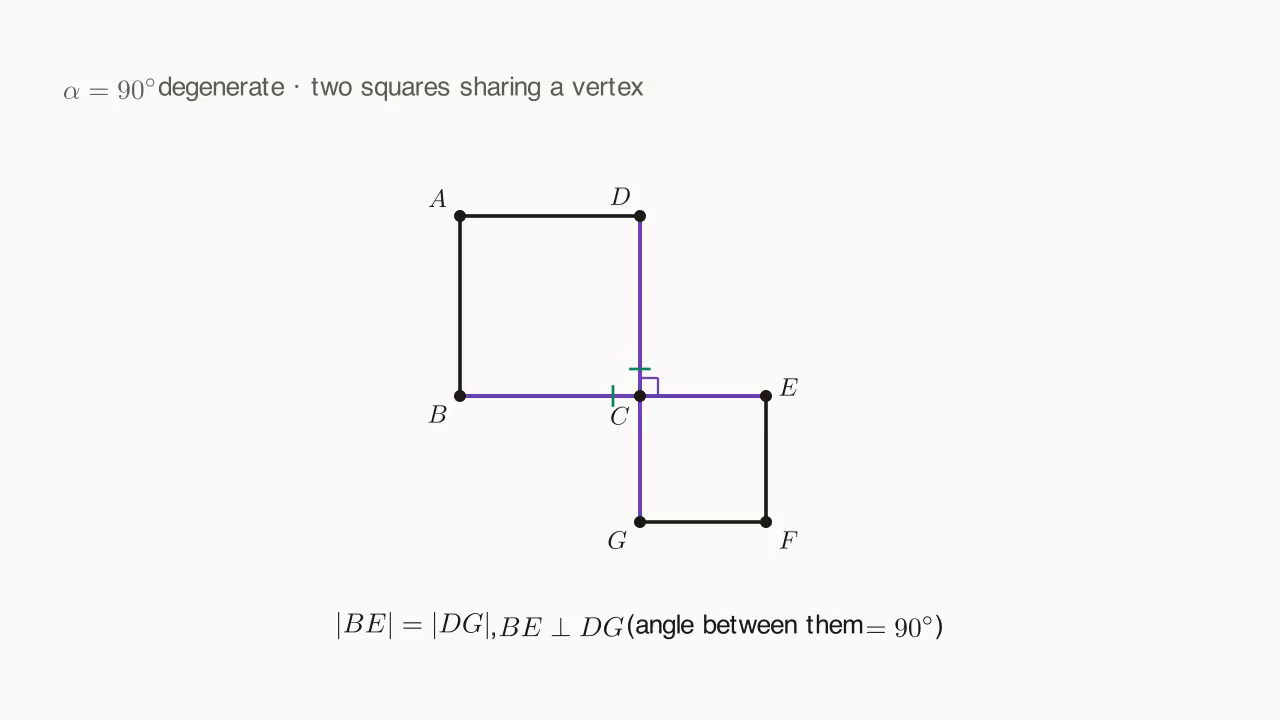
- Squares ABCD and CEFG sharing vertex C: show BE = DG and BE ⊥ DG (the α = 90° degenerate version).
Variants / generalizations
- Non-isosceles but similar — swap SAS congruence for SAS similarity, and the conclusion becomes AE / BD = (similarity ratio), with the angle still equal to the shared apex. This is the gateway to Melon-and-bean (spiral similarity) / spiral similarity.
- Shared apex 60° combined with an external equilateral triangle gives the construction for Fermat point.