Brahmagupta's formula (area of a cyclic quadrilateral)
Dependencies: Heron's formula, Ptolemy's theorem, Opposite angles of a cyclic quadrilateral are supplementary.
Statement
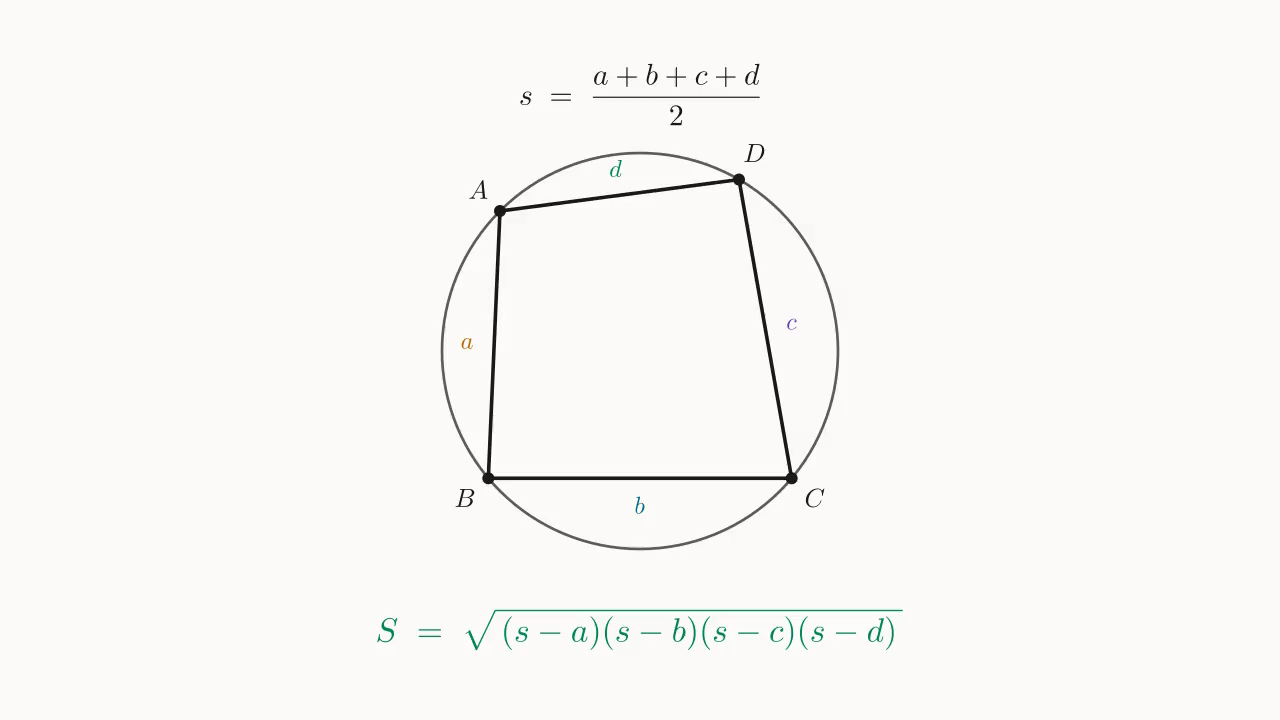
Let be a cyclic quadrilateral with side lengths in order
and semiperimeter
Then the area of the cyclic quadrilateral is uniquely determined by the four sides:
This formula is exactly parallel in form to Heron's formula (Heron's formula: ) — substituting the "triangle special case " (i.e. vertex merging with ) into Brahmagupta's formula, the extra factor recovers Heron's formula. So Heron's formula is the special case of Brahmagupta's formula on a triangle, and the two form a "triangle ↔ cyclic quadrilateral" duality.
Unlock the complete proofs forever
Matching GeoSnap, 10 foundational theorems are completely free. Unlock every other proof, animation, and consequence with one $10 purchase.
Sign in to unlock