Preface — before entering the Principia
Contents
Before we lay out the "four axioms," we need to agree on a few things first: what an axiom is, what a definition is, and how the "three-layer structure" of geometry is put together; and how that set of rules has travelled — from Euclid more than two thousand years ago, through Hilbert's repairs, all the way to the Birkhoff system we use today.
1. Why start from "axioms"?
You have probably seen a sentence like this in your middle-school math textbook: "Two points determine a line." From there the textbook just runs off — using it to prove triangle congruence, the Pythagorean theorem, on and on.
But the moment you stop and ask seriously, you bump into a question that gets quietly skipped over again and again — this sentence "two points determine a line," what is it based on? Why is it allowed, without proof, to be the starting point of all of geometry?
And the questioning can keep going: What is a "point"? What is a "line"? What does "determine" mean? Why "two" points and not three or four? You'll find that this piece of common sense, which slips off the tongue so easily, has not a single word that holds up under scrutiny.
You flip back a few pages looking for an answer. The textbook will try to say something — draw a picture, give an example, add a few intuitive descriptions. But follow each explanation one step further, and you'll always run into the same word — "obviously."
But the word "obviously" is exactly geometry's most dangerous trap. For two thousand years humanity has tripped on it, again and again. What this Principia of Geometry sets out to do is to refuse every "obviously," and honestly derive every theorem from the few sentences at the very bottom.
So those "few sentences at the very bottom" — where do we start?
Let's trace theorems backwards. Try this:
- the "Pythagorean theorem" can be proved from "triangle similarity";
- "triangle similarity" can be proved from "triangle congruence";
- "triangle congruence" rests in turn on more basic facts like "segment length" and "angle measure"…
At each step, the premise is simpler than the conclusion. This is a process of stepping backwards, level by level.
But — can this regress go on forever?
It cannot.
If "theorem A relies on theorem B," "B relies on C," "C relies on D"… and you keep chasing, then either one day you loop back and run into A itself (circular reasoning, which proves nothing), or the chain has to stop somewhere — stop at sentences we no longer try to prove, but accept directly as the starting point.
These "sentences that can no longer be pushed back, that must be taken as the starting point" are what we call "axioms."
This is actually a very general way of thinking — it is called first principles: any complex truth must, in the end, be reduced to a few of the most basic starting points that cannot be questioned any further. Physicists use it to look for the fundamental laws of the universe; chemists use it to look for the smallest elements; and geometry is the field where humans first pushed this idea to its limit.
But there's a second wall: words
Axioms only solve half the problem — "which propositions we no longer prove." But look back: what we were questioning wasn't just propositions, it was words too:
"What is a 'point'? What is a 'line'? What does 'determine' mean?"
Words have to be chased to the bottom too.
Try defining a simple notion — circle. In ordinary language you might say "a circle is something that is round" — that is a tautology. In geometry we hand "circle" a precise name tag: all points at equal distance from a fixed point. That name tag works like a fence: even a hair's difference in distance and you're outside. This is what a definition is — to "carve" a concept out of more basic ones.
But try another word — point.
How do you define a point? Say it's "something with no size"? But what is "size"? Say it's "the intersection of two lines"? But what is "a line"?
If you keep pushing down, you will always hit this wall — there must be a few most-basic words that can no longer be defined, that can only be "pointed at." In geometry, "point," "line," and "plane" are these undefined terms. They aren't "defined" — they are "agreed upon."
So a question arises: if "point" and "line" have no definitions, how do we make sure the "point" in your head and the "point" in mine are the same thing?
The answer is — let the axioms do the agreeing. We don't tell you what a "point" is, but we write down a rule — "through any two points there exists a unique line." You may still not know what a "point" looks like, but you do know: in our game, a point is the kind of thing such that, picking any two of them, you can pull through them a unique line. Slowly, axiom by axiom, the "personality" of "point" and "line" gets sketched in.
Axioms don't tell you "what a point is," only "what a point can do." But once the rules are detailed enough, "what it can do" pins down "what it is" in reverse.
The three-layer structure of geometry
If you splice the two pieces above together, the way the whole of geometry is built actually looks like this:
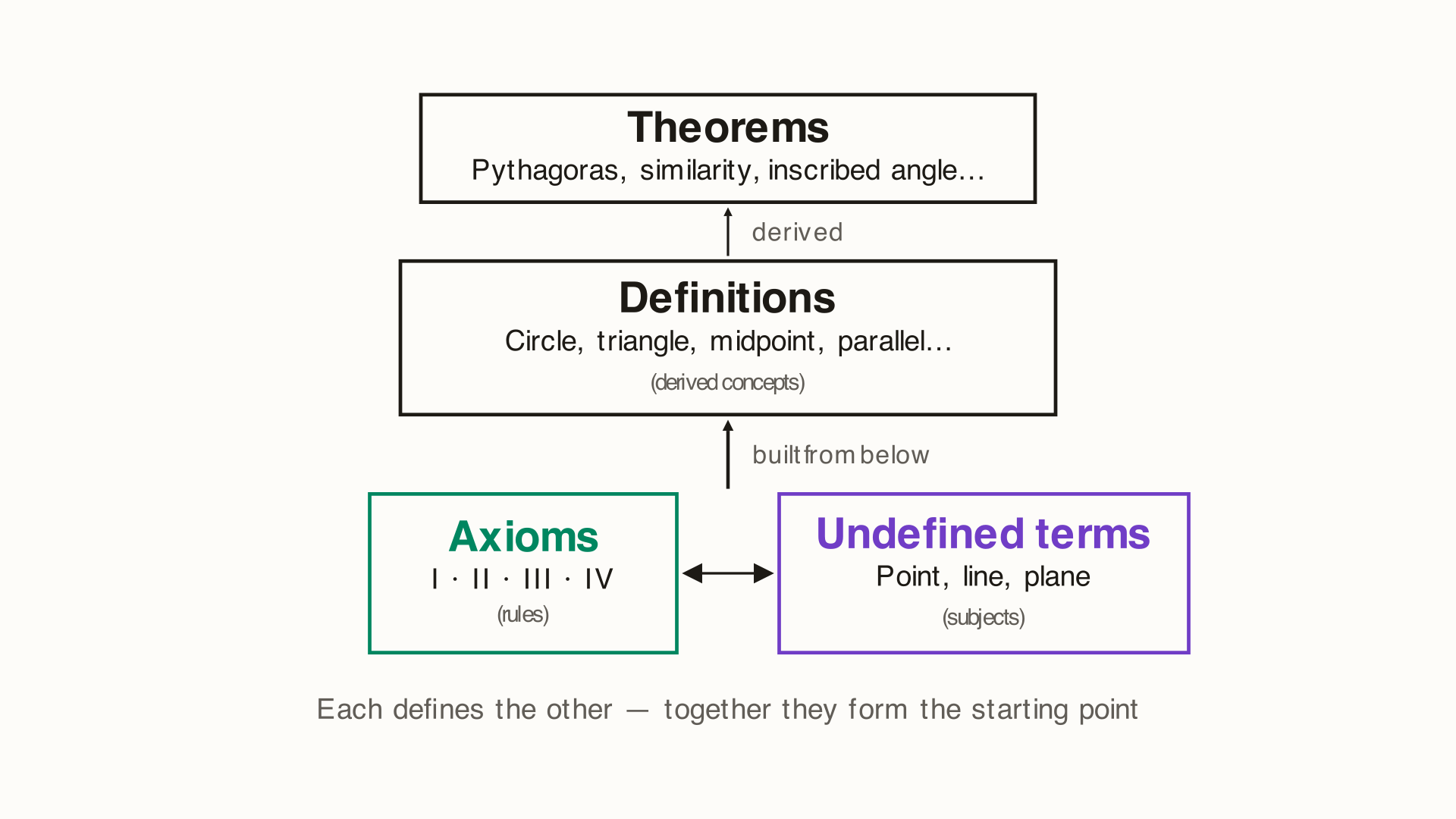
The crucial thing is the two-way arrow at the bottom:
- undefined terms give the axioms "subjects to talk about" — without "point" and "line," the axioms have no subjects;
- axioms give the undefined terms "all of their meaning" — you don't need to know what a "point" looks like; as long as it satisfies the relations the axioms list, it counts as a "point" in this game.
Once that bottom layer is in place, the next layer up is definitions — the vast majority of geometric concepts you're familiar with (circle, triangle, midpoint, parallel, congruent, similar, angle bisector, circumcenter…) are rigorously defined, and must be built up layer by layer from "undefined terms + already-defined concepts." Above that come the theorems — every conclusion derived from the axioms and definitions.
Put another way: "definitions" haven't been abandoned. It's just that, when you trace down to the very bottom, you find there are always a few words that can no longer be explained in simpler ones, and those few words can only be characterized by axioms.
This matters, because it tells us something important: geometry is not describing the world, it is describing an "ideal world" we have carefully built out of language. The inhabitants of that ideal world — points, lines, circles, triangles — are far "cleaner" than anything in the real world: any circle you draw has thickness and wobble; the "circle" in geometry is an absolutely perfect outline, with no thickness, no impurity.
Pieces and rules
Here's a not-quite-rigorous analogy. Suppose you find yourself on a strange little island, and the locals are playing a board game you've never heard of, called "Glyn-chess."
The board is a sheet of grid paper. A local hands you a piece and says, "Here, this one is called a 'Glyn.'"
You take it and ask, "What is a 'Glyn'? A pawn? A knight? Some sort of animal?"
The local shakes their head. "Don't worry about what it 'is.' Just remember three rules —
- on each turn, a Glyn can move one square in any direction;
- a Glyn cannot move onto a square already occupied by another Glyn;
- when there is exactly one of the opponent's pieces between two Glyns, that piece can be captured.
Play by these three rules and you can play this game."
And the strange thing is: the whole game can play itself out without you ever figuring out what a "Glyn" really "is" — it could be a stone, it could be a tiny bird, it could be just an abstract token — and none of that matters at all to playing the game. Because what determines how a "Glyn" works in this game is not what it looks like, but what the rules say it can and cannot do.
Geometry is that game. "Point" and "line" are the pieces; the axioms are how they move. We don't tell you what a "point" is — you can imagine it as a bean, a pinpoint, a star, whatever you like. We just write down a few rules, and those rules are the role "point" and "line" play in this game.
So what are those "few rules," concretely? How did humans find them? Let's look at the history.
2. Two-thousand-year audit: from Euclid to Hilbert
Organizing "geometry" into the structure of "axioms → theorems → more theorems" was first done by the ancient Greek Euclid. Around 300 BC he wrote a book called the Elements (Στοιχεῖα · Elements), and from 23 definitions, 5 postulates, and 5 axioms he derived 465 theorems.
This was the first mathematics book in human history written in this style, and apart from the Bible it is one of the most-printed books in the West. For two thousand years it was the standard textbook of European education; from Newton to Einstein, every great thinker grew up reading it. What it taught humanity was not just geometry, but a way of thinking: any complex truth can be reduced to a few simple, self-evident starting points.
But Euclid's work is not perfect.
On one hand, his "definitions" mix in a lot of sentences that aren't really definitions at all — for instance "a point is that which has no part." What does "has no part" actually mean? This is using a vaguer concept to "explain" a word that should have been an undefined term in the first place — which just kicks the can down the road.
On the other hand — and this is more serious — his arguments quietly use many "obvious" assumptions that he never wrote down as axioms. For instance, in the very first proposition of the Elements (constructing an equilateral triangle on a given segment), his proof silently assumes that two circles meet at a point; but "whether two circles must intersect" is something his axioms never declare. For two thousand years countless readers read past this without noticing — because in the picture it was "obviously" so.
But "obviously" is not an axiom. This is the great homework Euclid left for posterity.
Fast-forward to 1899. The German mathematician David Hilbert gave the Elements a thorough audit. He wrote a book called Grundlagen der Geometrie (Foundations of Geometry), dragged every "obvious" assumption Euclid had skipped out into the open, and reorganized everything into 20 axioms, in five groups:
- Axioms of incidence (8 axioms): the "lies on" relation between points, lines, and planes
- Axioms of order (4 axioms): what it means for a point to lie "between" two others
- Axioms of congruence (5 axioms): what it means for two figures to be "congruent"
- Axiom of parallels (1 axiom): Euclid's most famous one
- Axioms of continuity (2 axioms): the "continuous" character of points on a line
Hilbert's greatest contribution is not that he discovered some new theorem, but that he turned "geometry" into a genuinely purely logical game. In that book he wrote a now-famous, almost shocking line:
"We must be able to replace 'point, line, plane' by 'tables, chairs, beer mugs,' and have all the theorems still hold."
Meaning: what a "point" actually is, what a "line" looks like — does not matter at all; what matters is only the axiomatic relations they satisfy among themselves. This is the three-layer-structure picture from the previous section pushed to its limit — geometry no longer depends on any intuition, only on logic.
But once Hilbert had settled "which axioms need to be written down," the status of axioms themselves started to look suspicious. That's the question we'll face head-on in the next section.
3. Axioms are not "truths" — they are "conventions"
Hilbert's "tables, chairs, beer mugs" line carries a deeper, more unsettling implication.
Many people imagine that "axioms" are "absolutely correct truths" — sentences written by heaven, carved in stone, that everyone must accept.
That's not how it is.
Axioms are simply a few sentences that mathematicians choose as the starting point. They aren't proved, but they aren't discovered either — they are agreed upon. We say, "Alright, let's assume these few sentences are true, and see what kind of edifice we can build from them" — that's all there is to it.
Sounds counterintuitive, doesn't it? "Through two points there is a unique line" — isn't that just "absolutely correct"?
Let's do a small experiment. On the surface of this ball we call Earth, what is the "shortest path between two points"? A straight line segment?
No — it's a great-circle arc (this is exactly the path airplanes fly). On a sphere, the "straightest" line you can draw is in fact a great circle that goes all the way around the globe.
So a question arises: pick two points on the sphere; through them how many great circles are there?
In general, just one. But if you pick "antipodal points" — say the North Pole and the South Pole — then there are infinitely many great circles through them: every line of longitude is one! "Two points determine a unique line" fails on the sphere.
Several 19th-century mathematicians (Lobachevsky, Bolyai, Riemann) took this seriously and pushed it further. They asked a question their contemporaries called "insane":
If we replace one of Euclid's axioms, can we still build a self-consistent, contradiction-free geometry?
The answer is: yes. By replacing Euclid's "parallel postulate," they built a brand new kind of geometry — non-Euclidean geometry. In this geometry, sentences that had been worshipped as "truths" for two thousand years — "the angles of a triangle sum to 180°," "through a point not on a line there is exactly one parallel" — simply no longer hold. But seen from the inside, the system is perfectly self-consistent; no two theorems clash.
What came next is even more striking: in 1915 Einstein put forward general relativity and discovered that the actual geometry of our universe is, in fact, non-Euclidean — light bends near massive bodies, spacetime itself is curved. In other words, those Euclidean "self-evident truths" celebrated for two thousand years are actually wrong as a description of the real universe.
This completely changed how mathematicians think about axioms.
Axioms are no longer understood as "truths about the universe," but as "rules of a game."
They are like the rules you agree on before a board game. Rules have no "right or wrong" — only "today we choose this set" or "today we choose that one." From one set of rules you get one game; from another set, another game. Which one is "more correct"? The question itself is meaningless. But which one is more suitable for the problem at hand — that's a meaningful question.
This brought astonishing freedom to mathematics. There isn't just one geometry in the world: Euclid's flat plane, Riemann's curved sphere, Lobachevsky's hyperbolic space… each is a self-sufficient universe, each obeys its own logic, none is right or wrong; it just depends on which universe you're talking about today.
Axioms are not truths about the universe; they are scaffolding for human thought.
We put them up so that truth has somewhere to stand.
4. Our choice: Birkhoff's four axioms
So the axioms we pick for this Principia of Geometry — are they "the right ones"?
No. They are simply the most suitable ones for describing the flat sheet of paper and the level desk in your daily life — that is, for the world middle-school geometry studies. If one day you look up at the night sky and want to understand how light bends in a gravitational field, you'll need a different set of axioms. There's nothing wrong with that — it's exactly what makes mathematics so fascinating.
So what do these "most suitable for middle-school geometry" axioms look like?
Hilbert's 20 axioms, rigorous as they are, are simply too many — and too fiddly — for middle-school students (and the teachers teaching them). Just to spell out what "two segments are congruent" means, he needs 5 axioms by themselves.
In 1932 the American mathematician G. D. Birkhoff came up with a cleverer idea. He noticed something: middle-school students already know how to use "real numbers" — they use rulers to measure lengths and protractors to measure angles. Since real numbers are already so familiar, why not take "measurement" itself as the basic concept?
So Birkhoff compressed Hilbert's 20 axioms into just 4:
| Axiom | In one sentence |
|---|---|
| I · Ruler axiom | Points on a line are in one-to-one correspondence with real numbers; distance = absolute value of the difference |
| II · Point–line axiom | Through two distinct points there exists a unique line |
| III · Protractor axiom | All directions through a point are in one-to-one correspondence with angles (real numbers) |
| IV · Similarity axiom (SAS) | Two sides in proportion + the included angle equal ⇒ the triangles are similar |
Stunningly clean, isn't it? Four axioms make up the entire raw material we need to prove every theorem in middle-school geometry.
The ruler and the protractor — that's why we call the first two the "Ruler axiom" and the third the "Protractor axiom": they distill the powers of the two stationery items in your hand into mathematical language. Middle-school geometry has been, from day one, about measuring lengths with rulers and angles with protractors; Birkhoff just took that thing you already knew how to do and wrote it formally into the rules of the game.
By the way: the "360" printed on the face of your protractor is itself a convention — axiom III only states "directions are in one-to-one correspondence with real numbers"; it does not require a full circle to be 360. That number was left to us by the ancient Babylonians: they counted in base sixty, and they approximated the year as 360 days, so "a full circle = 360 degrees" stuck. When mathematicians do calculus they switch to radians (a full circle is ), because then the derivative of doesn't pick up an extra factor. This echoes the previous section perfectly — convention isn't only at the level of "which axioms to choose"; even the units used inside an axiom are another layer of convention.
That's also why this Principia of Geometry picks Birkhoff over Hilbert: it strikes the best balance between rigor and intuition, and it's especially well suited for someone starting from middle-school knowledge who genuinely wants to understand the "why."
What you'll read next
The next four chapters each correspond to one axiom. For each axiom we'll do three things:
- State the axiom carefully — explaining word by word what it says;
- Explain what it prevents — what would go wrong without it;
- Point out what it unlocks — which later theorems "grow out of" it.
When you've read all four, you will hold the "birth certificate" of every theorem in middle-school geometry. Look back at the theorems you already know how to use — the Pythagorean theorem, similarity, the inscribed angle, four-point concyclicity — and you'll see clearly how each one grows as a logical tree out of these four sentences.
You'll no longer be brushed off by "obviously," and you'll no longer be confused about "why is this step allowed?"
The fence is now in place; the rules are now written down. Turn the page — our journey through geometry begins with axiom I.