Half-angle model (rotational stitching)
In an isosceles figure with apex angle , the "half-angle " drawn from the apex cuts off two polyline pieces; rotating one piece about the apex by aligns them into a single straight segment along the other side's extension.
When to use
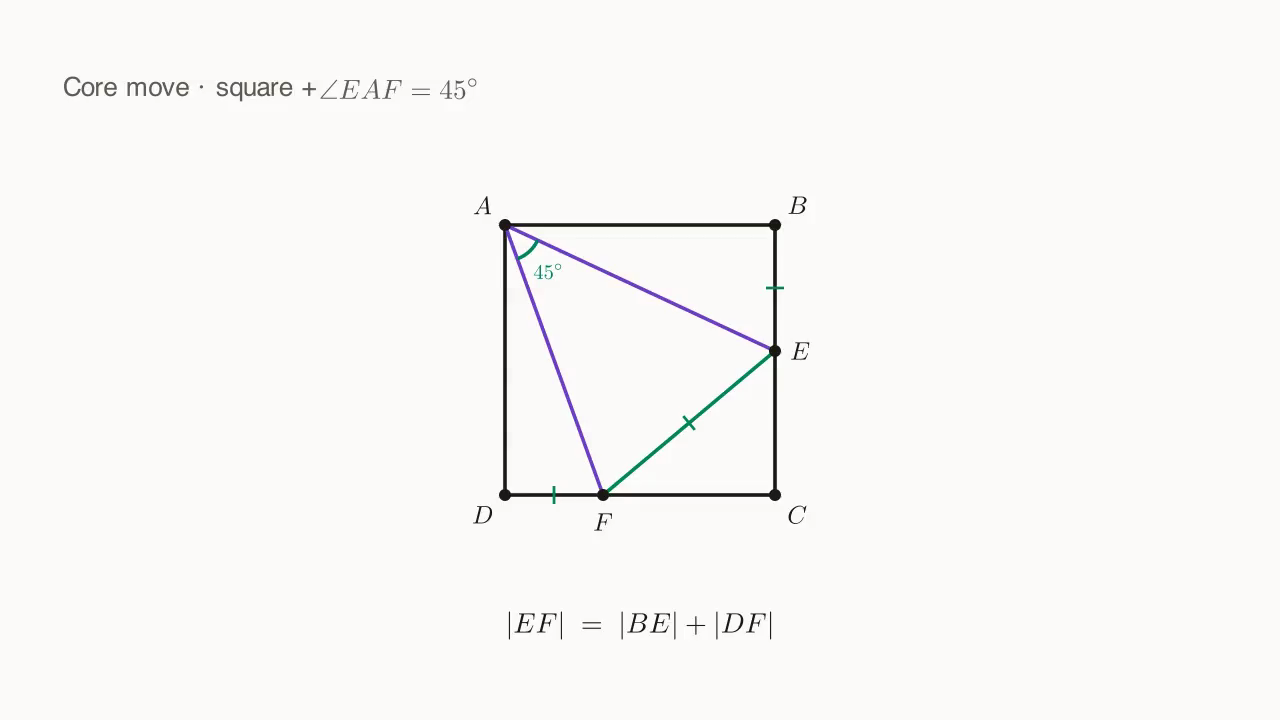
- A angle inside a square (the classic): in square , vertex opens an angle , with on and on
- A angle inside an equilateral triangle: equilateral , vertex opens
- More generally: an isosceles figure with apex angle exposes a single angle ("half the apex") at the vertex
- You need to show one segment equals the sum of two others (e.g. )
Core move
Rotate one piece around the apex by — the three pieces stitch into two congruent triangles, and the two polyline segments line up into a single straight segment in their new position.
Construction
Take the square + ( on , on ):
-
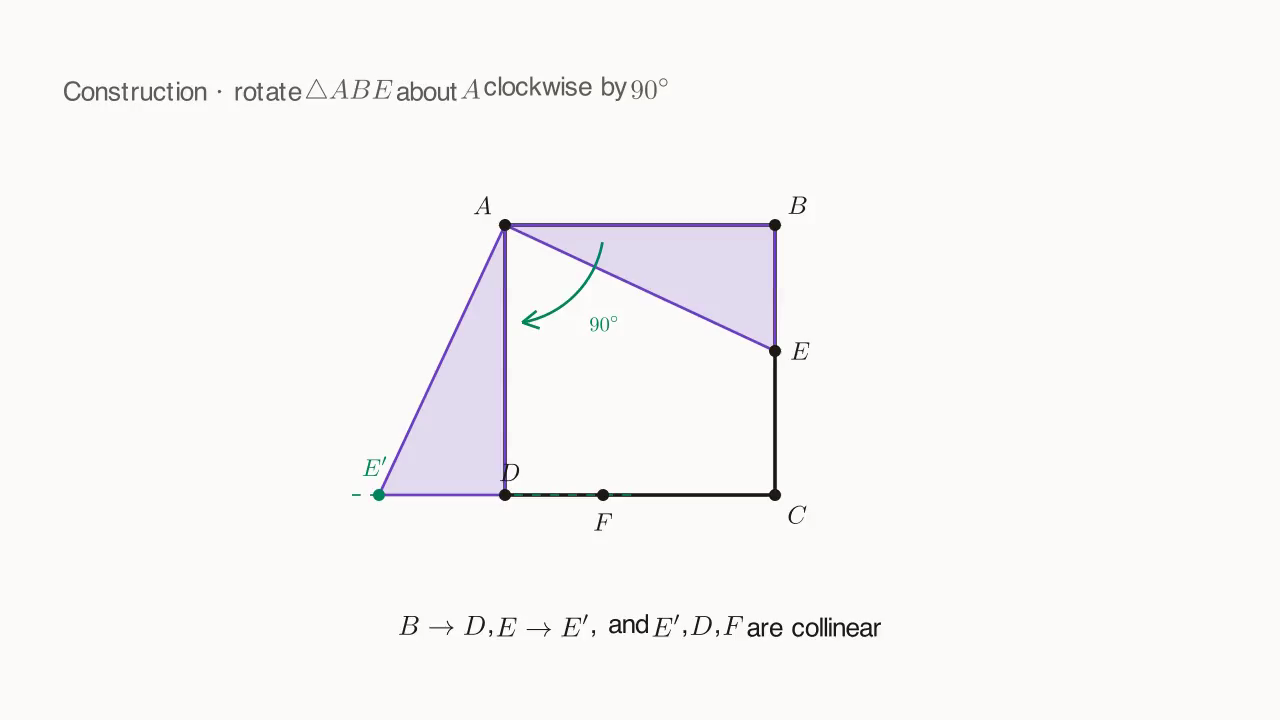
Rotate one piece: rotate about by clockwise ( apex ): , .
-
New points are collinear: and , so , , are collinear.
-
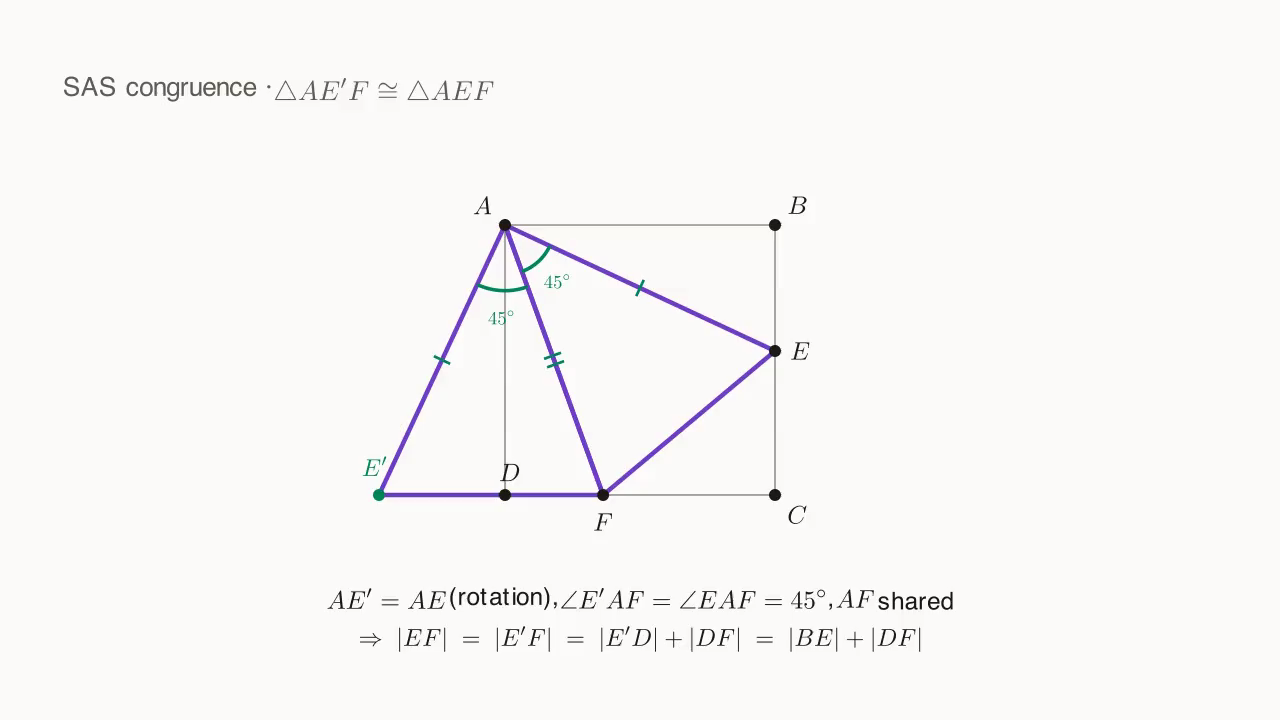
The half-angle reappears: .
-
SAS congruence: (rotation), (shared), , so .
-
Read the conclusion: .
Why it works
After rotating to , the only "angle structure around " left is one (the half-angle) and one (the -to- angle after rotation) — precisely the side-angle-side ingredients for SAS congruence. The essence: half-apex + apex-rotation = the bend in the polyline disappears.
Worked examples
- Square , , , : show
- Square , on the diagonal, , , : find the extrema of
Variants / generalizations
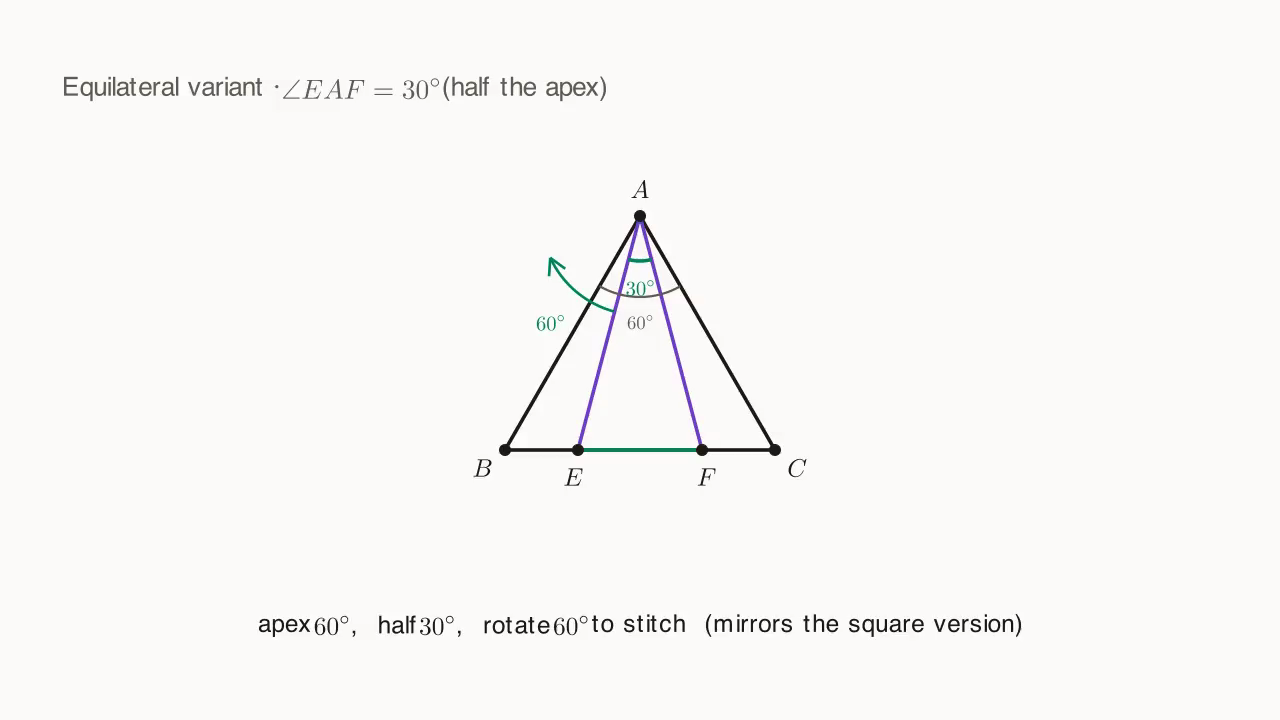
- Equilateral triangle + half-angle: apex , half-angle , rotate to stitch
- General isosceles + half-apex: apex , half , rotate ; the conclusion "" upgrades to an equality scaled by the leg-length coefficient
- Non-isosceles apex: the isosceles condition is mandatory (rotation preserves distance); without it you must use the similarity version (Melon-and-bean (spiral similarity)).
- The (square) and (equilateral) coefficients tied to half-angle are essentially — a hint that they share the same mechanism as the weight triangle in Weighted Fermat Point (rotation + scaling lemma).