Bridge-building
For a polyline whose middle piece is a "bridge" of fixed length and direction, minimize by translating along to ; the minimum is achieved when are collinear.
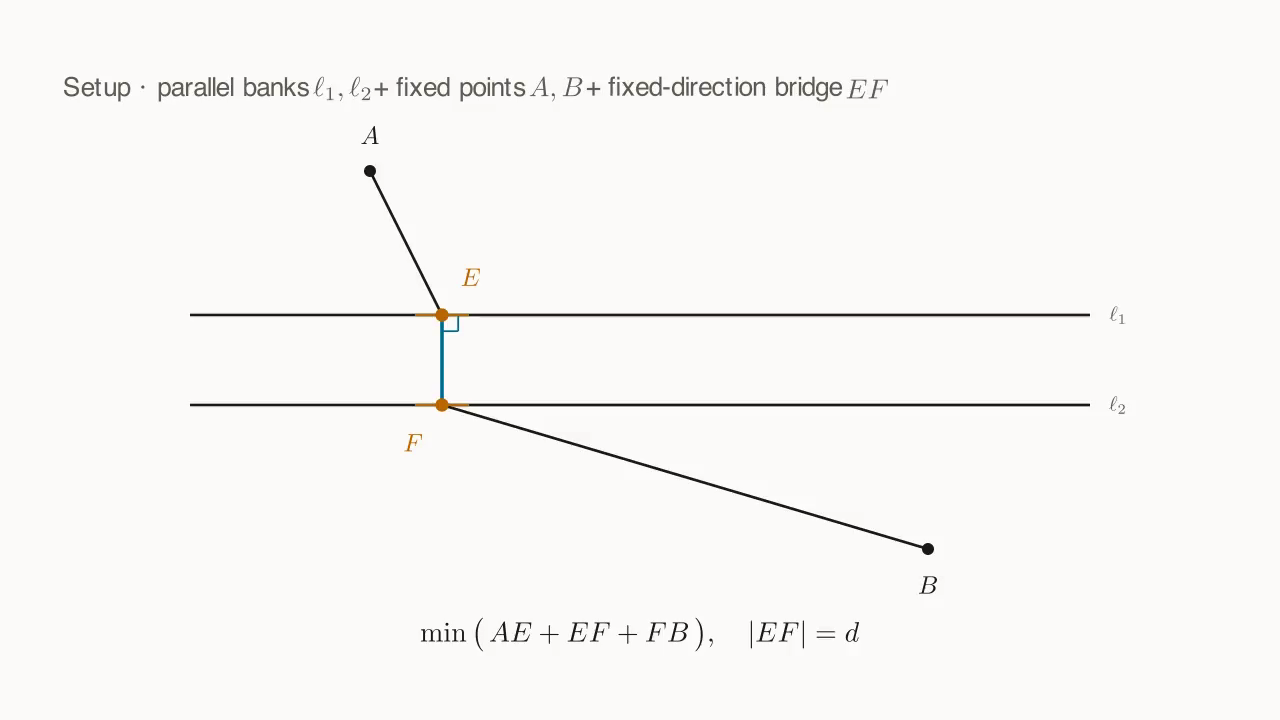
Bridge-building — polyline minimum where the middle segment is a "bridge" of fixed length and fixed direction. Use translation to splice the two variable side-pieces of the polyline into a single segment.
Universal form
Since has constant length , this is equivalent to
Classical model
- Moving point : on a line
- Moving point : on a line ()
- Fixed points : separated by the two riverbanks
- Key constraint: perpendicular to both banks (more generally: has a given direction and a given length)
Intuition: a river (with parallel banks ) separates from . Build a bridge perpendicular to the banks; where do you put the bridge so that the total path from to is shortest?
Conclusion
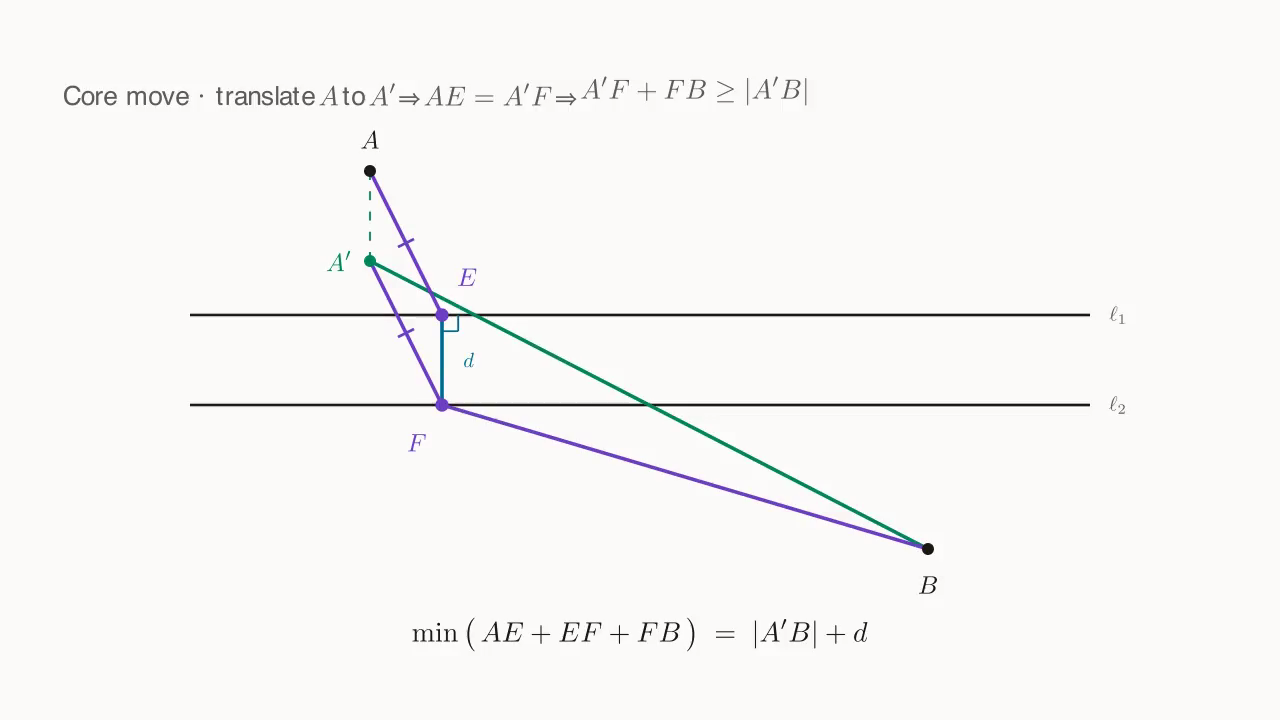
Translate by the vector (length , fixed direction) to get . Then
with equality when are collinear. At equality, is recovered by translating back: .
The answer does not depend on where the banks are ('s positions). It depends only on and the bridge's fixed direction and length.
Proof
Step 1 · Translate. Translate by the vector (length ) to get . The quadrilateral satisfies
so and ⇒ it is a parallelogram (parallelogram tests). By parallelogram properties:
Step 2 · Triangle inequality. The polyline has length
directly by [[triangle-inequality]], with equality when are collinear ( on segment ).
Step 3 · Chain them together.
Add the constant to get .
When to use / mnemonic
- A polyline minimization where the middle segment is fixed in length and direction (not "pick two points on some line and minimize the middle segment") → bridge-building
- The problem mentions "build a bridge perpendicular to the river bank" or a similar narrative trope → bridge-building
- Signature: the variables are the two side-piece endpoints (), but is a fixed vector
Versus "General drinks his horse"
| Model | Middle | Tool |
|---|---|---|
| General Drinks His Horse | A point (the same moving point appears in both side-pieces) | Reflection (axial symmetry) |
| Bridge-building | A fixed-length fixed-direction bridge | Translation |
Both use "rigid transformation + triangle inequality", but the transformation differs: reflection alters "polyline direction"; translation alters "endpoint positions".
Pitfalls
- The bridge direction must be fixed: if the bridge can tilt (direction changes with ), this model does not apply — the problem degenerates into a harder optimization needing calculus or variational methods.
- Translation direction: translate by (from to ), not the reverse; flipping the direction gives the symmetric solution (usually not between the banks).
- Result is independent of bank distance: often disguised — the problem may give "river width = 5" as the source of the constant , but after the move the bank positions drop out.
- must be on different banks: if both slide on the same line (not on two parallel banks), the problem degenerates into "General drinks his horse" or a plain two-point distance.
Applications
To be added.
Related
- Translation — translation preserves distance and direction
- Parallelogram properties / Parallelogram tests — basis for
- [[triangle-inequality]] — closes the polyline
- General Drinking Horse (axial-symmetry shortest path) — the "reflection" sibling in the same family