One-line three equal angles (K-shape similarity)
Three equal angles on the same side of a single line force the two adjacent triangles into an AA-similar pair; use the corresponding-side ratios to solve for unknown lengths.
When to use
- Three equal angles, all on the same side of a single line (most common is , but any works)
- The figure shows a "polyline / Z-shape / K-shape": a moving point on a line, with slanted segments on each side meeting the line at the same angle
- Find segment-length ratios; or pin down the moving point that "makes two segments proportional"
- In rectangle / square problems with "moving-point polylines": the right angle at the bend is the equal angle on the line
Core move
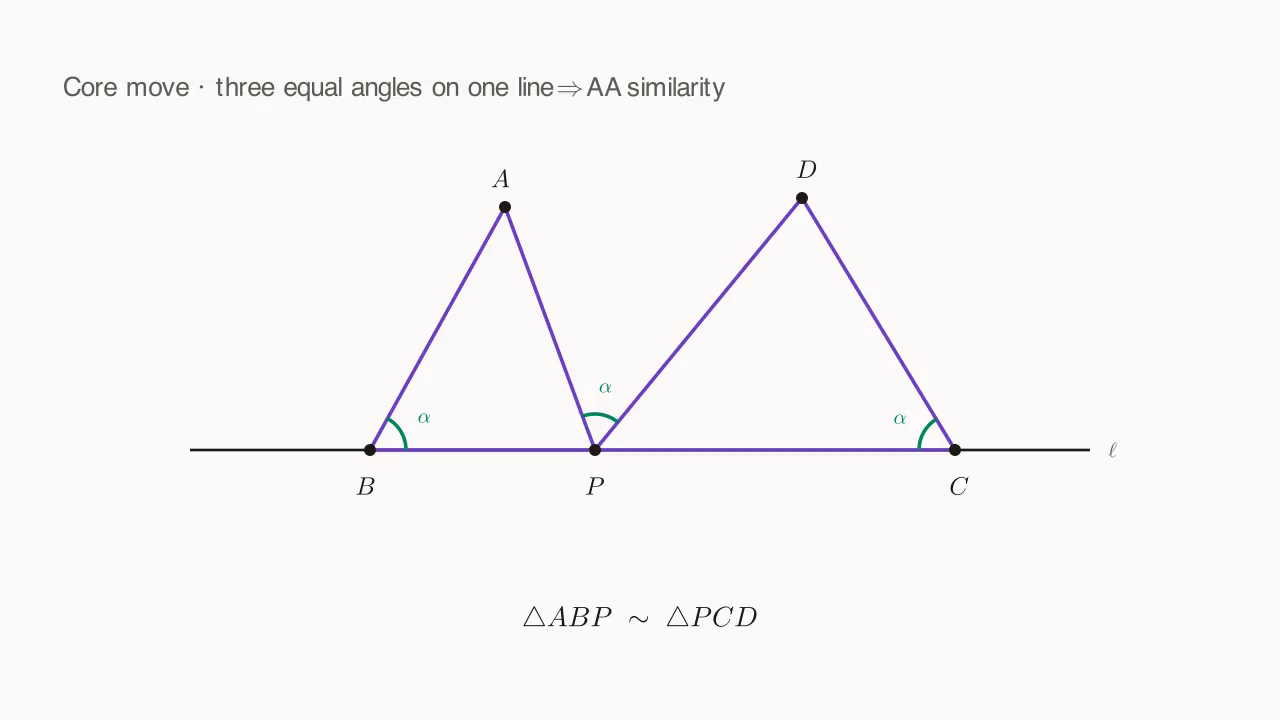
Three equal angles on one line ⇒ the two adjacent triangles are AA-similar: use corresponding ratios to solve for unknown lengths.
Construction
Let line contain in order, with on the same side of , and :
-
Use the straight angle at : the three angles at sum to , so , giving .
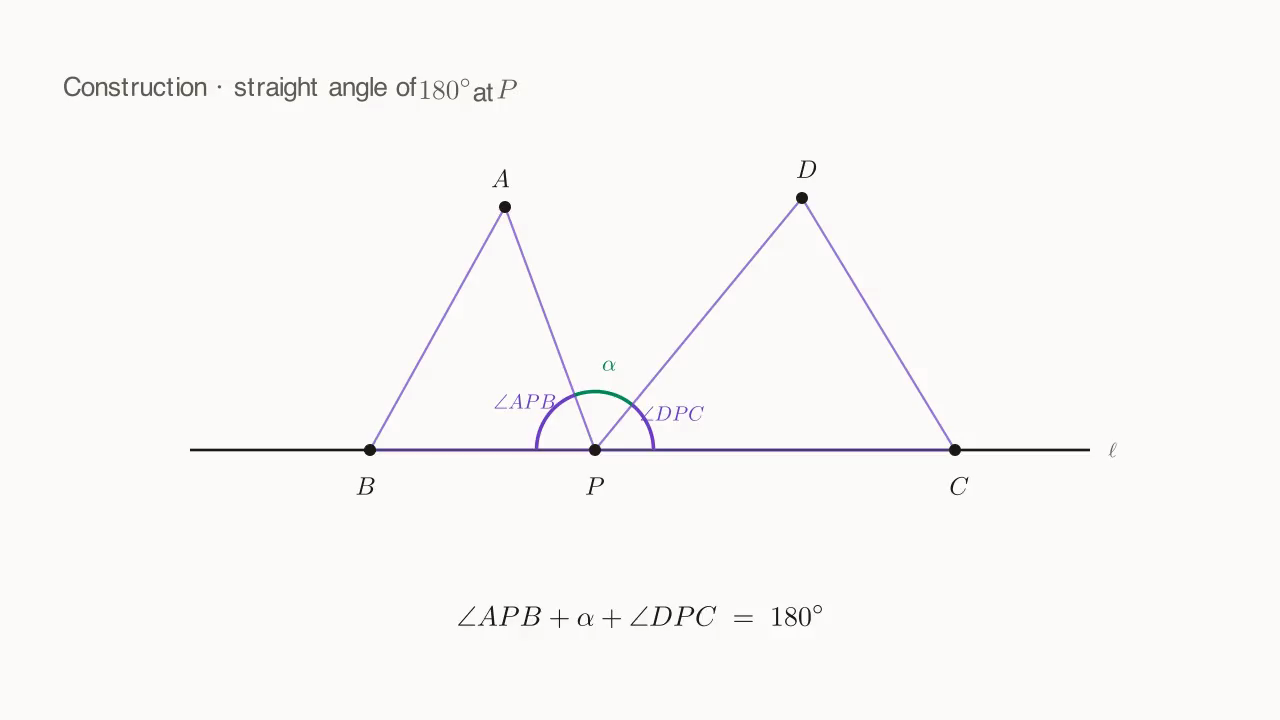
-
Chase triangle interior angles: in , , so .
-
AA similarity: and , so .
-
Write the ratio: matching corresponding sides — .
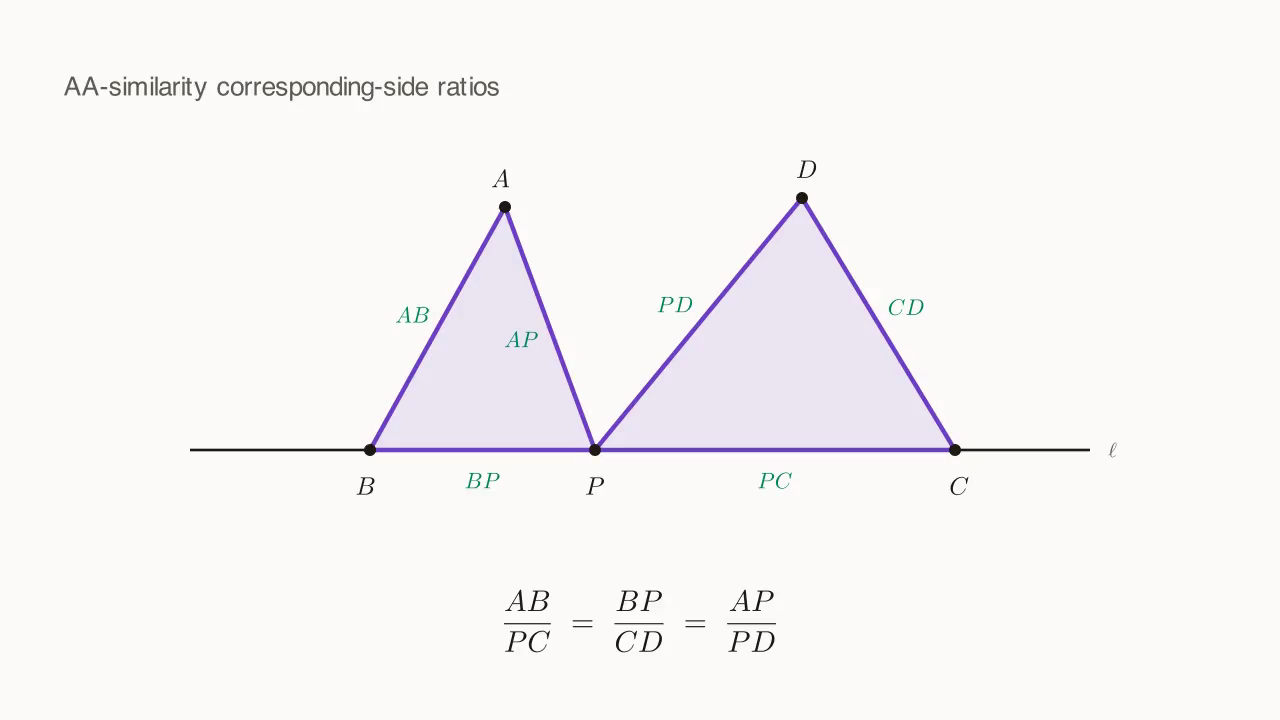
-
Substitute and solve: typically three of the four lengths are given and you solve for the fourth, or you set up an equation that locates .
Why it works
"Three equal angles on a line" is equivalent to "the slanted-line directions on the two sides correspond pairwise" — the essential condition for a similarity transformation. The straight angle at "transports" the third equal angle across, completing the AA criterion. The mechanism is the same as alternate / corresponding angles, just with the angle equal to a generic rather than or .
Worked examples
- Rectangle , on with ( on ): find the relationship between and (the version)
- Equilateral triangle folded so the apex lands on the base: three angles align ⇒ the two side triangles are similar
Variants / generalizations
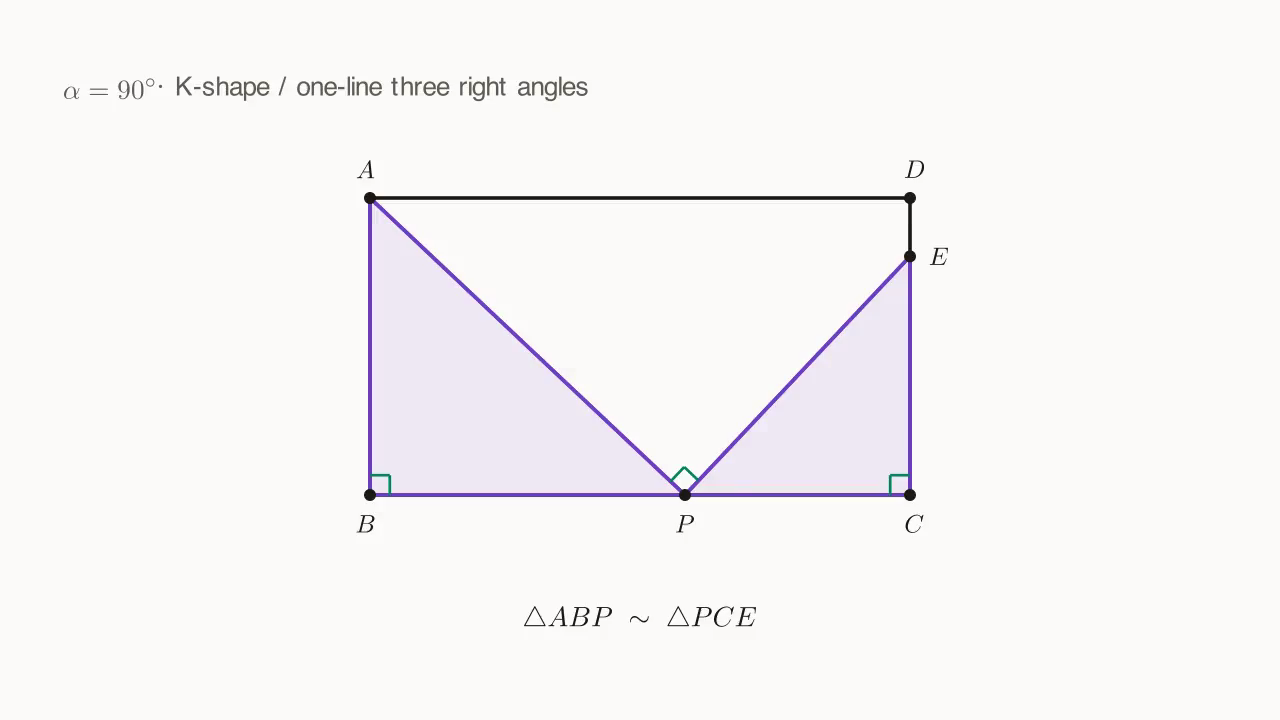
- Degenerate to right angles (): commonly called the "K-shape" or "one-line three right angles" — the most familiar middle-school version.
- Bow-tie / X-shape: two lines intersect at a point with four equal angles formed by vertical pairs — similar mechanism, gives "vertical-angle similarity".
- Add the isosceles condition (e.g. ): similarity upgrades to congruence, and gives the geometric meaning of "rotation by around the bend".